



...continued from page 2...
[b]Precautions taken[/b]
Around 2005, smaller hip-hop parties organized by a growing number of inexperienced promoters proliferated throughout the city. Some were held at smaller clubs, like the Annex on Regent Street, or restaurants like Frida’s, which moonlighted after hours as a club.
In many cases, the establishments were struggling financially and had turned to local hip-hop’s ability to boost bar sales. Madison concert promoter Tag Evers notes that during this period countless of similar, but better managed events happened without incident.
But unlike the more professionally run events, these smaller, less controlled parties often advertised all-you-can-drink specials.
“There is a demand for that and it brought in a big crowd and an enormous amount of money in a short amount of time,” says Evers. “But it almost always seems to bring with it a crowd that gets out of control.”
The list of venues over the years to chart this fateful course is considerable: The Paramount, Liquid Lyric’s Lounge, Adair's Lounge, King Club, Club Seven, Mass Appeal, Kimia Lounge, The Underground, Club Hilltopp, Que Sera, Stillwaters, Club Majestic, the Annex and most recently Frida’s.
Many drew a largely black clientele. And most, if not all, closed following headline-making violence.
Woulf agrees that safety at any kind of event in many cases comes down to how it’s managed. What happens, he says, is establishments with little experience running a show of any kind tend to relinquish control of the building to the promotion group in exchange for a packed house. “That can be very valuable as far as sales from the bar are concerned,” says Woulf.
But neither the Majestic nor the High Noon fits this mold. Both are financially successful, experienced at managing events, and are seen by city officials as two of the most responsible – and responsive - venues.
It’s hard to imagine what more Cathy Dethmers could have done to prevent a man from bringing a gun into her club during a rap battle on Jan. 16, short of canceling the event. Following a fight at a hip-hop event in December, Dethmers and Mark “Shah” Evans, the event organizer, asked police for suggestions on a beefed up security plan.
Patrons were wanded with a metal detector, uniformed officers did walk-throughs at least twice during the event and there was a five-person security team on-duty throughout the night. Still, not long after midnight, a gunshot in the men’s room sent party-goers scrambling toward the exit.
The bullet lodged in the ceiling of the adjacent women’s room after piercing the wall. In the men’s room bar staff discovered a man, bleeding from his face, who claimed to have been pistol-whipped. He hightailed out before officers arrived.
“It was really frustrating after doing everything the cops suggested that someone was able to do that,” she says. “Luckily that bullet didn’t hit anybody.”
Similar precautions were taken at a Madison Preparatory Academy fundraiser at the Majestic on Christmas. Still, two men reportedly aimed guns at Majestic staff amid a brawl involving upwards of 30 people.
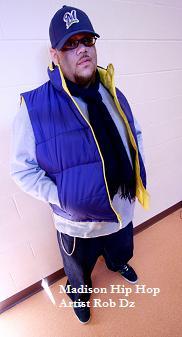
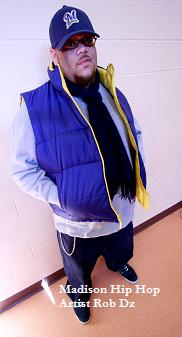
“I don’t know what happened,” says event co-organizer Rob Dz, who also performed that night. “Things were going good, then it just got crazy.”
Dz, who’s performed in Madison for nearly a decade, says it was the first time one of his shows ended in violence. It was also his first show at the Majestic since the venue came under new ownership in 2007. He doesn’t believe he’ll be welcomed back.
Bayley, too, isn’t known for drawing an unruly crowd, but after it was publicized he’d performed on the nights in question several establishments severed ties with him.
“I'm no more connected to a fight than a bartender or soundman,” he says. “I would never condone, encourage or participate in a violent act, let alone one at an event that I've been hired for.“
[b]’Music of revolution’[/b]
At the recent hip-hop forum, a few who spoke during an hour-long sound-off session offered terse words for artists who rap about the thug life and the fans who can’t control their emotions. Police say many of the problems at hip-hop shows stem from petty rivalries, grievances and sleights.
“There’s a difference between blacks and niggaz,” said 93.1’s Big Mike. “Niggaz is why we’re here today.”
Moore suggests that hip-hop’s relationship with “the street” - where the early rappers who pushed hip-hop into the mainstream came of age amid the crack and AIDS epidemics of the 80s - is what keeps it in proximity to trouble’s potential.
But the street is not only a template upon which the poetry of most hip-hop is arranged. It’s also an aesthetic many hip-hop artists and fans take pride in representing, yet seem uncomfortable talking about.
Keep in mind that without the street, there is no hip-hop.
As Moore sees it, hip-hop is the music of revolution and struggle, with artists’ authenticity often culled from an intimate understanding of the urban condition.
“Even if you’re doing some of the more socially conscious stuff, you still got to have your pulse on the street,” he says. “However, when you’re tight with the street that puts you close to people that are doing things they probably shouldn’t be doing. There’s a fine line for a lot of those folks.”
This is particularly true of gangsta rap, the most commercially successful strand of hip-hop that many claim glorifies the kind of street violence that has upended the local scene.
In 2009, Evers wrote a scathing critique of gangsta rap - and the thug life in general - using rapper Game (formerly The Game) as a case-in-point.
“Gangsta rap is The Game’s game, and accordingly he trades on black-on-black violence, exploiting the ongoing tragedy of America’s racist legacy,” he wrote. “One might add the music industry doesn’t seem to mind a bit – rapping about killing niggaz makes for a nice bottom line.”
Evers went on to describe gangsta rap as “post-modern minstrelsy, black culture grossly caricatured for the entertainment of predominately white audiences.”
Moore, who listens to gangsta rap from time-to-time, praises the “phenomenally talented artists,” who form the local scene. Some he met as kids through his work as a drug, then gang detective.
He suspects the commercial appeal of gangsta rap compels some of them to root their lyrics in the violent imagery and misogyny that drives mainstream hip-hop. Occasionally, he’ll hear references to local crimes in their music.
A song by local group U.T.G., for example, contains the lyric: Two face shots from the .40, Bohanan, a nod to James Bohanan, who is serving a life sentence for the July 2007 murder of his romantic rival Kevin Cobbins on Lorraine Drive.
“That’s part of the gang culture, too – and I’m not saying gangs are hip-hop – but when you look at gang activity, the preferred music of most gangs is going to be hip-hop. They’re not listening to classical music.”
When asked what they see as the most immediate factor behind the violence at local hip-hop events, most of those interviewed say, unequivocally, it’s the paucity of black nightlife in Madison.
“You go to Milwaukee or Chicago and there are four or five places in every neighborhood where people can go,” says Dz, whose cousin's bar, R Place, had its liquor license revoked by the city last year. “You can go hear jazz, soul music, hip-hop, R&B… or you can just hang out. In Madison there is one place where everyone goes and that one place always gets shut down.”
The connection between street gangs and the unrest at local hip-hip events is tenuous at best. But many, including Moore, say those with bad blood between them are more likely to attend the same event, since that event is likely the only show in town.
“No one wants to become a victim so some of these guys are carrying,” he says.
Police leverage the lack of black nightlife to their advantage. According to Moore, detectives will sometimes attend hip-hop shows to look for those he knows have warrants out for their arrest. “Everyone goes to the social events, because you got to see people,” he says.