




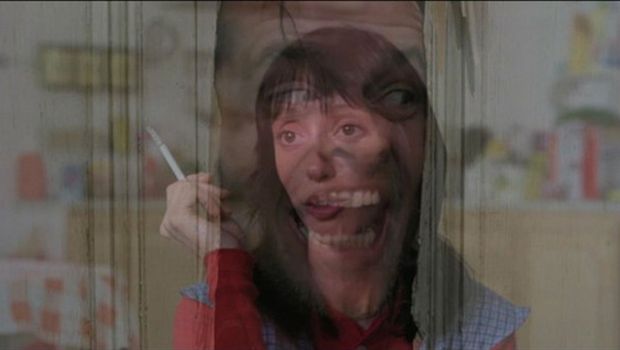
Room 237 director Rodney Ascher took the stage before and after his film screened at Sundance on Wednesday, and the meta nature of a Q&A with the director answering questions about a movie about people watching a movie and asking unanswerable questions of the late Stanley Kubrick was lost on few (Maddie Greene reviewed the film for dane101).
Is there such a thing as a “straight” question in this scenario? Director of Programming Jim Healy found a couple, discussing how Ascher had managed to move this found-footage extravaganza — which includes not only huge swathes of The Shining but nearly every Kubrick movie, and a dozen other movies besides, all in multiple interpreters’ attempts to disclose what The Shining is “really” about — out of the festival circuit, where everyone is forgiving about rights issues, and into regular release, where they are not. (It reopens at Sundance on April 26.)
The answer revealed a #wifilmfest connection — Ascher has fallen in with the producers of last year’s Patty Schemel documentary Hit So Hard, which also required a heroic volume of rights clearances, and their intervention resulted in a distributable Room 237. (Ascher also copped to grabbing a lot of footage from YouTube, which is eye-gratingly obvious if you see this on the big screen.)
But every other question was one more facet in the hall of mirrors: Did making this movie ruin The Shining for you? Has anyone Room 237-ed Room 237? Does the presence of crazy theories lend credence to or take credence from the more reasonable theories?
Ascher’s answers to those questions are no; yes; and no, because even when he’s inclined to dismiss any particularly bonkers theory, he finds there’s this one element that he can’t bring himself to discount. Viewers are likely to share this problem — Room 237’s coterie of obsessed critics bring just enough reasonability to their madness to string you along. (Madison’s own David Bordwell reckons with the movie’s different theories, and the mindsets that produce them, with a scorched-earth level of success; no more need be written.)
The random insight from the middle of the movie that struck me hardest is one theorist’s concept that Kubrick was just so bright, and had accomplished so much as a filmmaker, that all that was left to engage him was constructing the kind of formal games that the 237 commentators are responding to. Irrespective of any specific theory, this idea of Kubrick as cryptographer is narcotically alluring, allowing you both to interpret continuity errors as secret signals and to believe that it is fruitful to invest unlimited attention in the movie.
Perhaps fortunately, an audience member volunteered a word I never knew that is designed to deflate this idea — pareidolia, which is a sort of perceptual confirmation bias, like seeing the “face” on Mars as a face. Pareidolia is, to borrow another viewer’s excellent insight, the Occam’s Razor answer to this foolishness. A neat solution, and the lid on Pandora’s box stays shut.
Except … if there was a director that was going to do it, it would be Kubrick … and just why does that carpet pattern reverse itself ….