



Because The Shining by Stanley Kubrick has been my favorite movie since about age 14 (when I finally got the courage to watch it all the way through with my eyes open), I had heard of the Calumet Baking Powder/Native American theory. The theory states that Kubrick's movie (which is based on Stephen King's story of a snowed-in, dysfunctional family going mad in an inherently evil hotel) is an elaborate allegory for the slaughter of Native Americans by white settlers. The proof is not only in the Native American portraiture and designs seen (in some cases, barely seen) throughout the film, but more importantly in the deliberate placement— akimbo or tidy—of Calumet canisters.
I knew of that theory. However, I had not known that The Shining is also a metaphor for the Holocaust. The typewriter proves it.
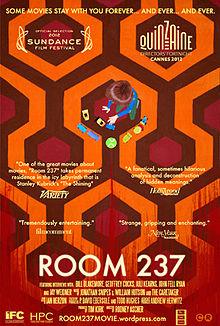
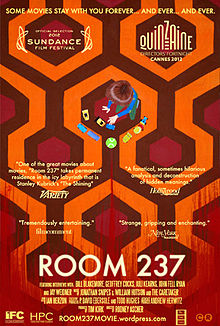
Your willingness to either accept The Shining as a standard horror movie or explore it as a communication channel for hidden messages will greatly affect your response to Room 237, a documentary by director Rodney Ascher about the movie’s role in film theory and audience interpretation. The gullible will gape and gasp; the skeptical in the audience will writhe in disbelief. It is a polarizing documentary.
But what, exactly, Room 237 is trying to accomplish still eludes me. Is it an exploration of film studies with an emphasis on conspiracy theories? Is it acting as a platform for some fairly loony beliefs, or is it subtly undermining its interviewees’ beliefs by including such out-there ideas? And what about the title itself? "There's a crazy lady in the hotel with us," shrieks Shelly Duvall's Wendy to Jack Nicholson's Jack, who meets that supernatural denizen in room 237. By naming itself after the room that represents the worst of the Overlook Hotel’s madness, the room whose unlocking kicks off the movie’s deadliest events, what does the film say about the people in it? I submit that it’s not a tremendous vote of confidence.
But it is a worthwhile and loving look at an occasionally under-appreciated film by a master of his craft. Interviewee Juli Kearns brings drawings of maps to her discussion of the Overlook Hotel’s impossible geography which (not unlike the haunted house in Mark Z. Danielewski’s House of Leaves) stretches and changes to discomfit the viewer and haunt the residents. In calling out specific windows and hallways that loom over the story but cannot actually physically exist, Kearns brings a useful level of criticism to the tale (and reminds us of how much more creeped out we should be as we watch). The labyrinthine house and grounds naturally call to mind the minotaur in his labyrinth, and Kearns valiantly tries to make a case for additional minotaur imagery throughout the movie.
A thrilling moment comes when interviewee John Fell Ryan discusses a unique showing at Brooklyn's Spectacle Theater, which simultaneously ran The Shining both forwards and backwards to explore Kubrick’s use of mirroring as a theme. Some of the results are beautiful and bewitching.
Other interviewees have to work a little harder to prove their points. You see, Kubrick never erred, runs popular opinion, and what might be a continuity error in another director’s movies is, in Kubrick’s hands, a message. That he reshot scenes hundreds of times is proof of this—or so it’s said. That’s why a prop that changes color is proof of a Holocaust metaphor. It’s why a missing sticker represents Danny’s loss of innocence (“Continuity error? I don’t think so,” chuckles interviewee Jay Weidner). It’s why the position of an office paper tray becomes a stand-in for tumescence. Some of these detail-magnifying theories ring true and some elicit groans, but the creative vivisecting is never dull.
The finest, maddest, most groan-inducing conspiracy theory in the film will not be revealed here. It is a frustration and a pleasure to be gobsmacked and I can’t deny you that experience. I found myself almost howling with disbelief at first… then slowly reduced to eyebrow-raising consideration as interviewee Bill Blakemore piled on his proof. This alone is worth the price of admission.
I didn’t come out of Room 237 believing wild fan theories about The Shining, but I did emerge more keenly aware of the possibilities of film theory, the glorious wealth of material in Kubrick’s shots, and my own fierce love for The Shining.
Room 237 runs Wednesday, April 17, at 6:30 p.m. Tickets available at the Wisconsin Film Festival website.