



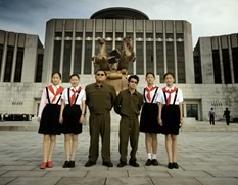
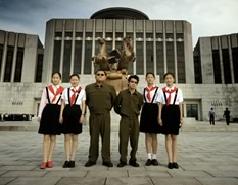
[b][i]The Red Chapel[/i] plays again Saturday at 8:00 at the Play Circle.[/b]
In most documentaries, if the director has an agenda he attempts to conceal his bias, though it often becomes obvious to the viewer. In [i]the Red Chapel[/i], Mads Brugger comes out and tells the audience what he's trying to do: expose the evil of North Korea. As heavy handed as it seems, this openness serves to make a much more effective and compelling film and, perhaps counterintuitively, one that's easier to trust.
It's an ambitious goal, and Brugger choses a fascinating method in his attempt. North Korea is not friendly to foreign press, so Brugger poses as the the manager of a two Danish comedians who were born in South Korea. As part of a cultural exchange, Jacob Nossell and Simon Jul Jorgensen will perform a comedy show for a North Korean audience.
Brugger opens the film explaining that every night they had to turn the day's footage over to censors on the lookout for anything critical of the state or its Dear Leader. The only one who can speak freely is Nossell, whose handicap makes his speech sufficiently unclear that when he speaks Danish, none of the Koreans stands a chance of understanding him. (Nossell's English is subtitled.)
The comedy team's hosts are a Korean director and a government handler who Brugger surmises learned her English as an interrogator. They are always impeccably polite, and if they catch on that the Danes are playing a subtle practical joke, they never let on. They do, however, completely rewrite Jorgensen and Nossell's act. All the Danish elements are excised and replaced with Korean ones, and Nossell is required to use a whistle and kazoo instead of speaking. When he asks Brugger why he can't just use his own voice, Brugger first says he doesn't know before correcting himself and saying he does but can't say right then. Brugger tells us that anyone born handicapped in South Korea is put to death or sent off to a camp. While nothing we see corroborates this, the revised show does seem designed not to call attention to Nossell. At the end, the Korean director instructs him, he should stand up from his wheel chair and pretend not to be handicapped. The comedian is perplexed.
By making his intentions so clear, Brugger makes it easier for the audience to sort out for themselves what to believe. He's clearly manipulative, and at times his treatment of the two young comedians seems cruel. But at the same time, he appears to have made no attempt to conceal this. By being so honest about his intentions and by showing himself in an unflattering light, Brugger earns far more trust than he otherwise could have.
While [i]the Red Chapel[/i] doesn't succeed in its stated goal of revealing North Korea's evil, it does present a fascinating picture of the way the South Koreans interact with outsiders. Setting aside Brugger's narration, there are a number of points where the facade of perfect Communist harmony appears to crack. Children applaud with looks of fear and confusion on their face. The government handler breaks down in tears at a monument to the start of the Korean War and, when pressed, says she was overcome with love for the Dear Leader. It is clear that many of the South Koreans featured in the film are not comfortable revealing their true thoughts and feel they must follow the state's script.
The most interesting part is Nossell's reaction to the situation and the South Korean's reaction to him. He is, by his own description, a "spastic. The handler is kind to him to the point of smothering, but the director wants him to hide who he is. At one point, he suffers a bit of a breakdown at the oppression of their situation and has to create a fake diary When, at Brugger's urging, Nossell asks the handler if he can meet someone else with a handicap, she looks to be on the verge of tears. Kindly, Nossell releases her from the trap and says "Maybe next time."