



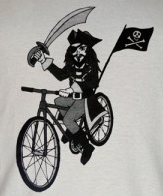
 View originalYesterday some co-workers and I were discussing the perennial topic of the lawlessness of bicyclists. It’s something that people bring up to me at least once a week. There is a strong public perception that bicyclists do not follow the rules of the road. And this perception leads to a certain level of hostility towards bicyclists. The tone I get from people is one of judgmental concern, i.e., “Those crazy bicyclists are going to get themselves killed!”
On the face of it, this is a simple dynamic. But I’ve had plenty of years to reflect on it, and the more that I think about it, the more complex the topic becomes.
There are several things at play here.
First, are bicyclists in fact more lawless than other road users? I don’t know of any study that has ever been done on the topic. There are some good reasons why bicyclists might choose not to follow traffic laws. For one thing, some bicyclists are people who do not drive and do not have driver’s licenses. I’m thinking mainly here of children, but there are other demographics that fit this description too. If you’ve never been trained on the rules of the road, and/or if you have no experience driving to teach the conventions to you, it makes sense that you might not know what the rules are, and therefore might not follow them. There are also the people who DO drive, but who don’t realize that the same rules apply to bicyclists on the road as to drivers of cars. In theory, all people who fall under the “didn’t know” category could be educated or trained on the correct behavior.
Unfortunately, there isn’t currently much in the way of widespread education programs that do this. Hopefully, the federal Safe Routes to School funding, which provides money to assist with increasing the number of kids who bike and walk to school, will help improve this situation. But there’s certainly not enough money in that pot to go around, and much of it is spent on building infrastructure, not on education. The League of American Bicyclists seeks to educate adults through its many training programs, but the number of people that those programs reach is minimal.
But if we could imagine a world where all bicyclists knew the rules of the road…would they still break the rules? Probably. Or rather, at least some of them would break the rules. But why? Why would bicyclists break rules that are put into place to create order and protect them?
And this is the part of yesterday’s discussion that really intrigued me. We began to discuss why we follow rules, specifically, why we stop at stop signs when we are driving cars. One person said she stopped because she didn’t want to get a ticket. Another said he stopped because he didn’t want to get into an accident. And this got me to wondering…why do I stop? Certainly both of the reasons outlined contribute, but neither could explain to me why I still stop at stop signs at 3am when there are no other cars, including police cars, in sight. Why do I stop then? The only reason I can come up with is, BECAUSE I’M SUPPOSED TO.
Full disclosure here, I am a lawless bicyclist. Sometimes, anyway. I don’t always stop at stop signs or stop lights and sometimes I ride the wrong way on a one way street. I don’t do these things carelessly. I only do them when I have a reasonable sense that I can do them without causing injury to myself or anyone else. I also try not to do them when it would obviously piss the other road users around me off (though I’m sure it often pisses them off anyway, which means I’m part of the problem).
So the question I ask myself is…why do I stop at stop signs in my car no matter the conditions BECAUSE I’M SUPPOSED TO…but not always on my bike? I am fully aware of the rules. And, as a matter of fact, I am fairly well known in the bicycling community as a safety instructor, so breaking the rules presents a fair risk of being spied by someone who knows me, eroding my credibility.
The answer that is usually given about why bicyclists who are aware of the rules break them is for convenience. It is harder to come to a full stop at a stop sign and then start up again on a bike than in a car. As for cutting down one way streets, they are often the quickest bike routes with the least traffic (an example, Mifflin by the YMCA off the square, is a shorter cut through on a bike with less traffic than going around the outer loop).
I think it is more than just convenience, though. I think a great deal of it has to do with measured risk. On my bicycle I am really well connected to my surroundings. I can hear, see, and smell things going on around me in a way that I can’t in my car. I’m also able to react to things more quickly in some cases. For instance, I can stop my bike faster and in a shorter distance than in my car, both because I’m generally going slower and because I am carrying less weight. It is also easier for me to bail out if things get really hairy. In an emergency, I can ride up on the sidewalk or down an alley or even jump off my bike entirely. In a car there are typically less options in an emergency. You are more constrained in a car by the built environment and the cars/bikes/pedestrians around you. Driving your car onto someone’s lawn to avoid a crash is an unpleasant option, while riding your bike onto someone’s lawn is much less of a big deal.
Measured risk probably keeps me stopping at stop signs in my car at 3am too. The consequences of making a mistake in a car are much greater than on a bicycle. Some would argue that a bicyclist is more vulnerable, and while this is true, it is much easier to do much more damage in a car than on a bike. A miscalculation in your car can easily lead to huge expense, not to mention injury or death to yourself or others. And even if there’s no major expense or injury, having a fender bender really messes up your day. So maybe I still stop at those stop signs in my car at least in part out of caution.
Measured risk may be one of the main points that ticks motorists off about bicyclists breaking the rules. Where measured risk gets bicyclists in trouble in the car-bike culture war is that the car drivers are viewing the situation from their driver’s seats. When a motorist sees a bicyclist breaking the rules, they perceive danger. They may even experience fear (both for the bicyclist, and for themselves, because they don’t want to injure the bicyclist). Meanwhile, the same situation may not seem that risky to the bicyclist. From their perch on their bike seat they are able to judge the situation much more intimately. A simple blown stop sign may not seem like any big deal to the bicyclist (and from a strict risk standpoint, may not in fact have been particularly dangerous for anyone involved). Meanwhile, the motorist is experiencing a range of emotion based on THEIR perception of the risk.
Which brings us to jealousy. It is my sneaking suspicion that part of the anger directed at lawless bicyclists is really more than just a little bit jealousy. Urban bicyclists may be some of the last outlaws in our society. Outlaws on “toys”. Let’s face it, bicycling is fun. Driving usually isn’t, at least not during the commute. It isn’t a stretch to imagine that the average motorist, trapped inside their steel box and isolated from the other human beings in the world, stressed about traffic and the work day, wouldn’t resent someone on a bicycle weaving through a traffic jam seemingly without a care in the world. A bicyclist may be breaking laws in a situation that poses no real danger to anyone, but sure irritates the person in the car who can’t break the same rules. Bicyclists remind motorists how oppressive the car-culture can be, and they don’t like that. “Why don’t those lawless bicyclists grow up and drive a car?” is the reaction, because the converse “I wish I was having as much fun in my life as that guy on the bike” isn’t easy to swallow.
Though I have no scientific data to back it up, it is my sense that bicyclists do not, in fact, break more laws than motorists. I just think that there is a certain level of tolerance in society for breaking certain kinds of laws in your car. It is okay to drive 5-10 mph over the speed limit. It is okay to roll through a stop sign if no one is around. It is okay to run a red light just as the other direction turns green. It is okay not to yield to a pedestrian in a crosswalk. It is okay not to give three feet when passing a bicyclist. It is okay not to pay attention when you are driving a two ton vehicle. It is okay to drive after a beer, or maybe two…but maybe not three. Well MAYBE three.
More than 40,000 people lose their lives in auto crashes (conversely, about 700 bicyclists die on the roads) each year. These are things that we accept. And in the United States, anyway, there are many, many more thousands of people driving cars and taking these risks, breaking these rules, than there are bicyclists on the roads. So it seems unlikely that bicyclists are more lawless than motorists. Ultimately, bicyclists and motorists are both people. And people are people.
I don’t condone any road user breaking the rules. The rules are there to protect us all and they work best when we all follow them. But I do think that the hostility towards bicyclists who break the rules is disproportionate to the actual risk that they present to themselves or to others. And I think all the hand wringing over “what are we going to do about all these lawless bicyclists?” is a bit over-blown. People ask me all the time what I’m doing to stop those lawless bicyclists. The truth is that I’m not sure that there’s much that CAN be done.
As society stands currently, there doesn’t seem to be much interest or resources being devoted to assuring that everyone knows the rules. Strike one. And we as a society seem perfectly willing to accept some level of rule breaking (as long as it is done in a car). Strike two. And changing behavior is one of the hardest things to do. Witness the limited success of anti-smoking, seat belt, and exercise/nutrition campaigns. Some change can happen, but it takes a long, long time and lots and lots of effort, and even then not everyone changes. Strike three.
Ultimately the only thing that we all have control over is our own behavior. That goes equally for following the rules of the road, and for how we react when others don’t follow them. So the next time a lawless bicyclist ticks you off, rather than getting mad at them, take a deep breath and think about what you can do to get yourself the rest of the way home as safely as possible.
Image credit