



 View originalIt’s the middle of March as I write this - a beautiful Saturday that leaves no doubt that spring is on the way. Despite the extra sunshine and warm temperatures, to someone like myself with locavore tendencies, March is just about the hardest month of all.
I moved back to Madison in early January, after spending 5 ½ years in Northern California. I made a pledge to myself to resist buying vegetables from far flung places, and I was glad to find all kinds of local foods available at the food co-ops and the winter farmer’s market. Over the last few weeks I’ve watched with dismay while many items I’d been enjoying faded away for the year: cabbages and apples have completely disappeared, certain root vegetables are waning, almost all the vegetable vendors have stopped coming to the winter farmer's market...what is a girl to eat?
Historically, if starvation was in the cards in a given year, March or April was the time it would happen (at least in the Northern hemisphere). Food stored from the previous autumn is running out or gone bad after months in storage, and spring crops are still months away from harvest. Even if some hardy spring greens can be coaxed to grow, there’s no way they can supply enough calories to keep people going through the early spring months – a time when hard work is required to cultivate the ground and plant for the upcoming year.
So what have I been eating? I haven’t yet given in to the temptation to buy fresh vegetables from outside of Wisconsin, but I did finally give in and purchase tomato paste shipped in from out of state. I wasn’t able to can any tomatoes this autumn since I was planning to move from California; but I promised myself that the upcoming year will be different, and I’ve limited myself to tomato paste, since it’s the most condensed tomato product you can buy and requires the least amount of energy to ship. Other than that, I’ve stayed quite pure, and my diet, though lacking in diversity, has still been quite satisfying. I’ve come to appreciate and rely on one of the most basic of food parings: meat and potatoes.
In most other months, I refuse to eat a meal that doesn’t include some sort of fresh vegetable. I’ve worked in the organic produce industry for years, and vegetables of all kinds are near and dear to my heart. In California, local greens were abundant all winter long, so this March has been a new experience for me. I’ve explored all the possible ways to combine the most basic of local ingredients: meat, potatoes, eggs, and dairy products. Although I expected it to be quite hard (and at times it has been,) I’ve found this simple diet to be extremely satisfying. It’s grounded me, and like many things about winter, it’s made me anticipate summer in a whole new way: I’ll appreciate the abundance and diversity of summer produce in a way I never have before!
And there’s new hope! If you’ve visited the winter farmer’s market recently, you’ll know that spring greens are starting to arrive! Many of our local farmers have taken advantage of the extra daylight hours in their hoop houses and have started producing tender spring lettuce and spinach. While they don’t supply many calories, these greens do add much needed vitamins to a meat and potatoes diet that’s heavy on protein, starch, and not much else. You have to get there early, and don’t expect these precious spring greens to come cheaply, but I’ve found their fresh crunchiness to be well worth it!
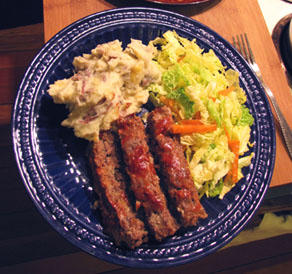
Celebrate meat and potatoes with this simple meatloaf and some buttery mashed potatoes. I enjoyed it a few weeks ago with a salad made from the last of the local cabbage, but you can instead pair it with a fresh spinach salad from Snug Haven Farm, and you’ve got yourself the perfect March locavore meal!
[b]Megan’s Meat Loaf[/b]
2 Slices stale bread (I like dark rye from Silly Yak Bakery.)
2 Eggs
2 Tablespoons Butter
2-4 Cloves garlic, chopped
1lb Ground beef
1 teaspoon Powdered sage
Salt and pepper to taste
1 small can tomato paste, mixed with about 1 cup water.
Preheat oven to 350 degrees. Combine all ingredients except tomato paste and mix well. Press mixture into a lightly oiled loaf pan. Bake for about 50 minutes. About 10 minutes before it’s done, pull meatloaf out of the oven and spread the tomato paste on top. Bake for 10 minutes more, or until the internal temperature reaches 120 degrees.
[i]Read Megan's February edition of The Madison Locavore here, or visit her blog at www.thegoodfoodmuse.net[/i]