



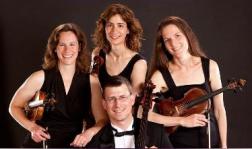
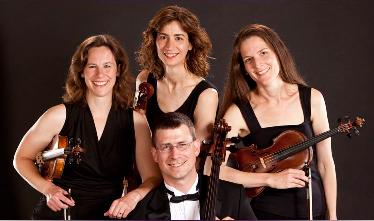
I finally caught up with the Ancora String Quartet and, not surprisingly, the results heard Saturday night at the First Unitarian Society lived up to the advance billing. After all, I had heard each of the players a number of times in larger ensembles, and as for how they played as a quartet, well, a chamber ensemble doesn’t last ten years and develop as loyal a following as the Ancora has without consistently delivering performances of great merit.
On the occasion of their tenth anniversary (and fifth at the FUS), violinists Leanne Kelso League and Robin Ryan, violist Marika Fischer Hoyt and cellist Benjamin Whitcomb opted for some creative programming. The first half was devoted to the String Quartet in A Major by Alexander Borodin. Most groups won’t touch the work — not because it is fiendishly difficult, although it certainly has some unique challenges — but because it was Borodin’s String Quartet No. 2 that has become something of a repertory mainstay. It boasts a “Notturno” that has been arranged for full orchestra, etc. and other tunes which, like a few from the “Polovtsian Dances,” found their way into the Broadway musical, “Kismet.”
So why bother with the rarely heard Quartet No. 1? Apparently because it deserves to be heard. Something of an unofficial homage to Beethoven, with various degrees of fugal writing in three of its four movements, the piece may not have that one unforgettable movement or can’t-get-it-out-of-your-head melody, but ultimately has some worthwhile things to say. The opening “Moderato—Allegro” is perhaps the weakest part of the work, and the contrapuntal section mid-movement did give the Ancora players a tussle, but the ensuing “Andante” saw the members click in their intensity and blend. It is with the Scherzo that things get extremely interesting: sometimes with mutes on, sometimes not, the movement is rife with harmonic effects, even in the cello part. At one point the effect could only be described as a celestial calliope. The finale does offer one of those tunes that surprises and refreshes like a cooling summer breeze, and the foursome delivered it with a delight that was reflected in a sustained ovation.
The second half selection was surprising only in that it was not a quartet, but the great Quintet in C Major of Schubert, with cellist Karl Lavine joining the quartet. It was as if the Ancora were saying that even the greatest string quartet written would not be enough to celebrate their tenth anniversary. One could confidently argue their position, from the standpoint that the Schubert Quintet in C is, simply put, one of the greatest compositions, period, let alone in anyone’s top three or five greatest chamber works. In breadth of scope and depth of expression, it is nothing less than symphonic.
With all the repeats taken, the work runs close to an hour, but one listener at least wishes that the Ancora had taken the first movement repeat — the indescribably poignant second theme may be all the evidence one needs that music is a divine gift given to express what words cannot grasp.
In the great Adagio, League’s principal theme emerged like a person who pauses for breath after every few words — and Schubert did finish this piece just weeks before his death at the tragically early age of 31. The melody was buoyed by the punctuation of pizzicati from Lavine, while the other three players wove a rich carpet of supporting sound.
The Scherzo had more precision and power in its initial presentation than in the recap, but the contrasting Trio emerged in vivid emotional contrast. The five players simply hit a bullseye with the tempo they employed in the finale, a rustic dance that relies more on accents and rhythmic inflection than sheer speed. Best of all, the energy did not flag, and the final lines were brought to life with the same urgency with which a runner strains for the finish line.
So Happy Anniversary, Ancora! May the next decade (or so) be just as rewarding for Madison music lovers, and beyond.