



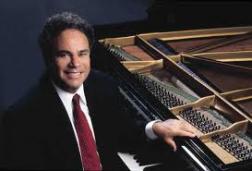
Jeffrey Siegel’s “Keyboard Conversations” are the one place you don’t need program notes — he is the notes and more, which is the whole point of what he has been doing in this unique format for about three decades.
That’s no secret to most of Madison’s classical music community of course; Siegel has been bringing his show here for over twenty years. But in Tuesday’s bicentennial tribute to Robert Schumann, “Fantasies Forbidden and Fulfilled,” a new fantasy came to mind: that Mills Hall might actually be full for Siegel’s next performance in March.
Alas, the hall appeared to hold but 150 or so audience members as of about five minutes before the program began. And it can’t be argued that after all these years the Siegel brand has worn thin — he gives fresh insights into whatever program he puts on, combined with his well-established world class pianism. Furthermore, “Keyboard Conversations” remains among the best starting point for anyone just beginning to learn about classical music.
Siegel’s theme this time around focused on some of the music written by the ultra-Romantic Robert Schumann during the time of his enforced two-year separation from his soul mate, Clara Wieck. He was ten years her senior, and when Schumann started living in the Wieck household to facilitate intensive study with her father, Friedrich, Clara was an 9-year old prodigy, but within a few years, she and Robert fell in love. Friedrich was vehemently opposed to the marriage, eventually allowing no communication between them — save the exchange of compositons.
Siegel’s first illustration was the short work “Soaring,” from a collection of 8 Fantasy Pieces, Op. 12. Dating from 1837, the thick chords seemed to boil over from the Steinway. The overall sound struck one as overly bright at times, and the particular instrument to be more responsive to ebullient dynamics than hushed ones.
Then Siegel really dove in to what he does best: elucidating a critical overlapping element, and using it as a springboard to lay bare the multiple levels of great works for piano. The starting point was a 5-note theme that Clara wrote — and that Robert then used in his Sonata No. 3, Op. 14, and it gave Siegel a full panoply of expressive possibilities from which to work. Siegel then backtracked to the Sonata No. 2, Op. 11 which Robert sent Clara with a smuggled letter, declaring that the work “represents my overflowing heart.” Hearing the first two movements in their entirety after Siegel’s laser-like highlighting, one realized anew that not only does he bring a technique that in its mastery alone mitigates the naturally thick textures of Schumann’s music, but his verbal pointers prepare the alert ear to recognize signposts in the musical heat of battle that could otherwise be easily missed.
The last short selection of the first half took the virtuosity up yet another notch, as it was Liszt’s arrangement of a Schumann song (“Dedication”) that Robert gave to Clara on their wedding night (yes, there was a happy ending: after a lengthy court case, the couple was allowed to wed — the day before Clara turned twenty-one, when she was free to do so anyway!). Siegel made it the tour de force “song without words” that is this version’s raison d’etre..
The second half had a most interesting twist, however. Before the eventual marriage to Clara, Robert fell in love with and had a secret engagement to Ernestine von Fricken. But when her father told Robert that she was adopted, and would be cut off from the family fortune as soon as she married, Robert (as Siegel said with characteristically dry humor and impeccable timing) realized how deeply he loved…Clara. But there was a musical hook: the Baron von Fricken had written a set of variations on an original theme. Schumann disliked the variations — but loved the theme, and wrote his “Symphonic Etudes” Op. 13 as a result.
Again Siegel not only illuminated a few of the highlights to come, but told a fascinating story of five “extra” variations discovered in manuscript after Schumann’s death. Siegel chose to incorporate only one, but the episode and the way he presented it was a clear reminder that while “Keyboard Conversations” is in many ways the perfect primer, the most experienced listener is almost always bound to learn something new, too.
As is his wont, Siegel took a number of insightful questions from the audience, and gave us a preview of the next presentation in March: “1911: A Centennial Celebration,” in this case of not a single composer, but works of Debussy, Faure, Ravel and Stravinsky from that special year in music. Here’s hoping everyone in Mills Hall Tuesday night brings a bunch of friends.(sdg)