



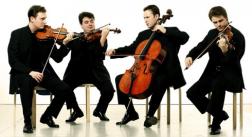
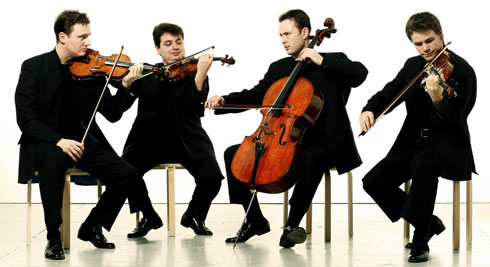
If the Jerusalem String Quartet is not yet a household name in the classical world they should be. With their penchant for programming distinctive styles for a given performance, their appearance Friday night at the Union Theater was a vivid demonstration of what constitutes a great string quartet.
Not all ensembles would have pulled it off: Brahms can sound similar to Haydn, only louder, and Debussy could just be run-of-the-mill lush with a few piquant harmonies. But from the first movement of Haydn’s Quartet in F Minor, Op. 20, No. 5 one experienced a group that can use dynamics to define parameters. When a quartet can go from soft to softer, without losing intensity, then “loud” (a relative term to begin with), can remain conversationally subtle, not just an obvious increase in decibels.
Debussy’s only work in the genre, the String Quartet in G Minor, Op. 10 provides a wide palette of effects and expression. The first “impression” (pun intended) was that it seemed as though violinists Alexander Pavlovsky and Sergei Bresler, violist Ori Kam and cellist Kyril Zlotnikov had simply put some sort of French filter on their instruments, the way string players clip a mute onto the base of their strings. The second movement was full of wonderful individual moments for Kam and Pavlovsky, but again and again one was captivated by the collective effects. The slow movement was like an indistinct voice in a dream, or the voice of someone speaking to a person asleep whom they don’t want to wake. Again Pavlovsky and Kam provided a special moment when they shared a melody in octaves, as if the viola were the violin’s shadow — a sequence easily lost on even the best recordings.
It is said that Brahms wrote as many as twenty string quartets before allowing one to see the light of day as a published work, and while his String Quartet in C Minor, Op. 51, No. 1 is a satisfying work, Brahms never did achieve the heights of Beethoven (or maybe even Dvorak) in the field. But the Jerusalem Quartet’s reading did lead one to wonder if it is in the late Romantic repertoire that they are after all most at home, despite the earlier mastery on display.
It was in the second movement Romanze that I noted something admittedly speculative: a number of times during the evening I had the impression that cellist Kyril Zlotnikov seemed impatient when his part had a stretch of rests. It appeared that he couldn’t wait to get back in and play and be a part of what his colleagues were up to. Yes, label the observation silly if you care to — but it strikes me as good a way as any, albeit ambiguously, to describe the great intangible that makes a superior quartet a whole that exceeds the sum of its parts.
The lovely third movement was taken at a more relaxed pace than is often heard — making the contrasting middle section seem unhurried. The Finale was fiery enough but too brief, and seemed all the shorter when no encore (alas!) was forthcoming.