



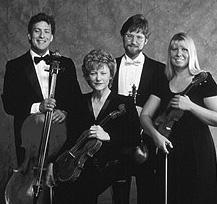
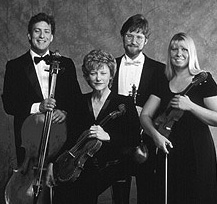
The Pro Arte Quartet is a year or so away from celebrating the centennial of their founding, making them the longest continually performing ensemble of its type. Founded in Belgium in 1912, in 1940 they became the prototype of a resident ensemble — invited to stay when Hitler invaded Belgium while the quartet was performing in Madison. Everywhere the current foursome travels they get praise heaped on them: to Carnegie Hall (NY Times: “a first rate quartet”), San Francisco (“One of the greatest quartets of our time”), Boston (“Exemplary”).
They opened their Madison season at Mills Hall Saturday night and they get — an audience that filled no more than two-thirds of the seats. Perhaps the fact that it was free (being a UW Faculty Concert Series event) threw folks off. Perhaps the Pro Arte Quartet is simply the musical embodiment of a prophet without honor in his own country. This must change.
Let’s get the basics out of the way: all those out-of-town critics were right. Violinists David Perry and Suzanne Beia, violist Sally Chisholm and cellist Parry Karp play as if one ultra-instrument was being manipulated by a single entity of eight arms. Whether in the mature classicism of Mozart’s K. 428, the neurosis-tinged emotionalism of Schumann’s Op. 41, No. 3 or the happily-ever-after romanticism of Dvorak’s Op. 34 quartet, the members of the PAQ matched one articulation after another. Even the subtlest dynamic shifts surged and ebbed of one accord.
In short, one can forget the usual checklist of essentials: are they in tune, how well-matched are the sonorities, do they agree on rhythms and tempos….every aspect of the performance is so well in sync that one just gets lost in the music, never distracted by an unexpected musical disagreement, no matter how small.
After a deeply polished reading of the Mozart, the opening measures of the Schumann revealed the breadth of the PAQ’s collective control. The music may have radically changed in personality, but the execution level remained top-notch. The third movement Adagio molto was edge-of-the-seat stuff; one half expected to hear a sob or two from the rapt audience. As in the finale of the Mozart, Perry ignited the finale with the merest nod of his head. It is not unusual for quartet leaders to use an audible and/or a sharp intake of breath as a conductor would flick their preparatory motion, or at least a more obvious head nod. But the constant eye contact and laser-focused attention the players pay each other make all the most efficient signals superfluous.
The Dvorak was the perfect restorative on the second half: warm, cuddly, boisterous and joyful. One stretch of the opening movement was particularly cherishable, with Perry and Beia engaged in a duet within the quartet, Chisholm’s viola tossing off pinpoint pizzicato, and Karp’s cello adding a richly sonorous foundation. The second movement was based on a polka — not the kind to inspire the Mills Hall faithful to dance in the aisles, but the rendering was so infectious they could have been forgiven if they had. The Adagio could only be punctuated by a listener’s wistful sigh, and the finale exuded the kind of energy that precedes the moment when a jack-in-the-box finally escapes.
No encores greeted the extended applause…but surely many took notice that the Pro Arte Quartet’s next local appearance is October 28. Oh yeah — don’t let the free seats thing throw you. It’s already clear that the average PAQ performance is priceless.