



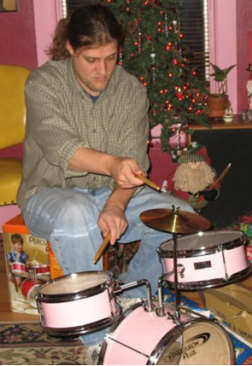
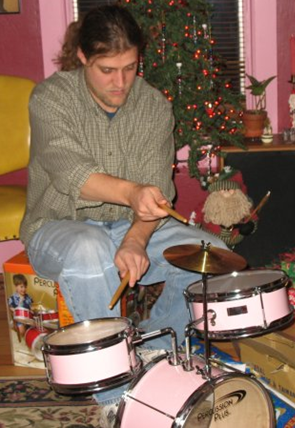
Ethan Noordyk is a busy man. He’s also the best drum instructor in town. But, then again, I’m biased because he’s my drum instructor. Sadly, at the end of the summer he’ll be pulling up stakes and heading to the east coast. It is a true loss for the Madison music scene. He’ll be playing plenty of shows this summer, though, and you ought to get out to see him before he’s gone. Catch Ethan with Clovis Mann on May 23 at the WORT Block Party (around 12:30 p.m.) or with So Dang Yang at the Crystal Corner Bar the second Monday of every month (May 10 or June 14).
Dar Ward (DW): What bands have you played in and which do you currently play in?
Ethan Noordyk (EN): Old bands: Otis and the Alligators, The Janet Macklin Quartet, The Danger Project, The Big Mouth Cooperative. Current Bands: Clovis Mann, The Jim Schwall Band, Marcus Bovre and So Dang Yang, and Overserved. I get called up to play with a lot of different bands at any time.
DW: How long have you been playing drum kit and at what age did you start?
EN: I got my first kit at age eight, but didn’t take lessons 'til I was in 5th grade. That is when band started at our school. I also played in the marching band in high school. We didn’t march much, though. The jazz band was a lot cooler. I have a music degree from UW Stevens Point that I received that back in '02.
DW: How much do you practice currently?
EN: I like to practice as much as I can. I do not practice as much as I did when I was in college. But I try for an hour or so a day. Sometimes I get more practicing in but then life happens and you have to pay the rent.
I like to get a good warm up in for 20 to 30 minutes. Then I work on sight reading and practicing different solos (snare, drum set, marimba, multi-percussion). Then I’ll listen and transcribe different drum set players. For fun I will just improvise if I have time. Sometimes I will play one groove for an hour or two. This is a mental exercise. Keeping one groove going and sounding good for and hour is difficult but fun. I also try to listen and play to a variety of music. A lot of the time I am learning songs for the bands I am working with.
With my bands, we try to practice every week, sometimes more, sometimes less. It seems like everyone is in a couple of bands so you have to spread your time around.
DW: Do you play other instruments besides drums?
EN: I play marimba, guitar and piano. I do consider drums to be my primary instrument, though.
There are times when the guitar or piano get more practice time, but it is all related. The piano and guitar help me to learn chord structures and the forms of songs. It is important as a drummer to know the chord structure and form of a song. As a drummer you have to kick the form so knowing it is very important. I sing with Clovis Mann so knowing what key the songs are in is also a big help. I also write so it is good to be able to relate what I'm thinking to other musicians.
DW: Do you help write the songs that your bands play?
EN: The musicians I play with are great song writers so I mainly write the drum part. Sometimes there is collaboration with the song writer, but I normally just go off of what they are feeling. There is always time to develop ideas, but most of the time the simplest ideas work the best. If I try to do too much it doesn't flow like it should.
My drum parts will normally evolve for a few weeks until I have played a few shows with a new song to get that live feel.
I have written out my parts but I normally just remember them. If I don’t remember how a song goes it just take a couple off beats from the band and I will remember the whole song.
DW: How do you approach learning the drum part for covers?
EN: I will study the song, get it as close to the original as I can. But I find each player has their own version of a cover so I will adjust to the player.
DW: What types of recording processes have you participated in?
EN: I have done studio and live recording in all types of settings: garages to world class studios. They all have advantages and disadvantages. Sometimes we get just drum tracks. Other times we record live with the whole band. It depends on the group and the ability of the other musicians to play along with a click. With most groups, time is an issue in the studio, so we try to be well rehearsed. We will take one to four takes at a song then pick the best one. Usually the first or last take is the one. More takes than that and I feel the song starts losing its feeling. With technology these days it is real easy to punch in and out of a song, especially with Pro Tools.
DW: How many drum kits do you have?
EN: I have three different kits: a 1960s Ludwig, a 1990s Ludwig, and a 2004 Gretch. Then I have pieces of other kits I use if I have a lot of space on stage. I will bring another floor tom or two. I pick which kit to play depending on the gig.
DW: How much effort do you put into tuning your drums?
EN: I try to tune the drum to the room. If a drum is not speaking in a certain environment I will adjust it until I feel comfortable with the timbre of the drum.
DW: Do you always try to bring your own kit to shows, or are you okay playing someone else's kit?
EN: I am always OK playing someone else’s kit. It is exciting to see how other drummers set their gear up. It normally only happens when we are opening up for someone else. The sound guys don’t like to set up more than one kit a night, so I will play the other drummers kit “as is.” I will try not to move anything if I can avoid it. Normally I only have to adjust the seat height. Then it's time to rock.
DW: What do you view the role of the drummer in a band to be?
EN: To keep great time. The drummer should become a big couch that everyone else in the band can sit in and feel comfortable.
DW: Many bands in Madison that play out have their drum parts based strongly in the 4/4 rock genre. Do you also dabble in more "complicated" genres?
EN: I really enjoy playing in odd time signatures. I like Latin music, especially clave patterns. Most of the bands I play with keep the 4/4 time. But when I have an opportunity to play jazz I do get to stretch out with odd meter and Latin grooves.
DW: Anything else you’d like to add?
EN: I think drums have the most important role in the band. Without drums there is no back beat for the rest of the band to follow. Drums provide that driving pulse that gets people dancing. I think drummers have an important role but playing in a band is a team effort. That is why it's called a band and not a solo act. It is important to know your role in the band. Interaction between band members makes a cohesive unit. Otherwise it sounds like mud. It is important to listen to each other. I always have one ear on the bassist and one on the soloist/singer. Everyone is replaceable. That is why it is important to keep a positive and honest attitude. Nobody wants to play with someone who has a bad attitude, no matter how talented a musician is. A positive attitude can go a long way. And it helps to be on time!
Read-only archive. Accounts and comments are unavailable. Browse the archive.
featured