



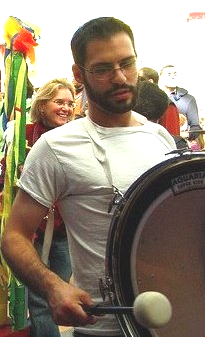
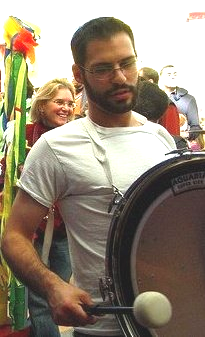
Despite what you sometimes here on the doomsday report, one of the nice things about the internet is that it can bring people together. And so it was that I “met” Jordan Cohen. He said he liked my drum column. I said “can I interview you?” And we were off and running.
Dar Ward (DW): What bands have you played in and which do you currently play in?
Jordan Cohen (JC): My current bands, in order of gigging frequency:
- Mama Digdown's Brass Band (in which I play bass drum)
- Kid Jordan Second Line (New Orleans jazz band)
- Marcus King & Thee Royalty (soul covers)
- The Optimistic (Louka Patenaude's rock band)
- Onlooker, my solo project that emphasizes beats and electronics. I'm working hard on a record with the goal of finishing it this summer, but I'm not sure how (or if) I'm going to go about playing the music live.
DW: Does your current band play originals, covers, or both?
JC: Digdown plays originals, as well as New Orleans standards and brass band arrangements of pop music (usually R&B jams). Our next album will be all Michael Jackson arrangements. Kid Jordan and Marcus King don't do originals, but the Optimistic and Onlooker are both all original.
DW: How long have you been playing drum kit and at what age did you start?
JC: I took drum lessons from Dave Schoepke in Milwaukee (he plays for Willy Porter but is a hugely underrated drummer) during middle school and part of high school, which was great. However, I feel like the really valuable stuff that I've learned has come from just being around great drummers, not from formal lessons.
I was in the marching band and the orchestra during high school, but only because they wouldn't let me be in the jazz band without doing that. In college, I played in the Black Music Ensemble and the big bands, but wasn't part of the percussion program.
DW: How much do you practice currently?
JC: I play on the practice pad as much as I can, but don't really have a situation where I can practice drumset. I should practice more. We all should, right?
Usually I just work on rudiments and improving my right hand. I'm left-handed, but learned to play drums right-handed because I didn't know any better. A couple of years ago I admitted that my right hand is never going to be able to do quite what I want it do, so I started practicing left hand lead on a righty kit. Now, whenever I have to play fast tempos or do something involving a lot of 16th notes on the hi-hat, I switch to left-hand lead. It was pretty interesting rewiring my brain and limbs for that purpose, but I'm glad I pursued it. It was a little tough feeling like a beginner again and starting from square one independence-wise, but I think the learning process went a lot faster the second time around.
For fun I like to put on rap music; it's way better than a metronome.
DW: Do you play other instruments besides drums?
JC: I mess around with keyboards at home, but I wouldn't insult any real keyboard players by saying that I play them. I do a lot with cutting up and programming drum tracks at home, though, so I would say that I play the computer pretty well. I think it's helped my time to hear so many perfectly quantized beats, and trying to make those beats sound less perfect/more human has helped my feel.
DW: Do you get together and play with other drummers?
JC: New Orleans brass bands use two drummers, one on bass drum and one on snare drum. There's a real relationship that goes on there, a lot of communication. It's a serious thing down there, and I've been fortunate to play with a lot of great drummers in this context (both here and in New Orleans). If you didn't grow up with that music, it takes a long time to absorb the vocabulary and the attitude. It's not rocket science, but drummers coming to it for the first time usually have a lot of misconceptions.
DW: How often does your band practice together?
JC: Digdown doesn't rehearse much because we're spread out across different cities, but we've been making it happen to work on the Michael Jackson arrangements. None of my bands rehearse on a regular schedule, but might get together before a show to brush up or work on new material.
DW: How do you approach learning the drum part for a cover?
JC: I usually start by learning the original drum part verbatim, by ear, but as time goes on (and my memory of the recording gets fuzzier) I'll usually develop a different way of playing it.
DW: What types of recording processes have you participated in?
JC: Mama Digdown's Brass Band records live with everybody in the same room, which is nice. The polar opposite of that is the Onlooker project I'm working on, where everything is cut-up, sequenced, and controlled. It's nice to have that yin and yang. Onlooker satisfies my control freak tendencies, but when sitting at a computer starts to seem like a ridiculous way of making music, I can go play with the band. And New Orleans brass band music is basically the loudest, most physical style of music I can think of.
DW: How many drum kits do you have?
AM: Two. My beat-up high school rock kit with the 22" kick, and my Premier jazz kit with an 18" kick that I use for Kid Jordan Second Line gigs. They both do the job, but I wouldn't mind having a nice in-between kit that could work in both situations.
DW: Do you always try to bring your own kit to shows, or are you OK playing someone else's kit?
AM: I always go back and forth on this. Laziness makes playing on someone else's kit really appealing, but I'm always so much more comfortable on my own kit. Luckily I rarely play multi-band shows, so it doesn't come up too often.
DW: Many bands in Madison that play out have their drum parts based strongly in the 4/4 rock genre. Do you also dabble in more "complicated" genres?
JC: I don't really like to draw lines between genres like that, but I'd agree that there's a learning/absorption curve when it comes to music that you didn't grow up with. I like playing odd-time signatures and trying to make them feel natural and danceable. There's a lot of 5/4 on the record I'm working on, which is weird because I don't really like 5/4. I guess I see it as a challenge to come up with beats in 5 that feel good, and don't sound anything like Take 5 or Mission Impossible.
DW: How important is it to you to “get your licks in” various playing the groove?
JC: Not at all. I love when a groove feels good more than anything.
DW: Who are your favorite drummers and/or your drum heroes? Anyone locally who is a standout for you?
JC: I'm most inspired by the great drummers around me. We have so many sick individuals around: Dave Skogen (of Youngblood Brass Band/Cougar), Michael Brenneis, Frank Martinez (El Clan Destino), Joe Wong (Milwaukee-based drummer who plays in Parts & Labor), Joe White, and Jamie Ryan when he was in town. Otherwise, besides all the obvious drum heroes I always check for Dave King, Chris Dave, and lots of other dudes whose level I'll never come close to. I'm also inspired by a lot of producers who don't necessarily play live drums but have great ideas and make amazing drum tracks, like Four Tet, Madlib, Just Blaze, and many others.
DW: What are your goals as a drummer?
JC: I don't have any illusions about becoming a chops monster at this point; I just want to play in situations where I can sound good and make some records that I'm happy with.
You can hear Jordan play with Mama Digdown's Brass Band on Friday, April 9 at Terrace Town at the Monona Terrace from 10:30 to noon and 1:45-3:00 p.m.