



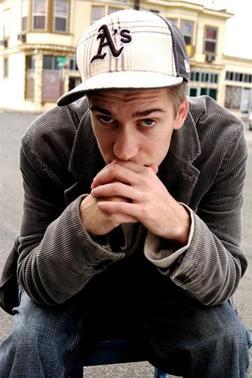
On Saturday, Dec. 5 at the Rathskeller in Memorial Union, Bay Area hip hop artist Rafael Casal will perform songs from his new LP “Monster” at a concert that also features several up and coming MCs from the University of Wisconsin-Madison’s First Wave Spoken Word & Urban Arts Learning Community, a program that recently received the 2009 Wisconsin Foundation for the Arts Governor’s Award.
Casal came to the University as a highly decorated performance poet, a two-time champion of the Brave New Voices National Poetry Slam and a three-time performer on HBO’s Def Poetry. Casal was brought to the university as the Creative Director for the Office of Multicultural Arts Initiative and the First Wave, a collective of over forty students receiving scholarships for their work as spoken word poets and hip hop artists.
His second LP “Monster,” which dropped Oct. 31, is available for free download at the Getback Productions website, www.getbacknews.com, or at www.uwhiphop.com..
[b]The name of the new LP is “Monster”. What makes you a monster? [/b]
Rafael Casal (RC): I think I make it very public that I constantly contradict myself, and that’s a process of growing. I consciously in all my writings talk about doing things that I felt like were inappropriate but were happening anyway and try to expose them as something human. There’s a discrepancy between what I’m doing and what I’m feeling but that is a process, that’s a person in transition. I like talking about the break and the destructive qualities of habits that people develop over time. That idea of being imperfect and being publicly broken brought on this idea of being a monster, something that’s not the normal figure.
We are constantly changing beings, and music, especially hip hop music, always declares itself so certain, so sure of every state that we exist in. I really wanted to expose a lack of certainty, because it's ugly but it's real to me, it’s the most authentic thing I can capture about where I’m at in my life.
What I search for in music is perspective from folks, even some of my favorite artists--their best lines are lines that question themselves for a moment. But they drop the line and then move on. It’s like, I was kind of interested in where you were going with that. So I guess when I go in, I want to go just a little bit further into the content if I can.
Archived media unavailable
[b]The songs on the album put a lot of emphasis on your personal relationships. It seems as though the monster persona was bestowed upon you by those relationships. [/b]
RC: There’s so many different reasons the record was titled that way. There’s little stories that are told on the record that inform that, like the “Bitch” song, the first time I started calling women bitches, it’s like two or three stories that I strung together for that song. Here I come from this strong feminist household of working class women who have worked very hard to not be marginalized in any way. And you know, 14 -15 years old, it’s a very interesting time period in a woman’s life. I’m from Berkeley, California, it’s a liberal place so feminism is introduced at a very young age. There’s women who don’t fully understand what feminism is at 14-years-old so they’re righteous as fuck and they don’t know why. And there’s dudes who are trying to holler but they don’t know how to do it, so there’s this clash of these two powers trips, and what happens in that moment is no one knows how to act, so men are getting rejected because of the power trip that women are on about being treated right, so what starts coming out of a 14-year-old’s mouth is “fuck this bitch." You as a 15- or 16-year-old who’s throwing these things out, all your friends are doing it, you don’t think much of it. But the older you get the more you deal with women who’ve been traumatized by male bullshit, you realize that was your entry point into being a misogynist jackass.
I think now I’m very self-aware, at the time we are kind of intentionally unaware. I feel like we make conscious decisions when we’re younger to not think things through, because we have one line or two lines that we feed ourselves that let’s us say ‘I don’t have to think about it. I’m not saying all women are bitches, I’m just saying some women are bitches.” And that’s your line, that’s the shit you feed yourself so you don’t have to think about the shit. That’s part of where this monster comes up because I’m not done with letting things like that go. I feel that’s an important stage to document, I don’t think you can just become aware of your misogynistic side and be free of it. That’s like step one of 50--it’s a long process.
Archived media unavailable
[b]Talk about the difference between being an MC and being a spoken word poet. [/b]
RC: Being a poet has a certain relevance to the world of academia, so its social rewards are very different, meaning if you’re a great poet, scholars, authors, high school teachers, they respect what you do. For me being this fucked up 14-year-old kid who was not going to school and being a smart ass, I got into poetry and this got me back into the good graces of people who could open doors for me as far as school is concerned. All my teachers had pretty much given up on me, then here I come into poetry slam, which they endorse because its not rap, they’re not opposed to it.
There’s the whole poetry slam scene which adults come to and appreciate, and the San Francisco Chronicle would write about and highlight people, because it’s a positive thing that young people are doing, even though you are talking about a lot of the same things you talk about in rap. The same topics, different platform. Same language, same terminology, but it’s a little bit more accessible and a little less abrasive because it’s done in a way that’s more accessible to older generations. So while rap was getting me studio time and some street cred, poetry was getting me newspaper features and trips to the national slam and onto Def Poetry. The audiences are very different. Poetry audiences don’t really fuck with my rap shit.
[b]You represent the Bay Area, which has produced a lot of great hip hop artists. What’s your buzz like in the Bay Area rap scene? [/b]
They’re just now starting to give me love. The “Bay Area Slang” song is the only reason the Bay scene knows who I am musically. But when they talk about me it’s like, “Bay Area mini-celebrity Rafael Casal released this song.” And that’s crazy because I didn’t know they even knew who I was, because they weren’t writing about me when I was a poet, other media outlets were. But I put out that little “Bay Slang” video and it got a lot of attention. And now I can go to the radio stations and they let me in and talk to people, these huge DJs who put on E-40 and Too Short are hitting me on Facebook. That’s a very new platform for me.
Archived media unavailable
[b]With your position as creative director for the Office of Multicultural Arts Initiative and the First Wave Program, you’re not only creating your own art, but you’re helping to shape and form minds at the university.[/b]
RC: As far as working with the program, I feel like it came up at the perfect time in my life. It’s not like I went from high school to college, it was very much my art that got me into college.
I barely made it out of high school, then I was like, "OK, I’m going to tour now and do my art." But it was just coming through here on tour that this happened and got plugged into the program. The program was just getting on its feet and kind of scattered but had all this potential, I just thought it was a really good idea that was not quite realized yet but somebody had started something really tight. If they could make this last in any capacity at a university, this could be revolutionary for the university.
I shied away from university in the first place, I felt like this was not the place for me, I’m not going to feel comfortable, I don’t like the people that I meet at universities, and I was doing college gigs all the time. That was where my income was, touring colleges, so I was collecting college money but I wasn’t trying to go. For the most part, I would just reaffirm every time I would do a show, I wouldn’t want to go to a place like this, it’s so confined, it’s all theory and none of this is in practice. You need to get out and experience life and not sit here and talk about it.
So what’s great about this is it was come here, tour all you want, use this as an incubated space to work on your craft and as you’re doing that pass the information down to these kids who are coming into the program, who really have come through the same shit that you have. They’re poets and rappers and singers and dancers who try to balance it in high school who made it through fine, but they’re at that point where they’re like school or art, and we have this great opportunity to say you can do both, I’ll help you do both.
I think I’ll only be relevant to the program for a few more years. If I don’t go out and do more, the information that I have expires, because the scene is changing. If I don’t stay relevant artistically, I don’t really have much to contribute. I think that’s the beauty of the other students in the program is they graduate and the ones who want to pursue art go off and do their thing, and we bring them back to pass along that information.
If we create this recycling of information, it really becomes the first place I can think of in the country on a university campus where they may actually be doing popular culture studies on campus right, in a way that doesn’t feel like it’s institutionalizing too much. Even as a university program, it still operates slightly outside of the radar of the folks who could fuck it up, to be blunt. It’s just outside of what they can touch, and as long as we stay there it’s cool. And I’ll be here as long as those lines are there. Once the institution comes all the way in, I’m out.