



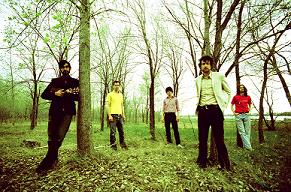
 View originalThe High Dials are a band built on sounds laced with watermelon sugar and the later pop grooves of the Beatles and The Zombies. In between the sunshine strums they grind in just enough dirt and spit to channel the grittier moments of the Who with a dollop of the bluesy moments of the Kinks. The last time the High Dials came through town was in September supporting the Brian Jonestown Massacre (click here to read Kevin's review). They return Wednesday, Nov. 9 sans the eccentricities of BJM frontman Anton Newcombe for a headlining slot at Cafe Montmarte. They will be joined by Madison's Tangy. Dane101 had the opportunity to interview frontman Trevor Anderson (a nod to Ariel for helping make this interview happen).
Dane101: You were just in Madison opening for the Brian Jonestown Massacre, what brings you back so soon?
TA: Well, we haven't toured western Canada for this record yet and Madison seems like a great place to stop on the way out west, especially since the BJM show in September went really well. The crowd that night was great and so we're looking forward to this gig a lot.
Dane101: That was an interesting show as Anton Newcombe, who is notorious for his eccentricities, launched into a 35 minute droning jam about five songs in. What was it like sharing the road with them?
TA: Anton has always been a big supporter of our band and we are fans of BJM too so it was amazing to tour together. I love the unpredictability of their sets. I like the chaos that sometimes takes shape. Anton is an infamous character for sure, but he has always been a friend and gentleman to us. He introduced me to some great things-like vodka and grapefruit (greyhounds), Sikh devotional music and Scott Walker. It is always interesting hanging with that man.
Dane101: You cracked number one on the Canadian college music charts - are you making a conscious effort to embrace a college audience in the states?
TA: We would like to have a presence there obviously, but we haven't had the resources to really push the record that way. We get a lot of play from some of the influential stations like WOXY in Cincinnati and KEXP in Seattle though, and just kind of hope that interest will spread that way.
Dane101: What was your vision going into War of the Wakening Phantoms? Do you think the album accurately reflects that original vision?
TA: There wasn't really a plan at first. I just started meeting up with our drummer in our rehearsal space to demo some of the more acoustic stuff I had written, building up the recording in layers from just me and my guitar. Then suddenly the process became pretty exciting. We had never been in control of recording that way, never been in a non-studio setting where there was no time pressure and we could record whatever the hell we wanted. We got really adventurous and the successes made us more and more confident creatively. By the time we decided to go to a real studio later that year, we already had about half of the record done on our laptop and were just looking to enhance that with some stuff we had already mapped out in demo form.
I guess I wanted the album to be a moody piece. It's a lovesick record, there's no hiding that. The next one may be too. I guess the theme and feel I was going for was the end of things- the end of love, the end of the world and the end of the known world as it appears at the edge of the sea, or sky. I felt like I had just left a familiar world and was heading into very unknown, mysterious places.
This clash of the known and unkown world felt like an epic battle, a supernatural struggle and hence the CD title "War of the Wakening Phantoms."
Dane101: I was told that while touring for your previous album the band basically fell in love with the West Coast and that it was strong in your mind when you sat down to write "Phantoms." How is the west coast influence manifested in this album?
TA: Hmm, that's an interesting idea. We definitely felt very welcomed by some of the bands on the west coast. There is a lot of talk about the Montreal music scene right now, but over the last couple of years we spent a lot of time out West and took some inspiration from the idealistic and experimental attitude of bands like Brian Jonestown
Massacre and the family of bands that have some affiliation with them. And I like the dark side to the sunny California most people know, there is a darkness in the psychedelia of bands like the Doors and Love that Anton also draws upon. That tradition is in our music for sure. I know "Master of the Clouds" was written in and about California while on tour. But it was a different coastline I had in mind when writing most of the songs on the new album. A cold, stormy and isolated place. I had done a lot of traveling in Ireland and Scotland and those travels still affect me deeply and that comes through in our music a lot more than the American West.
Dane101: Since starting your current tour, have you discovered any other landscapes that have impacted your art?
TA: I'm always writing while we're traveling in the van and the landscape is bound to be a big influence. The desert in California, Nevada, Utah, and Arizona has inspired some stuff. And I love American cities. They create this beautiful, frightening contrast. There's an ancient world that's dormant in them. Modern America is really just this thin veneer that's been painted over something very old and powerful. The river in Chicago is one example. It still winds along its centuries-old path oblivious to all the skyscrapers around it. And there are still fish in it, I've seen them! I love Detroit too; there is so much crumbling history there. It's a very gothic American city. For most of the last three years I have been living out of a bag, literally. I used to live a very settled life and I wrote about feeling stifled, trapped. Now I feel dislocated. I've lost my home, I'm wandering. So all the places I've seen are going to come through in the music definitely, as real settings or images that represent other things.
Dane101: The sitar is a sorely underused instrument in western music, I'm curious if Rishi has always played the sitar or if it is something he chose to learn for the High Dials? Why was it important to include the sitar and what do you think it adds to the music?
TA: It's unfortunate that the sitar is associated so strongly with the 60s for most people, those who know about it at all. I guess George Harrison and Brian Jones and the hippies in general kind of introduced it to pop culture back then and it has not been used much since, except in awful stuff like the Tea Party or Ricky Martin's new song. It's importance to our band has grown over the last couple of years.
Although we only really use it on one song, that song is important. Rishi plays sitar outside the band and began lessons before it really became a part of our music. He's of Indian heritage so I guess the interest began there.
Sitar works so well with electric guitars, I'm surprised it's so under-used. The drone and bright textures blend naturally with rock and roll. I remember my first sitar revelation. We were sitting in some guys house in Toronto and Rishi had just come back from little
India and put this tape on he had just bought. The music slowly worked itself up to this tremendous climax, it was thrilling. It felt at the time like a golden thunderstorm, that's what I remember. I remember being shocked at how much emotion could be expressed in it. I had never heard a sitar sound so raw and exciting. We would like to use it more than we do.
Dane101: The High Dials evolved out of the Datsons. That band was heavily associated with the "mod" scene. Do you feel the High Dials have been able to shake off that stereotype?
TA: Yeah, definitely. We have beards. Mods rule though. They have impeccable taste in music. The best of them are open-minded. The worst are like Nazi historians.
Dane101: I understand Little Steven of the E Street band chose your name and has been a huge supporter by featuring the High Dials on his radio show. Where did he come up with the name (a google search reveals it as the name of an obscure kitchen scale)?
TA: Actually we came up with the name. We just needed a celebrity to endorse it. We had been feeling really insecure about choosing a new name but he dug that one and that made it easier to accept. Little Steven has been a great friend to the band, plays us a lot. And we get to go backstage at Springsteen concerts. Yeah!
[i]photo by Mila Aung-Thwin[/i].