




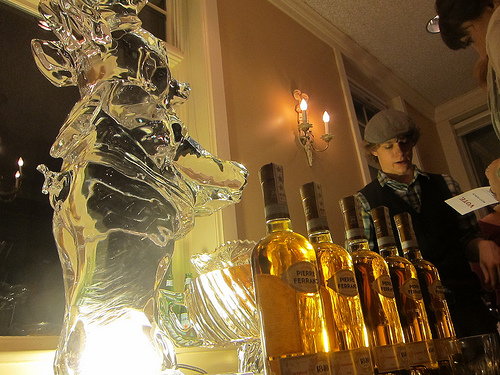
A number of promising new spots from 2010 came into their own this year, and some old standbys stepped up their game to make 2011 a very fine year for craft cocktails indeed. Here are this year’s top trends in distilled diversions:
1. The rise of local distilleries.
It was only a matter of time until the do-it-yourself Wisconsin spirit that gives us killer local beer and cheese began to give us great liquor. From there, it was only a matter of time until the rest of the country caught on.
For starters, there’s Death’s Door, whose gin is quickly becoming the Spotted Cow of spirits—accessible, affordable, and everywhere. Ordering a Death’s Door martini in Madison has become more likely to elicit a nonchalant “vodka or gin?” than a confused “death what?”—which would have been a much more common response two years ago. Death’s Door’s white-dog whiskey is also catching on—I’ve seen it on menus as far away as San Francisco. Add in the success of Old Sugar Distillery, which got a nod in the New York Times this year for its beautiful space and habit-forming Honey Cap, and you’ve got a number of rising Wisco stars in the national spirits scene.
At home: Because of its relatively neutral character, Death’s Door gin makes an excellent dirty martini. Add judicious dashes of olive brine and vermouth to a shaker with as much gin as you’d like; gently shake, strain, and serve with olives as a garnish. Use Niçoise olives and French vermouth for a Gallic variant.
2. The death (and subsequent resurrection) of the Mojito.
They go down easy, look pretty, and generally taste like a Ricky Martin song with a straw. But for whatever reason (my money’s on the proliferation of derivatives like “mojito” gum) the Mojito bubble has undergone a familiar burst since its heady heyday in 2006. Not that Mojitos can’t easily be found, they just aren’t as cool as they used to be. Kinda like Ricky Martin, actually.
Undeterred, Madison bars have stepped up to the challenge of finding herb-infused replacements. Drinks like the rosemary-infused Regret from Merchant—one of my favorite cocktails of the year—and the basil-powered mojito from jacs play off of the familiar herbs/lime/booze formula, but with a surprising and often satisfying twist.
At home: rosemary simple syrup is easy to make and rather versatile. Take several sprigs of fresh rosemary and heat in a saucepan with equal parts sugar and water until the sugar fully dissolves, the mixture turns green, and your kitchen smells wonderful. Use it as a substitute for simple syrup in Margaritas, Lemon Drops, or Tom Collinses.
3. Rye
Since absinthe’s re-legalization in 2007, America has rediscovered the Sazerac, and it seems that was all it took to rediscover rye. And no wonder. Rye’s quality is much more reliable at low price points than other whiskeys, and it’s more neutral and hence better suited for mixing than your typical vanilla-and-caramel-driven bourbon.
Rye’s been all over the place, so it’s tough to pick out leaders in this category, but Nostrano has reliably produced exceptional rye drinks, including its current offering, the spectacularly complex Pear Necessity. The Necessity carefully balances rye, pear, apple, and chocolate flavors without ever becoming insipid—a remarkable feat. For a classic, check out Nattspil’s Sazerac, which hits the right licorice notes without overpowering the rest of the drink.
At home: Rye makes a great Manhattan. Some would say it’s the only way to make a true Manhattan, but those are the same folks who still reject vodka in martinis. I checked out Jim Beam (look for the yellow label) on the recommendation of a Nostrano bartender—and it turns out the reputation of Beam’s bourbon belies the value of their rye, which is hardly crap at all. Add a healthy dash of orange bitters and an even healthier dash of sweet vermouth, stir with ice, strain, and serve up with a maraschino cherry and/or orange peel.
4. Barrel-aged Negronis and Manhattans
Let me tell you a story. I was sitting in Aviary, the Chicago molecular mixology funhouse, and looking at a menu with a flight of barrel-aged martinis on it. When I inquired with the waiter, she replied with pride that as far as the Aviary staff were aware, they were on the cutting edge of barrel aging cocktails. “Ha!,” I thought. “They haven’t been to Madison.”
…Because barrel-aged cocktails have flown off the shelves here. Osteria Papavero, Sardine, Nostrano, and jacs all served barrel-aged cocktails this year. The miniature bourbon barrels meld and develop flavors, turning standbys into something special. Most are limited runs, so check them out while they’re still on menus.
At home: If you’ve never had a Negroni, you’re missing out. Combine equal parts Campari, sweet vermouth, and gin; serve up or on the rocks with—this is important—an orange peel. Some garnishes can be left out in a pinch, but Negronis suffer without their zesty companion. If you want to age a few, you can find 3L bourbon barrels for about $100 on Amazon. They last for several batches.
5. Fat-infused booze
I know, it sounds gross. But there’s a lot of flavor to be had from the butters, oils, and lards of the world, and where there is flavor, there are opportunities.
43 North led the local charge on this one with their aptly named Madman, a combination of bacon-infused scotch and maple syrup. Also in the offing were batches from Bittercube, the Milwaukee-based bitters brewers who stepped up to the Slow Pig cocktail event with their own bacon whiskey. I hear they’ve also done brown-butter pumpkin drinks, which sound delightful.
At home: Next time you make bacon, do some experimenting. Add 2/3 cup liquid fat to a bottle of liquor, let sit in the fridge overnight, and strain off the now-solid fat in the morning. Then make a Bloody Mary.
6. Punch
Someone—a number of people, actually—figured out in 2011 that anything called punch is bound to feel like fun. Maybe it’s the Mad-Men-fueled retro feel of a fancy glass bowl, maybe it’s just the cheap buzz, but punch isn’t just for coffee hour anymore.
The once and future Underground Kitchen had one of the better punches in town, and continues periodically to mix up new ones in pop-up bars throughout the city. Fifteen bucks for a carafe bought you an inventive, complex several cups of cocktail. Graze also serves fantastic punches, and they often serve two—one hot, one cold—which is most excellent for wintertime.
At home: Beer punch is different, delicious, and great for parties. In a pitcher, combine a can of frozen lemonade concentrate with a bottle of relatively neutral beer (the Spotted Cows and Island Wheats of the world work well), quite a lot of gin and vodka (proportions equal or to taste—this one’s hard to mess up), and top off with lots of ice and two cans of San Pellegrino or Orangina. Stir well until concentrate dissolves.
7. Food ‘n’ booze pairings
Sure, wine pairings are great, but cocktails aren’t just for before and after dinner. As mixologists gingerly lift the chip about being taken seriously by the gastronomic community off of their shoulder, part of that process of legitimization has been learning to love the munchies.
Slow Pig was a super example of food and cocktails together, with a punch competition that accompanied the titular pig. I hear it was great if you could afford that $100 price tag. Sniffle. The Underground Food Collective folks also did cocktails and pork, serving barbeque with five different quinine quaffables to a standing-room-only crowd at the Corral Room. Cocktails have also shown up in tasting menus, such as at the fantastic all-veg collaboration between 43 North and Osteria Papavero this summer.
At home: like champagne, a good champagne cocktail goes with just about everything. For a classic French 75, mix a dash of simple syrup with the juice of half a lemon and a shot of gin in the bottom of a flute. Add your favorite inexpensive sparkling wine, such as Cava or Prosecco.
8. Amaro
Is it just me, or can Cynar do no wrong? It’s one of a family of bitter, vegetal liqueurs from Italy that totally took off this year—you may be more familiar with its cousins Luxardo and Fernet. It’s delicious in just about everything, and a brand-new taste to many.
Osteria Papavero has too many Amaro-based cocktails to name here, but suffice it to say that you can spend many evenings there figuring out everything there is to know about Amaro and its many applications. Scotch lovers should check out the Chiodo Fisso, but my favorite is the Venere Rosso, a happy blend of gin, Aperol, St. Germain, and lemon. Merchant, too, knows its Amari, and you can pick up a bottle or two while you’re there.
At home: Like I said, Cynar is hard to misuse. Try combining two parts tequila with one part Cynar in a glass with ice, and topping off with grapefruit soda. The beauty of Amari is that you get complexity for free; it’s just a question of finding something to up the ABV and level off the bitterness.
9. Dance music at cocktail bars.
So, cocktails have alcohol in them. When people have alcohol in them, they like to listen to loud music and start dancing.
Graze rang in the New Year with some tunes spun by L’étoile chef Tori Miller, but the grand experiment of 2011 has been Merchant’s after-ten DJ-and-dance-floor setup, where the posh speakeasy morphs into a clubby bar. Love it or hate it, they usually get a scene going by eleven or midnight, giving way to incongruities like sipping a prohibition-era Aviator while grinding to Radiohead’s “Lotus Flower.” Of course, it would be remiss not to mention that Nattspil has featured DJs after 10 p.m. since before it was cool…hipsters.
At home: It doesn’t quite feel like a dance party without shots. On the other hand, bar shooters rely on lots of sugar and fake flavorings, which are both gross and an express train to a terrible morning. The Kamikaze, however, scales very nicely with better ingredients: fill a shaker with two parts of your favorite vodka and one part of your favorite orange liqueur. Squeeze in half a lime for every two people, shake, and serve into two-ounce glasses. Shoot or sip.
10. Flips
2011 was the year we all got over our collective fear of egg whites in non-nog. You’re shaking your cocktail anyway; why not make a light meringue out of some of that kinetic energy? Plus, cocktails shaken with whites have such a cute name: flips.
Nostrano served flips out of the gate when it set up shop in late 2010, and has continued to whip its drinks into a froth ever since. Check out their current Crispin Glover offering, which is an intensely apple combination of cider and calvados flipped with maple. jacs will make you the cleverly named Wisco Sour, which substitutes Korbel brandy into the Peruvian classic Pisco Sour.
At home: You can flip anything, but start with the classic. Make a lemon drop (3 oz. vodka, juice of half a lemon, simple syrup to taste), then convert it to a lemon flip by adding half an egg white to the shaker. Before you add ice, give it a good long shake. Then add ice, repeat, and strain—through an actual strainer, not the top of your shaker—into a martini glass. If you’re feeling really fancy, give the top a once-over with a culinary torch to lightly brown it.
So that’s been 2011, from fat to flip. What to look for in 2012? More molecular mixology (liquid nitrogen is fun!), shrubs (hint: they aren’t for the knights who say “ni.”), and bitters, bitters, bitters—but those are all another post. For now, a toast to the New Year, and here’s to some happy drinking along the way!