




This post originally appeared at Sustainable Nano, a collaborative blog featuring scientists from Wisconsin, Minnesota, Illinois, and Washington. Rebecca Klaper is a professor at the School of Freshwater Sciences at UW-Milwaukee.
“Behold, I have given you every plant yielding seed that is on the face of all the earth, and every tree with seed in its fruit. You shall have them for food.” —Genesis 1:29
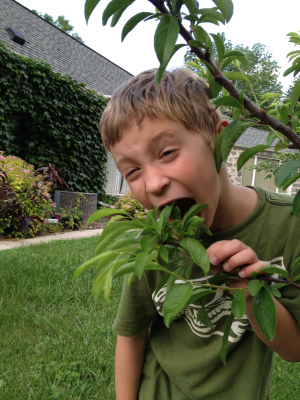
Can you imagine going outside when you are hungry and munching on a handful of leaves from any tree or plant? In reality we don’t just pick up any plant outside and place it on our dinner plate. But why?
There are a good variety of tasty things that do grow all around us. We do not eat everything because some of those plants produce chemicals that can harm us if we eat or even touch them. One would not go and grab poison ivy as the chemicals it produces, known as urushiols, would cause a tremendous allergic reaction. As a more drastic example– the manchineel tree or manzanilla de la muerte (little apple of death) is one of the most poisonous fruit trees on earth to humans. Even the sap contains chemicals that cause skin burns and lesions in the digestive tract if eaten.
On store shelves now you will often find products that are labeled “all-natural” or “chemical-free." However, no physical object on earth is chemical free, and what these manufacturers are really using are some of these plant-based chemicals in their products. They are no less of a chemical than non-plant-based chemicals, and as you can see from the example above, the compounds from the manchineel are all-natural but can be very poisonous. These all-natural chemicals may be derived from a plant. However, they are not “chemical-free," they are just manufactured by a chemical reaction in a living green plant rather than a chemical reaction in a beaker. Products labeled as “all-natural” may even contain chemicals normally found in nature but that are instead produced in a factory. Those factory-made chemicals are atom-for-atom exactly the same as their green plant-made counterparts.
You can read the rest of this post at Sustainable Nano.
Image copyright Rebecca Kleper, 2013.