



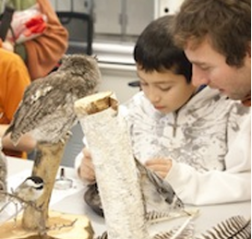
Hold on to your hats, science nerds. Today marks the start of the second annual Wisconsin Science Festival, and the program list is packed with things to do, see, feel, smell and taste--members of the public, of all ages and walks of life, are invited to absorb more than a hundred different workshops, lectures, and exploration stations, from the chemistry and politics of coffee, to the interplay between science and art--how do scientists help artists, and what does creativity have to do with science?
It’s also the kickoff of UW-Madison’s Year of Innovation, celebrating new ideas, environments that foster them, and the impacts they have. RadioLab is in town Sunday, as is famed TED speaker Sir Ken Robinson, and every museum on campus wants you to come visit.
On top of that, with satellite events in museums in Eau Claire, Milwaukee, Eagle River, Fond du Lac, Appleton, and several others, it’ll be a truly statewide event.
So what’s a poor nerd to go see, besides every single thing on the impressive schedule? Here are some suggestions.
The basics:
The festival runs Thursday through Sunday. All events are free, though there may be some fees for materials at some stations. Most events will be held at the Wisconsin Institutes for Discovery (parking information), but be sure to check before coming, as some events will be elsewhere on campus or in the city.
In addition to lectures and one-time events (see highlights below), a variety of exhibits and exploration stations will run 9 - 2 on Thursday and Friday, or 10 - 2 on Saturday, where visitors of all ages can extract DNA from plants, feed stem cells, learn the inner workings of solar power and the wonders of the fibonacci sequence, among others. Visitors are welcome at any time during those hours, and are free to explore at their own pace. For campus museums, the geology museum and the Washburn Observatory are well-known, but there’s also a physics museum, an herbarium, and many more.
Thursday event highlights:
1 p.m.: Splendor in the Math: A comedy dramatization of mathematical concepts, starring imaginary numbers and quantum physics, but still suitable for all ages. Designed to overcome your fear of math. Wisconsin Institutes for Discovery
6 - 8:30 p.m.: American English is Alive and Well: For language geeks, an exploration of the Dictionary of American Regional English, its development, and interesting findings. Pinney Library.
7 p.m.: No Mistakes, Only Opportunities: Neuroscience, Jazz, and the Science and Art of Recovery. UW neuroscience star Richard Davidson and jazz pianist Ben Sidran present some of the unexpected connections between music and neuroscience, including some new twists. Wisconsin Institutes for Discovery.
Friday event highlights:
10:30 a.m.: The Science of Homing Pigeons. Meet the homing pigeons that live on the rooftop of the Madison Children’s Museum, and see a demonstration of their flight back home (weather permitting). UW-Madison Botanical Garden.
3:45 - 5 p.m.: The Art and Science Synergy: How science influences and enables art, and where those synergies are at play at UW-Madison. Panel discussion with professors in a variety of arts-related disciplines. Wisconsin Institutes for Discovery.
4 p.m.: Beer: Civilization and Science: The basics of brewing, plus a look at how it’s changed history. Wisconsin Institutes for Discovery.
4 p.m.: Metaphors and Molecules: Poets on Science and the Natural World: Five local poets read from works that touch on atoms, eelgrass, senescence and more. Wisconsin Institutes for Discovery.
5:30 p.m.: Hybrid Cinema Presents Mad Scientists, Inc: A clip-filled discussion of the concept of the “evil institute” in films such as Ghost Busters, Terminator 2, Metropolis, and others, where scientists are portrayed as sinister and amoral. Where is the boundary between scientific suppression and healthy morality, and how does this play out in real institutions? Wisconsin Institutes for Discovery. (Followed by a screening (7 p.m.) of Carre Blanc at 4070 Vilas Hall.)
7:30 p.m.: Science and Storytelling: Sean Carroll, science writer and educator, on the role of narrative, particularly in film, in communicating science to audiences. Wisconsin Institutes for Discovery.
8 - 10:30 p.m. PULSE: Intersection of Dance and Science: Featuring actual dancing scientists demonstrating scientific concepts in a choreographed performance. Lathrop Hall, Margaret H’Doubler Performance Space.
Saturday event highlights:
11 a.m.: Archaeological Discoveries and Enduring Mysteries at Troy. What have we learned and what is still unknown about the famed ancient city, which saw nearly 4,500 years of uninterrupted settlement and could have valuable information about the development of civilization in Europe and the near East? Professor William Aylward, who has spent extensive time at the site, explains. Wisconsin Institutes for Discovery.
2 p.m.: Encounters: Scientists set loose in the Chazen Museum of Art will be asked to select one piece of particular significance to them, as a means of discussing where art and science intersect in their value of representing forms and ideas. Each scientist will give a short talk, and audience members will also be able to ask questions. Chazen Museum of Art.
4:30 - 6 p.m.: Science Cafe with NOVA: What a Winter...Summer...Can We Expect More Years Like 2012? NOVA hosts and UW-Madison climate scientists explore this year’s whether and what we might expect in future years based on current climate science. Wisconsin Institutes for Discovery.
8 p.m.: Old Time Radio Drama: 20,000 Leagues Under the Sea. A real-live radio dramatization of the science fiction classic. Seats are limited, but the show will be broadcast live on Wisconsin Public Radio. Wisconsin Institutes for Discovery.
Sunday event highlights:
12:00 p.m.: Sir Ken Robinson, featured speaker: A prestigious speaker in the itself prestigious TED Talks series, Robinson thinks we should rethink “outdated” assumptions about creativity and intelligence to unleash the real potential of people and organizations, including but not limited to the education system. Wisconsin Institutes for Discovery.
2:30 p.m.: Splendour in the Math: 1 p.m.: Splendor in the Math: A comedy dramatization of mathematical concepts, starring imaginary numbers and quantum physics, but still suitable for all ages. Designed to overcome your fear of math. Wisconsin Institutes for Discovery.
8 p.m.: Radiolab: Live in the Dark: The hosts of public radio’s Radiolab explore science in the dark with dancers, music, stories, and demonstrations. More information and tickets (most price levels sold out) at the Overture Center site. Overture Center.