



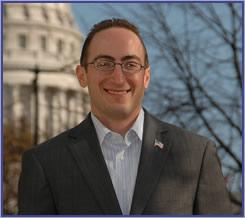
Congressional District 2 candidate Matthew Silverman will be the first to admit his campaign is taking risks. However, he argues, his stance on campaign financing and recall elections is vital to “lead by example” in a broken political system.
In an interview with dane101 Silverman outlined his campaign and candidacy in the highly contested race for Rep. Tammy Baldwin’s (D-Madison) soon-to-be-vacated seat in Congress.
“This year we have an opportunity to change the way we practice politics in our country,” Silverman said.
A University of Wisconsin law school graduate and Iraq war veteran, Silverman spent the time leading up to his candidacy working in a private law firm. However, he said the history of public service in his family was important to him, which is why he was drawn to the District 2 seat.
“Whether you’re on the left or the right, we’re sending the wrong type of people to Washington. To change that, we need something different. We need real leadership. I learned about leadership in the army,” he said.
Silverman said he recognizes he would work for everyone in the district—from Democrat to Republican and everything in-between. He said his service in the military, during which time he spent 15 months in Iraq, gives him the leadership tools necessary to be the next representative. He said the lessons he learned working with troops, both American and Iraqi, toward a common goal make him ready to govern.
Silverman has big ideas for Congress and he said he intends on furthering them by example. Three things must change, he said: Elected officials must be held to a higher standard, democracy must include proper representation and compromise, and politicians need to “get the money out of politics.”
Silverman is committed to keeping the money out of politics, and he said this practice is an integral part of his campaign. He will not be accepting donations from any organizations, only from “living, breathing people.”
“I don’t believe corporations are people, but neither are unions or church groups or the Girl Scouts. Not that the Girl Scouts are knocking on my door to give me money, but if they did I would politely say ‘No, thank you,’” Silverman explained.
He said this is beyond a personal ideology. In the places he has campaigned, he said “100 percent” of the people he has spoken with want less money in politics. He said District 2 is the prime place in Wisconsin to actively work for this. He admits he is taking a risk, “but it’s absolutely what people in Wisconsin want.”
“The only way to get money out of politics is to simply do it,” he said. “If you win the election using the old rules, you’re not likely to rewrite those rules.”
Campaign finance rules are changed by election winners, Silverman said, and getting elected to Congress on a “shoestring budget” will be the first step to progress. He acknowledged his status as a junior member of Congress if elected would mean that progress could come slowly.
On the campaign trail, Silverman said he prefers face-to-face encounters over any other form of outreach. With proper representation as one of his main goals if elected, he said it is important for him to actually go and meet the people in District 2 so he could better represent them.
Preserving Social Security and other social programs are at the top of Silverman’s priorities, too. He said those funds and services going to the citizens who need them is important for the state, and those will be the services that take the biggest cuts due to the country’s “spending problem.” People currently under 50 years old today can expect a significant decrease in social security benefits if the trends in spending continue, he said.
“Programs going back to FDR are at risk if we don’t change our ways,” he said.
Preserving those programs, he said, will take compromise—compromise he pledged to work for if elected. He would support “every meaningful reform” to make sure Social Security remained intact, as the status quo is “unacceptable.” He admitted this might mean not getting everything he would want.
It seems the primary for District 2 is already saturated with Democrats, however, Silverman said there are key values that separate him from the pack.
Silverman freely admits he did not sign a petition to recall Gov. Scott Walker and he said his work as a law student and member of the Army Reserve kept him from being active in the Capitol protests. While he said he believes Walker has hurt the state of Wisconsin, he also said he fundamentally disagreed with the idea of a recall as a way to initiate change.
Though he did acknowledge the power the recall effort has had to politically mobilize formerly uninterested citizens, he said Walker has polarized the state, and the recall is not healing that divide.
“I understand that this will likely hurt me. I easily could’ve signed it. But I felt like I didn’t agree with it on principle,” he said.
While Silverman believes in the importance of Social Security, one aspect of his campaign may be “scary” to the people of District 2—he won’t make promises on what to do if elected because of the value he puts on political compromise in a functioning democracy.
“These promises get in the way of government,” he said. “I think it’s important to understand how I will approach the job.”
Silverman said he has seen two democracies “up close”—the one in the U.S. and Iraq’s government, which he said is failing. In order to succeed in a democracy, one has to know how to effectively operate within it, and he said this does not mean just winning an election.
“You either have to convince a majority of people you’re right or you have to compromise. And winning is great, but when we can’t do that we have to compromise.
"I won’t make specific promises, because every decision needs to be made in the moment. And I can’t tell you what that’ll be ahead of time. I understand that can be scary to people,” he said.