



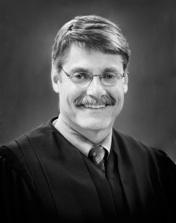
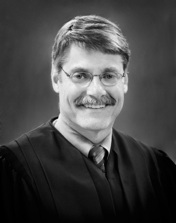
Circuit Court Judge Richard Niess on Monday ruled in favor of a lawsuit brought by the League of Women Voters in Wisconsin, granting a permanent injunction against implementation of the state's new voter ID law.
In an eight-page ruling Niess ruled the law violates the state Constitution and that the Legislature and Governor had exceeded their authority in enacting it.
"By enacting Act 23’s photo ID requirements as a precondition to voting," Niess wrote, "the legislature and governor have exceeded their constitutional authority. To be sure, the Wisconsin Constitution empowers the legislature and governor to enact laws regulating elections, both expressly and by implication. The express authority is found in Article III, Section 2 and is limited to (1) defining residency, (2) providing for registration of electors, (3) providing for absentee voting, (4) excluding from the right of suffrage certain convicted felons and adjudicated incompetents/partially incompetents, and (5) extending the right of suffrage to additional classes of persons, subject to ratification by the electorate at a general election.
"Act 23’s photo ID requirements do not fall within any of these five categories."
Last week Judge David Flanagan ruled on a similar lawsuit brought by the Milwaukee Branch of the NAACP and Voces de la Frontera, granted a temporary injunction against voter ID implementation.
Flanagan currently faces harsh criticism for signing a petition to recall Gov. Scott Walker, who is listed as a defendant on the lawsuit.
Judge Niess was originally appointed to the bench by Gov. Jim Doyle in 2004 and then re-elected twice in Dane County, in 2005 and 2011.
"A government that undermines the very foundation of its existence – the people’s inherent, pre-constitutional right to vote – imperils its legitimacy as a government by the people, for the people, and especially of the people," Niess went on to write in the decision. "It sows the seeds for its own demise as a democratic institution."
In a related case, the U.S. Department of Justice's civil rights division on Monday blocked the state of Texas from enforcing a new rule that would require voters to present photo identification at the polls, arguing that the rule would disproportionately suppress Hispanic voter turnout.
Under the 1965 Voting Rights Act "certain jurisdictions that have a history of suppressing minority voting — like Texas — must show that any proposed change to voting rules would not have a disproportionate effect on minority voters, even if there is no evidence of discriminatory intent. Such 'preclearance' can be granted either by the Justice Department or by a panel of federal judges."
Texas officials argued that the state would take steps that would lessen the impact of the law, including giving free ID cards to those people who did not have them. The Justice Department "said the proposed efforts were not enough, citing the cost of obtaining birth certificates or other documents necessary to get the cards and the bureaucratic difficulties of that process."