



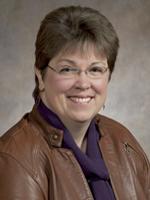

In the tale of two Kathleens vying to replace Governor Scott Walker come the recall election, Sen. Kathleen Vinehout is the lesser known, though her star is rising and she’s fast getting a reputation for straight, folksy talk and a hands-on, grassroots style. She’s also relatively new to politics in comparison, first elected in 2006 into a district that includes Tomah, parts of Eau Claire, and a solid chunk of the Wisconsin-Minnesota border.
Vinehout is a former dairy farmer, a former university professor (she taught health administration for ten years) and, along with her 13 Democratic colleagues in the Senate, left the state for three weeks last spring to slow the progress of the union-stripping Act 10 through the Legislature. She was one of several potential candidates interviewed by union leaders this winter, and on Feb. 8 she put an end to the speculation and officially declared she would run.
Vinehout and I sat down at Michaelangelo’s last Thursday for a talk similar to Emily’s chat with her opponent: why is she running, what are her plans, and can she say more about questions that have surfaced about her commitment to women’s reproductive rights?
First, I asked if she was worried about findings from Public Policy Polling that had been released the day before, where those surveyed had heavily favored her opponent, Kathleen Falk, in a hypothetical match-up of her, Vinehout, and potential contender Doug Lafollette, who filed papers last week.
Vinehout, who says she’d been asked about running since the signature drive began last fall, says at this point she’s not terribly worried. She only officially began ten days before the poll was taken, she says, and when it comes to campaigning, “The horses are just leaving the starting gate.”
She also says she’s not losing sleep over early gains by Kathleen Falk, saying her high-profile endorsements are likely to be both a “blessing and a curse,” for both of them.
“The blessing for her is that she’s gonna have some money. The curse is that there’s a whole lot of people that are mad at her. The blessing for me is that I don’t have the baggage that Walker wants to tie her with. The curse is that I’ve got to raise more money. So right now I would say it’s about even.” Meanwhile, she says, she’s heard from “a whole lot” of teachers and union members who are unhappy with the early move by their unions to endorse.
She acknowledges, though, that her opponents, including potential candidate Tom Barrett, all have a leg up on her when it comes to statewide profile. And she’ll have a lot of work ahead of her to get known to voters before the probably-early-May primary--which can’t even begin in earnest until the Senate finishes its session in the middle of March. But she says she’s on track to catch up, and meanwhile, the whole nature of the recall election and its origins makes the process hard to measure by conventional standards.
“We are living in most unconventional times,” she says. “People are so much more organized and so much more eager than they were in 2010. The majority of people we’re seeing donating right now are people who have never donated before, and they’re donating small dollars. This gives us an opportunity to engage people who haven’t ever been involved in politics before.”
She’s cautious to set too much store in money at this point, though, or whether fundraising alone can mark which candidate will be best to defeat Walker’s millions.
“Wisconsin has a long history of not necessarily voting for the candidate with the most money,” she says, pointing to Russ Feingold’s record, until recently, as an example. “I don’t mind being the candidate who’s known for being on a shoestring budget.”
As for the actual job of governor, she already has a clear plan for what she would do in office, though even if the Senate flips in the recalls this spring, no new legislation can be introduced until January 2013. Although, unlike Falk, she declined to pledge to veto any 2013-2015 budget that does not restore bargaining rights, she’s still dedicated to restoring them with stand-alone legislation--namely SB 233, which is already written and waiting for the Legislature and governor that will pass it.
But even before January she says it will be important to change the narrative of public discourse, to elevate public workers and counter the dialogue of the past year. “We can say here are our difficult problems, one by one, and celebrate the wisdom we have,” she says, pointing to the DNR’s technical expertise in mining and frac sand mining as one example. “When you start to change the discussion from state employees as being the cause of serious issues to being part of the solution, then you lift up what I believe is the majority opinion anyway, that collective bargaining is right and just and part of our society and what we want. It becomes easier to move into the new session, so I would have that whole second half of the year to look at problems, talk about solutions, showcase how state employees are helping to solve problems. And I have many ideas on how they can.
“And then in the new session, when we come in with a new Senate and a new Assembly, we’d pass that bill just as soon as possible,” she says.
She’s also urgently concerned with health care, and the private insurance exchanges that Walker’s administration has already declined the $35 million in federal money to fund. “We’re way behind, and we’re falling behind every day,” she says, when it comes to making affordable health insurance a reality for Wisconsin residents.
“Day one I’m going to be on the phone or with a letter to Katherine Sibelius saying please, have mercy on Wisconsin, give us the money back because we have to do this,” she says. “I know exactly how to get the exchange up and running. The bill has already been written.”
“Some things are harder to fix,” she says. “The good example is all the employees who left state services because they were upset. Are we going to get those people back? No. Does this have a direct impact on how effective state government is? Yes.” She says lifting up the role of workers in the public narrative will be part of fixing that one too, but still, she says, it will take a while to fix.
Education funding, too, will be hard to restore, she says. She doesn’t think it can take less than five years to get public schools back to pre-Walker levels, even using cuts she recommended in an alternative budget she wrote last year to counter Walker’s assertion that his cuts were necessary. “We’re talking about a lot of money we took out of the budget,” she says. But starting with her own budget repair bill that would change the funding formula to focus on lifting up the schools that need the most help while holding the wealthier districts harmless, she thinks it can happen slowly, with “normalcy” resumed by the 2015-17 budget.
And back to health care, which, as someone who has been involved with it since the start of her career, she’s understandably concerned with. She points to the recent audit finding that the Medicaid program can’t account for all its money, and says she wants to take a long, hard look at how the increasing number of state contractors are actually performing, as an alternative to the 65,000-person cut Walker has proposed. That would be another key to finding money for education and other areas that are currently hurting, she says.
In that vein, I asked her what she planned to do about the toxic levels of partisanship in the state Legislature, which she’s had plenty of chances to see firsthand in the Senate, and which any new governor would have to overcome in order to accomplish any of the above--especially if Republicans retain their majority in the Assembly after the fall elections.
Vinehout says that she sees much of that divide originating from the leadership of the Legislature, particularly the brothers Scott and Jeff Fitzgerald who, she says, are “drunk with power.”
“Tyranny breeds rebellion,” she says, and she says not just now-well-known moderate Dale Schultz is reconsidering party line-votes. “Part of the reason why it’s so toxic is that the Republicans have proved they don’t believe in bringing in full participation,” she says, citing the current struggle over the stalled mining legislation. “They will not listen. They will not sit down at the table. They will not work together,” she says. “In order to make peace, you have to talk with your opponents.”
Vinehout says she’s already used to bridging divides. In her first election, in 2006, she won as a relative unknown in a Republican-leaning district. “I won talking about health care, which is actually something that affects everyone,” she says. And she survived the “massacre” of Democrats in the 2010 election, even though Barrett and Russ Feingold both lost her district, which left western Wisconsin mostly Republican.
“But we’re working together to try and deliver for what has to happen for western Wisconsin,” she says. As chair of the Agriculture Committee, she passed on to the floor Republican-originated bills she had the authority to halt. “We have a great example in the raw milk bill. Even after opposition from the dairy industry, we came together, a whole bunch of Republicans and Democrats, and we figured out a compromise that 75 percent of the Assembly voted for. If you’re really committed to working together, you can do it.”
And, sounding pained, she adds, “It doesn’t have to be like it is right now.”
My last question addressed her record on women’s access to contraceptives in the face of pharmacists who might want to refuse them: namely, the amendment she crafted to 2007 SB 232 that would have allowed individual pharmacists to refuse contraception to women, in order to comply with the state constitution’s conscience clause, which is stronger than federal language in protecting people from being compelled to act against their religious beliefs.
SB 232 passed the Senate, but the Assembly never voted to pass it. While the language that eventually passed in the 2009-2011 budget did indeed do this while ensuring the pharmacies themselves are still responsible for filling prescriptions no matter what individual pharmacists feel, the original amendment to SB 232 could have forced women miles down the road to the next pharmacy. In sum, how does she reconcile the language of the amendment, versus the intentions she’s said she had?
Vinehout stands firm that her intent was always to preserve women’s access. Although the amendment’s wording would actually have exempted the pharmacies themselves, Vinehout says the reason for that was end-of-the-session haste: the amendment language was something she had found in another state’s legislation, days before the Senate would adjourn for the spring. “The fact that the Assembly had already gone home should tell you that this was a political bill,” she says. “Which is why when Planned Parenthood made a big deal about this, I said, ‘Come on guys, this isn’t going anywhere, let’s at least get it right and not end up in a lawsuit.’”
“I had to balance the constitution with the woman’s ability to get the prescription without any hassle. It wasn’t the best language. The language we came up with in 2009 was good. You rush things and they don’t get done the way they’re supposed to, on either side.”
When I asked if there was anything she could say to ease the minds of women concerned about her commitment to their freedoms, her answer was the same. “I believe abortion should be safe, legal, and rare,” she says. “It’s the woman’s choice.”
She also says her constituents, many of whom are Democrats who oppose abortion, would say something similar. “I think a lot of people in that part of the state see things differently. They’re from a more conservative background, but they’re very insistent that it needs to be the woman’s choice. They want to see a world in which abortion doesn’t have to happen.
“Look at my voting record, if you want to know how I’m going to vote. There’s a very long list of things I voted on that are for women’s health.”
Specifically, she cites her votes against recent bills that would complicate access to abortion, and promote abstinence-only sex education, as extensions of her platform. “If you really believed abortion should be safe, legal, and rare, don’t you think you should tell kids how pregnancies are caused?” she says. “How stupid.
“That’s why when you say, ‘Where would I begin?’ I would be here for a very, very long time telling you. Every day there’s more.”