



Located in far northwestern Wisconsin, Washburn is a big county with a small population. The county as a whole has a projected population of only 15,911 for the 2010 census. In the 2010 gubernatorial election, Scott Walker won by 600 votes – almost ten percent of the 6,600 votes cast.
It is also a poor county, spread out and very rural. About 20 percent of its population was enrolled in BadgerCare or BadgerCare Plus as of October. The only towns of any size – Shell Lake and Spooner – are mostly stops on the way to bigger cities in other counties.
Small donations, dedicated volunteers
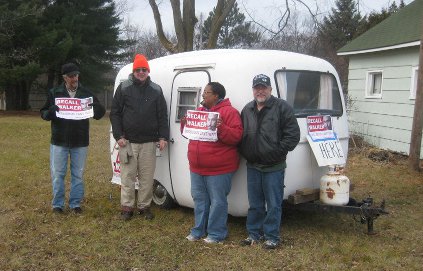
The Recall Scott Walker headquarters for the county is located in Spooner, a town of about 2,600 people, and the largest municipality in the county. It is a small, donated camper parked on a donated portion of a family’s residential lot along the main highway through town.
Volunteers staff the trailer for two two-hour shifts each weekday, and a four-hour shift on Saturdays. They wear orange vests and stand by the fence, near a donated, professionally-made “Sign here” banner. Now that it’s getting dark early, someone else donated old-fashioned floodlights to keep the station visible.
“We lay them in the snow and point them up,” says Sue Hansen, the head of the Washburn County Democrats, and coordinator of the county’s recall effort. “It works pretty well.”
Hansen, the former Washburn County postmaster retired now after 32 years in the service, isn’t taking money from the Democrats because she didn’t want the effort to be about the Democratic Party. As a result, she couldn’t rent an actual office, and the entire effort relies on volunteers and donations.
She says even their radio ad was donated by an individual volunteer, and they’ve had an offer of donated mittens from someone on Facebook.
“It’s just individuals going around and doing things,” she said. “It’s entirely grassroots.
Our volunteers have been standing in about six inches of snow. We had a guy offer to do our plowing, and I had a guy coming up to me today and say, ‘Let him know I’ll pitch in for his gas.’ People are coming from everywhere saying what can I do? A lady with fibromyalgia came and asked what she could do--I just handed her the phone list and said she could make phone calls.”
The volunteer force is smaller than in other counties, too, with about three dozen regular volunteers that staff the signing station in Spooner. Another three dozen or so are spread out across the county, with a “pony express” system of delivering petitions to locations on the way to Spooner.
“So the Minong people might drop theirs off to the person in Trego so no one has to drive all the way to their destination,” Hansen says.
Politics
On a good day, Hansen says, she’s “thrilled” to collect 50 signatures county-wide, and their goal for petition collection is, compared to numbers from more populous counties, modest: Hansen said she's aiming for 3,533, the precise number of votes Walker got from Washburn County in 2010. So far, they're about halfway. "We'll just keep working and see if it happens," Sue says.
Hansen says that, in the meantime, Walker’s union-busting in February energized the progressives of Washburn county. She says in an ordinary year, residents of small towns like Spooner have kept their politics more to themselves, part of the dynamics of small town life.
“People have to get along,” she says. “You’re all in the Lion’s Club together, you all have a goal, you work together toward that goal.” But now, she says, “closet liberals” upset by Walker’s policies have been coming out of the woodwork.
“It’s an interesting phenomenon,” she says. “In February, our Democratic party membership went from 60 to 80, and that’s significant here, when you’re dealing with this population.”
Unions and voter ID
Bob Ademino is one of those volunteers. Ademino, 76, is a retired teacher who was active in the formation of the teacher’s union in Spooner in the 1960s. He says the union worked hard to negotiate—with plenty of give and take—the healthcare and working conditions that the new union rules will likely wipe out. But even more important to him is the voter ID law passed this summer, which he sees as a clear-cut case of voter suppression.
For the record, for people who need valid voter IDs, Washburn County has one DMV office. Located in Spooner, it’s open from 8:45 to 3 p.m., one Wednesday every other month. Most of the time, the nearest open location is the Rice Lake service center, 25 miles from Spooner, which is open seven days a week. The only other nearby service center is in Hayward, and is open three days a month.
“That is definitely going to prevent a number of people from voting,” Ademino says. “I speak to older people, people that are much older than I am, and they are absolutely concerned. They’re up, they’re ambulatory, but they’re surely not rich. This thing is ridiculous.”
“I was around when the 18-year-old vote came to Wisconsin and I was teaching seniors and they were excited and I was excited. To put obstacles in the way of people so they can’t vote just galls me, it makes me angry.”
Cuts for the poor
Sherrie Wiegand, another Washburn County volunteer, has been staffing the Spooner trailer when able. She also takes her petition sheets to restaurants and sets them on the table next to her – other patrons will often approach her and ask to sign. “They come up to me and say ‘Oh, I’ve been meaning to do that,’” she says.
Sherrie Wiegand is a psychiatric social worker in a community program for adults with mental illness and developmental disabilities. She’s a former union member, and a friend of many others – a big reason she’s working for the recall effort. On top of that, Walker’s changes to state medical assistance programs, which her clients rely on, are causing problems for her clients.
Her clients, many of whom have problems with anxiety and limited cell phone minutes, have difficulty navigating the new, private LogistiCare system, which requires its users to call a centralized hotline rather than local transport-providers—many of whom, in communities like Spooner, got to know their patrons well enough to make the process friendly and easy for them, Wiegand says. “I’ve had two of my clients call me up and say they can’t do it, they have anxiety attacks.”
She’s also worried about what other cuts might come in 2012. “Wisconsin to me has just been a working class, union, public employee friendly place for so long,” Wiegand says. “Now the state is just cutting back on so many things for indigent people and people who have no way to increase income because they're disabled and unable to work.”
No typical volunteer
Ademino’s volunteering has included stints at the Spooner trailer, at a petitioning site in Shell Lake, the county seat, and making phone and house calls to pick up signatures from people’s homes. Ademino says that, in Washburn County, the recall effort goes well beyond the elderly or public employees hurt by Walker’s attack on unions. His fellow volunteers at a recent signature event included retired teachers, a stay-at-home-mom, two ordained ministers, a retired state employee, a retired postal worker, a retired craft union employee, two private college professors, and a retired minister’s wife.
“There are young people that are jumping in, younger people stop,” Ademino says. “Yesterday, some guy with a semi pulled over on the shoulder right across the street and wanted to be able to sign. He was out of breath.”
And despite some negativity, he says, the response has been positive.
“We’ve been treated pretty favorably. People drive by, they’ll beep the horn and give you a thumbs up or they’ll give you the middle finger. It’s been mostly thumbs up.”
Hansen agrees that the response has been mostly positive. “Maybe five out of fifty, if that, would be thumbs down – the rest would be thumbs up,” she says.
Back to progressivism
By now, Wiegand says she has personally collected about 50 signatures. And, she says two people who said they voted for Walker have signed her petitions, prompted by his actions to reduce the power of the DNR to protect the environment, collective bargaining changes, and tax breaks he’s given to the rich and corporations. “They said they never thought it would be like this,” Wiegand says.
Hansen says similar stories of Republicans signing petitions keep coming her way, and have made her hopeful. “Every time I see people, I hear a new story,” she says. “Just today I talked to a woman volunteer whose 93-year-old father-in-law, former military, Republican all his life, said, ‘they would never have his vote again.’”
At this point, she says, the challenge will be to reach out to people in more remote parts of the county: training point people who can then establish signing headquarters in their own villages. In addition, they’re sending volunteers to any households they hear of where would-be signers are housebound.
“We have not done door-to-door and we hope we don’t have to.”
As for what good will come of recalling Scott Walker?
“I don’t really know what the new governor could do to undo the mess, but that’s my ultimate hope, that the mess will be undone and we’ll go back to being the progressive state that we were once,” Hansen says. “I don’t expect it to happen overnight but the recall is the first step to getting it done.”