



Today marks Day 100 of the "#wiunion" pro-labor protests and related actions in Wisconsin. Yesterday Dane101 began our series of posts from people who've been involved in those events - reflections, predictions, photos and more. The series will continue through Wednesday.
Story and photos by Catherine Capellaro – Madison, WI
During the fourth week of protests, I traveled to Western Pennsylvania, steel country, for a Catholic high school’s production of “Walmartopia,” the musical that I wrote with my collaborator/husband Andrew Rohn. After the show (which was a delight), the father of a crew member asked me what the world wanted to know: “What’s really going on over there?”
He’d seen footage of unruly mobs, busloads of union folks he figured were following the orders of their bosses. He said he wasn’t a fan of unions, although he readily admitted that they have a place in history. But didn’t they need to do a little belt tightening to help close the budget shortfall?
I did my best, but I felt at a loss to describe the feelings that had welled up in me for those weeks of almost-daily visits to the capitol. I feel differently about my fellow Wisconsinites since we learned to stand shoulder-to-shoulder, look each other in the eye, and show our outrage at the direction our state and our country has taken. Life turned upside down when Walker dropped that bomb, and it hasn’t turned right side up yet.
In contrast to the images of near-rioting mobs, the emotion that first comes to mind when I think of the protests—and I was a little embarrassed to share this with the steely Pennsylvanians—was love. When I’d approach the capitol, by bus, in a car, or on foot, I’d feel love for my fellow Wisconsinites, as I’d fold into a massive (or occasionally smallish) crowd.
Long after the details of the protests are forgotten, after the Democrats regain a Senate majority and recall Walker’s sorry ass, I hope to remember the quirky individuals, who came together by the scores, to make up the largest protests in Wisconsin history.
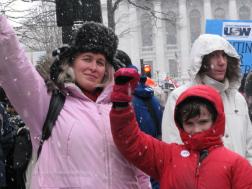
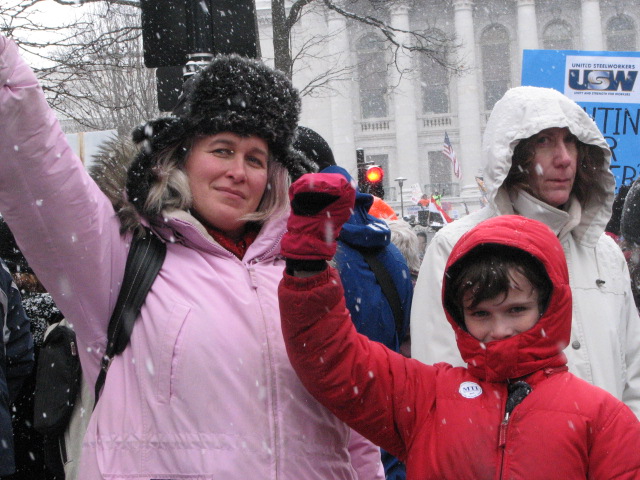
- For example, I’ll never forget the 91-year-old woman in a wheelchair whose sign said “91 Years Old and Still Young Enough to Kick Some Ass. Bend Over, Mr. Walker.”
- Segway Jeremy Ryan, who posts videos on youtube and facebook every day, has been at the capitol every single day, and has been arrested for holding signs or a copy of the Wisconsin Constitution.
- Matthew Schauenberger’s gaunt serious face under a Green Bay Packers hat became a fixture in the rotunda while he wasted away on a hunger strike, and his fiery blog posts never fail to shine a spotlight on the abuses of power in Fitzwalkerstan.
- The “I voted for Walker and I’m sorry” guy was out there rain or shine.
- I loved the giant pile of dung on a wagon.
- The Democrats’ outdoor offices.
- The palm trees that proliferated after Fox News coverage showed a guy in a union shirt shoving a reporter (against a backdrop of palm trees).
- The candy necklace dude.
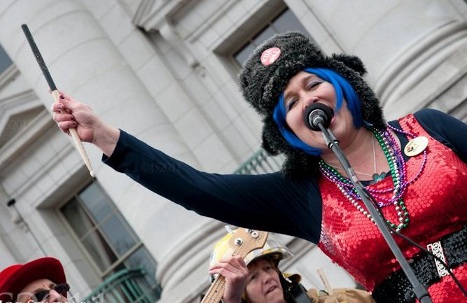 View original
And a couple hundred thousand more. The creativity and passion we brought into the trenches of these protests are the seeds of the cultural and political shift that reverberated across the country. Starting with my first day at the capitol, I felt an energy and connectedness in the crowd that I hadn’t felt in all my years of showing up at rallies in Madison. The crowds have been bigger and more racially and economically diverse than ever seen before. We protest with grandmas and babies, nurses, teachers, firefighters, and small business owners. And I’ll never forget the day the tractors arrived, hulking symbols of heartland fortitude, driven by weatherbeaten farmers, decorated with signs like “Pull together for workers’ rights.”
We’re nice. We chant “thank you” to speakers and even to the cops who guard the capitol doors. This was critical to the family-friendly, inclusive feel of the protests. Middle and high schoolers exited school by the thousands to show their support for their teachers. Within days of the announcement, an entire commune sprang up in the capitol: A quiet family area. Knitters. First aid. Food. Limitless pizza. Union guys handing you bratwurst. Charging stations. Yoga. Drum circle. Massage. Union presidents slept on the marble floor next to sweaty students.
Children wrote post-it notes that covered the imposing capitol doors when we were locked out. They outlined themselves in chalk on the sidewalks and some kids wore “union thug” shirts. The firefighters, though exempted from Walker’s bill, showed up daily, with helmets, drums, and bagpipes. The Cops for Labor and Deputies for Democracy kept coming, reminding us of whose side they’re really on.
I took notes, trying to hold onto these small moments that added up to something that felt earth shattering.
February 27
Last night, I slept on the cold marble floor of the Wisconsin state capitol, right next to the bust of “Fighting Bob” La Follette. I could have sworn he was grinning. I stayed up late into the night observing a town meeting where everyone who wanted to could speak—about the bill or more immediately to the coming crackdown on the capitol sleepover. I went to civil disobedience training, wrote a lawyer’s number on my arm. I drifted to sleep, my eyes wandering to the plethora of signs that covered every square inch of the rotunda. I could still hear the sounds of the town meeting. The drum circle ceased at midnight, after one last sweaty hour of wild rumpus, people banging on empty buckets and pots and pans, saxophone wailing. We skipped in a circle like third graders.
I slept next to a snoring man I’d never met. At dawn, my eyes floated open to the take in the sight of the blue sky streaming through the skylights in the dome, the gorgeous mosaics of “justice” and “legislation.” I’ve spent a fair amount of time in the capitol, but this perspective, lying down, looking up, is brand new. The eerie beauty of Buddhist chant began to fill the space, warming the slumbering crowd. The smell of pizza and feet still lingered: this is what democracy smells like.
That morning, as an impending showdown between sleepover protesters and cops brewed, there were officers everywhere. Young, bleary-eyed cops. Many would change out of their uniforms to march with “Cops for Labor” after their shift.
And then Hanah Jon Taylor, internationally known experimental jazz musician, walked in and wordlessly stood in the center of the rotunda and slowly played the “Star Spangled Banner.” From my ground floor vantage point, I saw three dozen people leaning over the balcony. One young woman in a red Bucky Badger hoodie, blonde and healthy looking, sobbed aloud.
March 1
Mostly, I’ve behaved admirably. But today I was a part of an angry mob, just for a moment, before my better self prevailed. Senator Glenn Grothman, a smug and self-righteous conservative who called the protesters “slobs,” was rounding the corner outside the capitol on the day of Walker’s budget address. We were angry and frustrated at being locked out of the capitol while lobbyists and tea partiers were reportedly being let in through tunnels. The capitol, which had felt so fully mine just days ago, seemed imposing and wicked. A group quickly surrounded and followed Grothman, shouting “Shame” and pointing fingers. (Naturally, several TV cameras captured the incident.) I lost my nerve after about 30 seconds. And cooler heads prevailed. Brett Hulsey tried to calm the crowd and protesters began chanting “Peaceful protest!” But I understood for a moment how pent-up anger and frustration can lead to ugliness.
March 7, 2011 (Day 21)
I drove up to the capitol with a sign reading “Slobs Unite.” We spent a little time looking at an easel with information on Scott Walker’s major contributors. A wizened woman approached and handed me a leaflet. “I’ve been going on the blogs to find out what these Republicans are really up to. Take this home and read it. You should really go on the blogs, too.” The leaflet has a lot of statements in ALL CAPS like “THIS IS NOW OUR TIME TO SAVE OUR COUNTY FROM BECOMING A THIRD WORLD COUNTRY.”
A solitary woman drummed on an upside-down dish tub.
As I entered the building, I emptied my pockets into a plastic bin and step up to be wanded by a security officer. “Thank you for coming out today,” he said. “Thank you for being so great through all of this,” I replied. “Well, we’re all in it together. I just hope it works,” he said, waving me through into the marble hallway.
Inside the rotunda, the folk duo Emma’s Revolution (from Washington, DC) led a cappella sing-alongs. Musical instruments and PAs were banned, but in between songs, people stepped into the rotunda to say why they were there. This had been happening for weeks, on microphones, or in this case, just speaking to a crowd of fifty or a hundred people gathered respectfully around. A firefighter said, “they can’t screw over the working people and get away with it.” His father used to be a Republican “but not any more.” An educational assistant said she works with suicidal teens and will lose her job if Walker’s bill passes, but she will not stop fighting for those kids. A bearded man led us in a chant of “Fox News Lies. Shame on You!” We signed the capitol guestbook. A woman carried a sign saying “302 days until recall.”
Captivated by the voices of the people, this democratic expression of outrage in the purest form, I forgot to look up. When I finally did, I felt a lump well up in my throat: the signs that had proliferated around every inch of the rotunda and columns, had all been taken down. Moveon.org’s 10,000 messages of solidarity, the tidbits of information on income inequality, voting records, education statistics, and a thousand other pieces of a living library, had all been whisked away, some of them to the Smithsonian.
Capitol officials estimated protesters had done $7.5 million worth of damage by taping signs to the marble. Later, they backtracked dramatically from that estimate, admitting that it was handwritten on a sheet of paper.
March 9
I arrived at the capitol after receiving texts and emails that the Republican senators had pulled a fast one and voted on the collective bargaining portion of the budget repair bill. (Our Democratic senators were still in Illinois, avoiding a vote and trying to extend the public debate.)
When I arrived, there were 200-300 people standing in the cold. We screamed and shouted, “Let us in!” Slowly the revolving door moved, letting people in two by two. As people checked their smartphones, word spread that the Senate had violated the open records law and voted 18-1 to eliminate collective bargaining for state workers. The crowd—angry, sad, but still peaceful —pushed toward the door.
Over the next hour or so, 9,000 people entered the capitol. We sang, chanted, shared information from the “outside” and wrote attorney’s numbers on our arms should it come to being carried out. Children napped in the halls. Someone reported that the Dane County Sheriff and the Madison police were refusing to remove anyone from the capitol. At first, people snuck in through windows and doors, then word spread that the doors were open. One hundred pizzas arrived, paid for by people all over the world, including demonstrators on the streets of Cairo. The “people’s mic” was set up in the middle of the rotunda again. The people began to speak and plan for our future.
Paul Soglin, our recently elected mayor and veteran of the anti-war movement, took the mic and said, “People ask me what’s different about this protest from the antiwar movement in the 60s? I say this is bigger, it’s better, and it’s going to have a longer lasting effect.”
People kept coming in. The cops seemed to disappear. The metal detector was covered with pro-democracy signs. The doors were flung open, for the moment, wide open for whoever wanted to enter. “Whose house?” “Our house!” chanted the protesters.
As we stepped outside onto the capitol lawn, we were greeted by dozens of “snowtesters,” snowmen and creatures holding pro-worker signs.
And a chorus of car horns honked the familiar rhythm: “This is what democracy looks like.”
March 30
Yesterday, I took my dad, age 74, survivor of a major brain hemorrhage, to the capitol to sing in the Solidarity Singalong, which happens every day from noon to 1 pm in the Rotunda. I felt his nervousness rise at we approached the metal detectors, installed weeks ago when the battle for capitol access began. Dad, who has aphasia, dutifully emptied his pockets as we shuffled from the sunny outdoors into the gloomy marble hallway.
In the distance, I could see light in the rotunda from the skylights in the dome. Protesters sang “We Shall Overcome,” a song I will never tire of singing.
Amidst the beeps and commotion, Dad became increasingly confused, and turned back toward the doors. As the capitol police officer sent him through the metal detector four times, a lump rose in my throat. Why are they subjecting my dad to this humiliation? When did he become a threat? He used to write speeches for a Republican governor. The officers were perfectly nice, but I felt angry that the administration put them in this position.
We moved into the rotunda, in time to join the chorus of “This Land Is Your Land.”
 View original
April 4
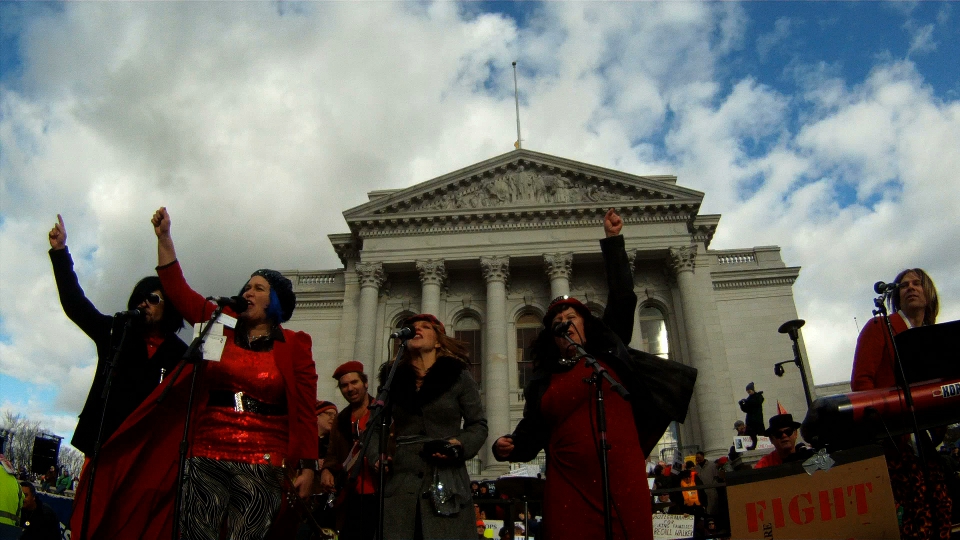
Today we commemorated the assassination of Martin Luther King in Memphis. Our band, VO5, had the privilege to play a warmup set for Michelle Shocked and then got to serve as her backup band. I’m happy as a clam shouting my lungs out singing “Solidarity Forever” with a couple of friends on a street corner, but nothing can equal the feeling of playing for this monumental crowd of people, sad to have lost Dr. King, but proud to be carrying out the dream of a civil rights leader.
When the event began, it was gray and chilly. Enormous clouds rolled quickly overhead, with occasional moments of glory, where the sky parted for a gorgeous sun that lit up the crowd and stage. Michelle Shocked was full-throated in her faith, her music, enthusiasm for our protest.
I stood amidst the Reverend Jesse Jackson, union members, and sanitation workers from the strike where Dr. King was assassinated and we sang “We Shall Overcome.” The sun shimmered onto the swaying crowd.
We played folk and gospel tunes, and then we launched into a reggae song. For a moment, I thought something was wrong, as Michelle turned her back to the audience, and moved to the back of the stage, gesticulating wildly. She was waving the group of firefighter/bagpipers up to the stage to play with us. What happened next will take a lifetime to comprehend. As VO5 continued the groove, and Michelle sang, the bagpipers launched into a song, something so incongruous with the flavor of what we were playing, that at any other time it would be classified as a mistake. But there we were. Here we are. We are Wisconsin. Nothing makes sense any more. This is what democracy looks like.
Catherine Capellaro is a musician and freelance writer in Madison, Wis. She is a vocalist and trumpeter with VO5. Along with her husband, Andrew Rohn, she authored the musical “Walmartopia,” which has been produced 11 times, including a four-month Off Broadway run at the Minetta Lane Theater. She is the former associate editor of the Progressive Media Project in Madison, Wisconsin.