



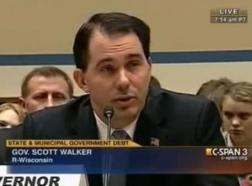
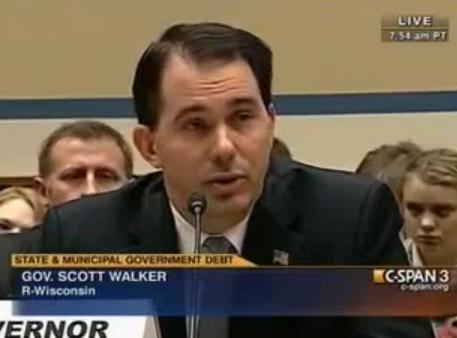
Wisconsin Governor Scott Walker joined Vermont Governor Peter Shumlin in Washington, DC today for the U.S. House of Representatives Committee on Oversight and Government Reform’s April 14 hearing on “State and Municipal Debt: Tough Choices Ahead.” The two Governors were a solid choice for testimony because their state management styles are diametrically opposed. Shumlin has embraced collective bargaining and welcomes opportunities to negotiate with workers via unions. Walker opposes collective bargaining for public sector workers and sees it as an obstacle for municipalities and the state when it comes to balancing the budget. Below are a handful of quotes pulled from Walker's testimony. You can watch the entire hearing on C-SPAN.
[b]How much money does requiring an annual vote for union representation save the state of Wisconsin?[/b]
“That particular part doesn’t save any.”
[b]How much does prohibiting employees from paying union dues from paychecks save the state of Wisconsin?[/b]
“It would save employees up to $1000 per year they could use to pay for pensions and health care contribution.”
“It’s to give workers a right. It’s to give workers the right to choose.”
[b]Are you ready to apologize to the people of Wisconsin for hiring the son of a donor, Brian Deschane, to an administration position when better qualified candidates had also applied?[/b]
“That person was five levels below me. When that hiring was brought to my attention I had my staff go back and have that person taken out of that position and I acknowledge the fact that there are more qualified people and I asked another person be put into that.”
[b]Will you pay a price due to the approach you took? [/b]
“If you’re going to participate in democracy you have to be in the arena. When 14 of my colleagues in the Capitol decided to leave for three weeks it made it very difficult to do that.”
“When I look at what Mitch Daniels did six years ago in Indiana, he did what we’re proposing to do. His numbers were far below mine in the first six months he was in office. He was dealing with some of the same passions, but not as big because he did it through executive order, not through a piece of legislation. Four years later he was reelected with 58 percent of the vote, because in the end people saw the results.”
[b]Did you explicitly single out collective bargaining during your campaign for Governor?[/b]
“No.”
[b]You might concede that some might be surprised then that you made collective bargaining such a centerpiece of your reform efforts after you were sworn in?[/b]
“I’d say no, because for eight years as county executive I not only talked about it I actually did what I called a “reality tour” where I talked about the challenges and that we were unsustainable and that collective bargaining was driving that.”
[b]Were you surprised by the response in your state?[/b]
“Not in my state. For eight years I took on the status quo in a county that’s never elected a Republican before. I was elected with 54, then 57, then 59 percent because I think in times of crisis people aren’t so much concerned about Republican or Democrat, they want leadership. That’s what we’re trying to do at the state level. What did surprise me, candidly, was the level of national attention, the people who came in from Washington and others to be part of that debate.”
W[b]hat did you mean when you said it would be outstanding for the fake David Koch to fly you out to “Cali”? [/b]
“At that point I was done with the call, I had two other people waiting for me, and I was trying to get off the call and get onto the next issue.”
[b]Are teachers paid too much or too little?[/b]
“If we could set up a system where we rewarded based on performance and merit, I’d even be willing to pay more, but we don’t have that system currently, we have one solely based on seniority.”
[b]Do you believe your actions were extreme?[/b]
“No, because I believe fundamentally if what we’ve heard said over and over again was a fundamental right you all in Congress would be acting on it now. You do not have collective bargaining, other than postal service workers, for the vast majority of public employees who work for the federal government for wages and for benefits. If it’s a fundamental right why aren’t you debating it right here and now. It’s a government entitlement. Collective bargaining is important for the private sector, for the examples we’ve heard about the impacts it’s had on families and legacies. Private sector unions are my partners in economic development, I work with them and I hope to work with our public employees. But collective bargaining itself is not a fundamental right, rights come from the Constitution and no where in the Constitution is that clearly defined.”