



Every so often we like to reflect on the way we run our website and see if there's a way we can do things better for our readers and to also move forward the cause of legitimatizing Internet-exclusive media. As we move into 2011 there are two policy changes that we'll be making that we feel achieves both of these goals. Personally, I've been pondering both of these changes for a few months, but two incidents involving Gawker Media and Cracked.com solidified my desire to move them forward. Yesterday I discussed our new increased dedication to better transparency of corrections. Today I'll be addressing changes we're making to our "photo attribution policy."
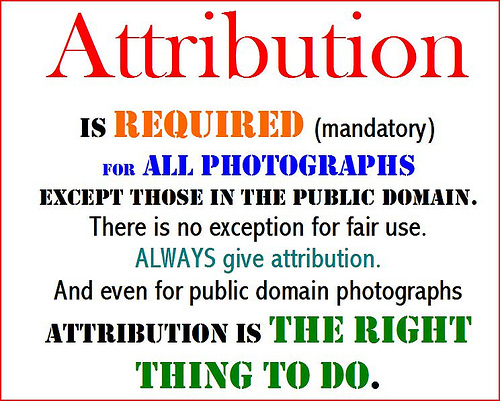
[b]All images will be sourced with a link at the bottom of the article.[/b]
[b]What?[/b] When we use an image, no matter where we find it on the Internet, we will link back to the source of where we found that image.
[b]Why?[/b] Currently, when we need an image we subscribe to a
Creative Commons Attribution-Share Alike policy. Often we search Flickr users who share our ideals for an image that will work with an article. When we find it we give an appropriate link back and on most occasions notify the person directly that we used their image (we're working on turning that "most occasions" into an "all occasions"). We're pretty proud regarding our track record and early adoption of this policy (from day one of this website) - however, we could do better.
We don't always find an image that suits a post in Flickr, so our next step is to go into Google images and search for corresponding art. If a certain image seems prevalent and used often on the Internet, we use it. I guess the justification has always been, "The Internet is the Wild West, so if everyone else is using an image why shouldn't we?"
That isn't the right way to think about the topic and so we reverse course. We regret the error. Our position has, thankfully, evolved and it evolved because the issue of theft became personal.
On April 14, 2009 I took what would become one of the most iconic images of the Tea Party movement. Shortly the image was popping up everywhere. Occasionally attributed, but often not. This isn't the first time one of my photos has left my Flickr account and found itself on a blog or news site unattributed, but it was the first time it happened on such a massive scale. Honestly, the main reason I like attribution is because I like to know where my images go.
When the Huffington Post picked it up and attributed it to someone else, I began my crusade to receive proper credit. Thankfully, with the exception of The Progressive who ignored my friendly emails, in every other case where I've contacted the website using that image they apologized and inserted an attribution.
What finally solidified for me that dane101 needed a new image policy was when Cracked.com used my photo of embroidered schizophrenia in this article without attribution.
Ironically, this was on the very same day they featured an article about eBaum's World that criticized use of unattributed images: "I ran aground in eBaum's World almost entirely by accident. I was hunting for a gun safety video I did over a year ago and I found a version on their site. It was stripped of the original water mark and the picture resolution looked like Vaseline smeared over a screen door. A little extra time poking around revealed that the entire culture of eBaum's World was built on stolen material, an island in the vast expanse of the Internet thriving exclusively on plagiarism."
I read Cracked.com nearly daily and I can't recall ever seeing attribution for a photo. I never really considered that until one of my images popped up on their site. How many other images are stolen?
Of course, unattributed images are one of the main plagues of the Internet - especially for artists, graphic designers, and professional photographers. If you find an image you want to use to accentuate your article's point you could spend an entire day trying to track down the original source. The "easier to ask for forgiveness" mentality sets in because you need to meet your deadline.
I decided we can do better. The frustrating part for me regarding the Cracked.com use of my embroidered schizophrenia photo is that they aren't the first publication or website to use it. In five other cases individuals have asked for permission to attach it to an online article or a print journal. I've granted permission in every case with the only request being they send me a link if applicable and they give proper attribution. In the case of Cracked.com one of their authors found my image on Flickr and ignored the licensing request, or if someone else posted the image on a blog without attribution and Cracked.com took it from that website without knowing from whence it came.
Our new policy comes from that frustration. If dane101 uses an image and we don't know the original source we will at the least always link to where we found the image. Hypothetically, this will allow the original creator of the image the opportunity to start following the trail as to how his or her work first began to spread without attribution.
A good example is the recent post by Chris Walker on the death penalty. I don't know the original source of the image we ended up using, but if you look to the end of the article I noted where I did find the image.
Article image by Timothy K Hamilton and used under Creative Commons licensing.