



The holidays are coming early for astronomy lovers, with the year’s only total eclipse of the moon due to grace the sky on one of the winter’s longest nights.
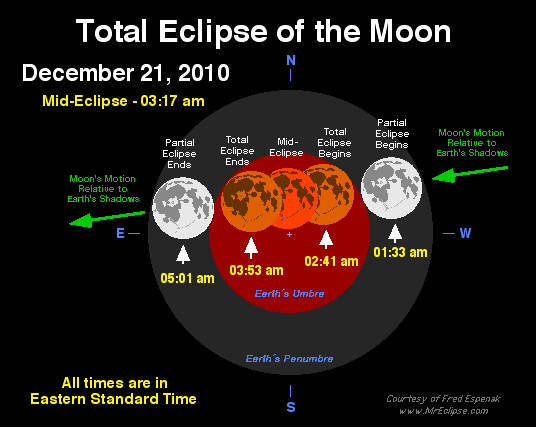
Astronomer Jim Lattis, director of UW-Madison’s outreach “Space Place,” said the faint penumbral eclipse begins at about 11:30 tonight, but the real show will start just after 12:30 a.m. on Tuesday, when the full moon enters the darker umbral shadow of the Earth. That’s when it starts to look like a chunk is missing, or perhaps like something is eating it.
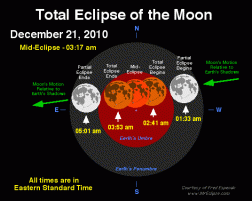
The moon will be fully covered starting at 1:40 a.m. with about 74 minutes of total coverage ending just before 3 a.m. The disk of the moon will never fully disappear, though, retaining a faint reddish glow from light refracted by the Earth’s atmosphere.
Then the process will reverse, as the moon reappears slowly. The total eclipse will end officially at 4:02 a.m., but the moon will remain faintly shadowed by the penumbral shadow until 5:06 a.m., at which point, Lattis says, “this lunar eclipse will be officially and completely over.”
You won’t need any instruments to see the show, but, Lattis says, “The moon in mid-eclipse looks very neat through a telescope or binoculars.”
If it seems like a late night for a Monday, consider this: we’ll only get to see partial eclipses for the next few years. The next total eclipse visible from Wisconsin will be in 2014. The last was in 2008.
UW-Madison will hold an eclipse-watching party at its Space Place Monday night, beginning at midnight and lasting until 5 a.m. Members of the public will be able to view the eclipse through a telescope. The party will be cancelled if its hosts can't see the moon, though, so best call to be sure: (608) 262-4779.
If you prefer a more solitary experience, any place with a good view of the northern sky should do the trick, though the darker your starting point, the more dramatically the night will unfold.
“We’ll go from full moonlight, when only the brightest stars are visible, to deep darkness during totality,” Lattis says. And if your location is dark enough, even the Milky Way will be visible at the eclipse’s height.
Monday is also one of the longest nights of the year, with Tuesday bringing in the winter Solstice. The sun is following its southernmost route for the year, before it begins the slow creep back to our hemisphere. Because the sun and the full moon are always directly opposite each other relative to us, this means the moon is at its northernmost point. “We’ll have much better visibility of it than we would have for a similar eclipse in the summer,” Lattis says.
And while you’re watching, feel free to consider the numerous contributions lunar eclipses have made to modern science, from revealing the Earth’s true shape to ancient Greeks (only a sphere can consistently cast a circular shadow) to convincing the natives of Hispaniola to help Christopher Columbus (for good or for ill).
(Unfortunately for Madison residents, as of Monday morning the National Weather Service was predicting snow and cloudy skies overnight, but don’t let that stop you from getting up in the middle of the night and craning your neck hopefully in search of a break in the clouds. Or at least thinking about eclipses, and how exciting it’s going to be in 2014 when the next total one comes through…As my high school science teacher said in response to the forecast, "Astronomy just breaks your heart.")