



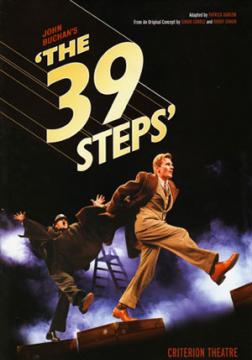
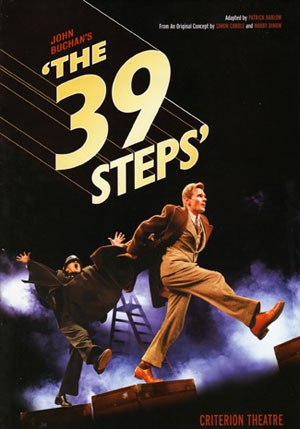
Four actors and a minimalistic set explode into a fast-paced comic adventure at the Overture Center in Alfred Hitchcock’s The 39 Steps. Based on the movie and novel of the same name, this parody spy thriller relies on inventiveness, imagination, and expert pantomime to tell its grand story. In a time when horror translates to torture porn and suspense feels the need to shoe in explosions, can a show that relies on the magic of theater capture the attention of youth?
Lindsay Christians mentored high school theater critics before the show, and they offered their perspectives to us so we might bring them to the public. These perspectives greatly intrigued me. The tenets of Hitchcock’s horror are suspense and surprise, carefully manipulating how and when you reveal information to create tension and excitement. This seems to me to be in direct contrast to the current aesthetic of horror, using excessive gore (see the innumerable Saw movies) or overproduced effects (the unending Final Destination series). Today Jonathan McHugh and William Sullivan share their critiques, but keep an eye out for more at 77 Square courtesy of Lindsay.
The story, faithful to the book and movie, follows Richard Hannay, a disillusioned Brit whose life turns around when a lovely spy is murdered in his flat. Like many of Hitchcock’s everymen he unwittingly is dragged into a conspiracy, and must thwart secret-ferrying spies who are out to kill him. This plot serves as a shell to stuff with precise physical comedy, creative use of props, and a flood of comic characterizations. Hitchcock references abound, including an easy-to-miss appearance by the rotund director himself.
Ted Deasy plays Hannay with confidence, tackling the dialogue with gruff, dry charisma and the physical comedy with lanky grace. Claire Brownell comes from the Broadway show, but with her portrayal of an accented femme fatale and a mistrusting foil for Hannay, she felt like she could have come straight from a Hitchcock film; unfortunately this also means she often is given little to do. However, the true stars of the show are Eric Hissom and Scott Parkinson, deceptively credited as Man #1 and Man #2. This pair plays all but four of the 150 roles the show requires, switching between costumes, accents, and mannerisms in the blink of an eye. Never do they miss a beat and never does a character fail to elicit laughs.
Director Maria Aitken’s creativity knows no bounds, using simple props, fog, and lights to recreate what would be million-dollar actions scenes in cinema. One of my favorite scenes involved a chase on a train, represented only by four trunks on the ground. At first these serve as seats in the train car, with the actors pantomiming entering crowded doorways, but they quickly turn into the roofs of the cars as the actors leap across them in a high-speed chase atop the train. Another scene brings to a life a thrilling plane crash using only light and shadow.
I was pleased to see the student critics were as impressed by this ingenuity as I was. Jonathan writes:
“The show was filled with things, left and right, that were simply a fun relief from many productions nowadays. It was exciting to see the witty ways in which they illustrated so much using such a minimal set. From the mobile door and windy train ride, to the character changes by means of hat-switching, the set’s hilarity could stand on its own.”
A Bernard Hermann-inspired score adds necessary life to the otherwise simple scenes. My only complaint was with the script, which places all the most inventive scenes in the first act, making the second seem slow by comparison.
Timing makes or breaks comedy, and this performance featured the best comedic timing I have ever seen. Deasy and Brownell would complete repeated double and triple-takes in perfect rhythm, while Hissom and Parkinson had many pairs of characters that move exactly in sync or in precise counters. Even the set changes were timed to the second, with items flying in to catch a character mid-stride. More than anything the polished rhythm keeps the show going through every scene.
This expert timing was not lost on our critics. William praises: “The cast all had excellent timing with their lines. While the play was going there wasn’t a second of dead space,” while Jon notes: “Timing was precise (which made it all the better in some scenes) and every action seemed to have purpose in it.”
The 39 Steps presents an incredibly refreshing experience, leaning wholly on talent and imagination, enjoyable by all. William sums it up nicely: “I sat down to this play and was sucked in within the first few seconds. When the curtain dropped at intermission I thought wow that was a short first act. In my mind I thought it could have only been thirty minutes long. I looked at my watch and saw an hour had zoomed by. “
The 39 Steps plays through Sunday, Nov. 15. Tickets run from $15-$50 and can be purchased at overturecenter.com.