



This is part one in a three part series detailing the proposed Edgewater Hotel redevelopment plan and surrounding issues and questions. Part two will run on Tuesday, with part three to follow on Wednesday.
Following several “brutal” encounters with Madison commissions, as described by one city leader, the developers behind a proposed $109 million redevelopment of Madison’s Edgewater Hotel have announced they plan to rethink their controversial design.
Alder Mike Verveer said that he and a half dozen representatives of Capitol Neighborhoods, Inc., a group that has maintained staunch opposition to many aspects of the project, met with Hammes Company President Bob Dunn for two-and-a-half hours Saturday. During that time, Dunn stressed to the group that it was “a new day” for the often contentious relationship between CNI and Hammes, and that he plans to set architects on exploring various options to address the neighborhood group’s concerns.
After months of heated debate, Verveer said “Hammes offering an olive branch in a pretty dramatic way” left him with a newfound sense of optimism about the project.
“It went spectacularly well,” he said immediately following the meeting. “(Dunn) has basically taken a timeout, if you will, and more or less is going back to the drawing board and will be working cooperatively with the neighborhood. It’s a very exciting dialogue.”
Accordingly, Dunn will request that upcoming appearances in front of the Madison Landmarks, Urban Design and Plan Commissions be delayed indefinitely. Verveer said staff at Hammes are already working to produce several alternate designs, and that the groups plan to reconvene later in the week to discuss their options for going forward.
Dunn’s announcement marks the first indication that the development team is willing to compromise on the addition of an 11-story tower that would increase the number of guestrooms at the hotel from 107 to more than 250. Opponents of the project like former CNI President Ledell Zellers have accused the developer of being unresponsive to neighbors’ concerns, and argued that the tower would obstruct views of Lake Mendota, violate a 50-foot zoning restriction on building height and break the character of Madison’s historic Mansion Hill neighborhood.
Along with neighborhood residents Fred Mohs, Eugene Devitt and several others, Zellers said they began the meeting Saturday afternoon by laying out their problems with the tower and other issues they have with the redevelopment plan. Faced with reassurances from Dunn that every option is open for discussion, Zellers said she is eager to see what the company brings to the table in the coming weeks.
“There were some positive aspects of the meeting,” Zellers said. “(Dunn) said that he is committed to finding resolutions to the biggest problems. We’re happy to work with him, and if that’s indeed the case, it would be fantastic.”
Alder Bridget Maniaci, whose district contains the Edgewater Hotel, was unable to make it to the meeting, but was nonetheless cheered by the news. She said Hammes’s initial presentation to the city Urban Design Commission, one of a number of regulatory bodies the company hopes to get approval from, fell somewhat flat.
“I think there’s a lot of design rekindling in order,” Maniaci said. “Now is a really great time to get the neighborhood involved.”
Evolution of the Edgewater
Overlooking Lake Mendota, the Edgewater Hotel was originally built at the corner of Wisconsin Avenue and Langdon Street in 1948, and has played a colorful role in Madison’s history throughout the decades. An addition to the building in 1973 expanded its capacity, added restaurant space and provided access to the waterfront and a rooftop public space that many view as less than optimal today.
In recent years, however, what was once a premiere Madison destination has lost some of its luster. So when Dunn began approaching city officials and business leaders nearly a year ago with an ambitious proposal to acquire the landmark for $5.5 million dollars, and then spend $109 million restoring it and creating a public plaza in its midst, he was quick to gain supporters.
Those supporters have come to include Downtown Madison Incorporated, the Madison Area Chamber of Commerce and Mayor Dave Cieslewicz, who included 16 million dollars in city funding to help the project along in his proposed budgets for 2010 and 2011.
“It’s a big investment in a property that frankly needs it,” Cieslewicz said. “I see increased access to the lake and I see some usable public open space, which I actually think will help bring more owner occupants to the downtown, and I think it does tend to outweigh any negatives of the plan.”
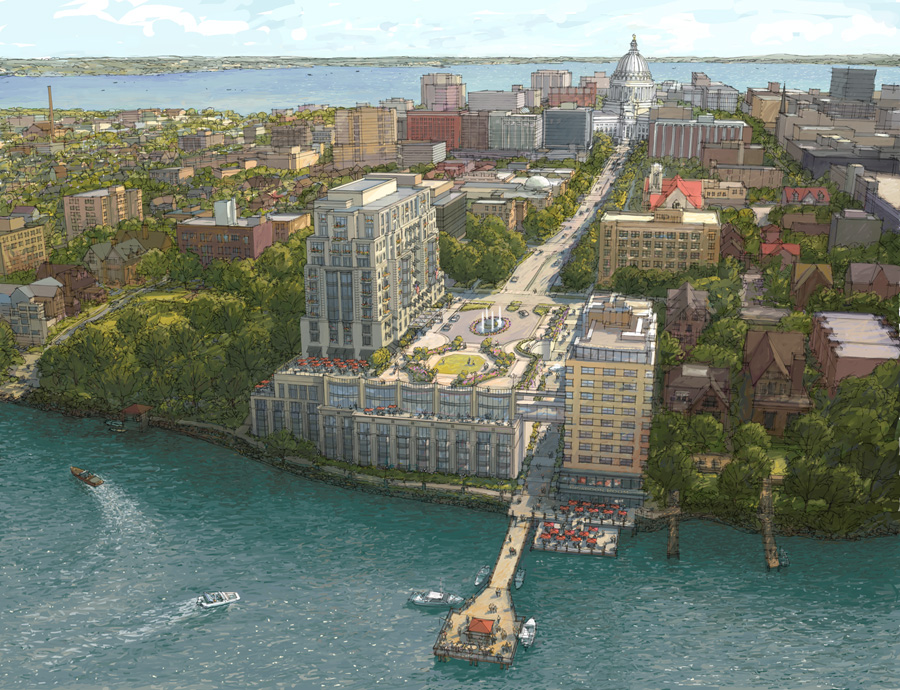
Also included in the original plans was the controversial 16-story hotel tower addition, five stories of which would rest below the top of the hill the building sits on. Amy Supple, Hammes Company Development Director, described the hotel tower’s additional 140-some rooms as the economic engine that would drive the redevelopment forward.
As the company remodels, Supple said they will have to eliminate around 40 rooms from the existing hotel tower to accommodate fire codes and expand amenities. Without the additional rooms, she said the revenue potential for the project would not justify the company’s substantial financial investment, and that a second tower was the most efficient means of adding them.
In early plans, Hammes caught criticism for locating the new tower where it would obscure the view of the lake from Wisconsin Avenue. Acquiring land from National Guardian Life Insurance, the neighbors to the east, allowed them to shift the tower by 30 feet, effectively taking it out of the public right-of-way.
In light of Saturday’s meeting with Dunn, Verveer said the developer had not ruled out acquiring more land to the east in order to shrink the tower in height, expand it in width and further appease critics.
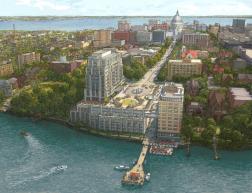
It remains uncertain how future redesigns would affect a 30,000 to 40,000 square-foot plaza the developer has proposed for the new roof of the building. It would be open to the public year round, offering seating, restaurants and sweeping views of the lake. A “grand staircase” would lead visitors down to a revamped lakefront area featuring more seating, a pier and a lakefront reincarnation of the hotel’s famed “Rigadoon Room.”
“It’s like a Memorial Union Terrace for adults,” Supple said. “I can see a variety of events occurring on this space. You can come down and you can hang out in a comfortable setting. There will be bars and restaurants you can eat at, and we’ll have improved the waterfront and boat access.”
Guests and patrons of the hotel would also have access to a host of amenities, including a gym, a spa, a salon, a lap pool, banquet facilities and meeting space.
As it stands today, the public can access the lakefront behind the Edgewater by navigating a staircase some describe as treacherous or by taking an elevator through the building. Likewise, the roof offers views of the lake to those who don’t mind standing among heating and air conditioning equipment.
The chance for an amenities upgrade is enough to have grabbed the attention of city leaders like Maniaci, who said the proposal faces a laundry list of city and even state approvals it must meet before it becomes a reality. Nonetheless, she’s cautiously supportive of the idea.
“My goal is to efficiently shepherd this through the city process,” Maniaci said. “But at the end of the day, I’m only one of a lot of people who will cast votes on this. I think the developer has a lot that needs to happen. People need to be flexible on all sides of this, and I think we’ll come out with a very well-vetted, well-debated proposal.”
Dusty blogs at It's All About the Story and is a reporter and news anchor for Madison 1670 WTDY