



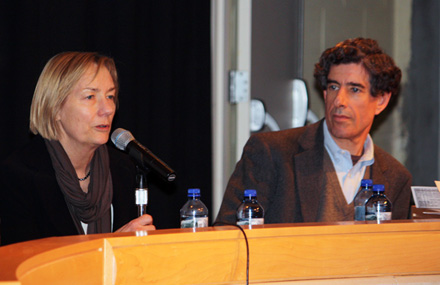
 View originalOfficials at the Waisman Center on the campus of UW-Madison perhaps weren’t prepared for the massive turnout this past Thursday as they played host to a free film screening and public discussion. Featured was a free screening of the film The Dhamma Brothers, followed by a forum discussion which included Dr. Richard Davidson. Even after the auditorium was filled to its 264 person capacity, up to 90 people filled an overflow room hoping for a chance to hear the guest speakers after the film screening and hundreds were turned away after them.
The Dhamma Brothers is a documentary film that tells the story of a group of prison inmates in Alabama who participated in a rigorous ten day training course on Vipassana meditation, a program implemented with the hope of profound rehabilitation. The film presents the inmates in a compassionate manner as men who participated in the training as a way towards inner freedom despite the confines of the prison. Though many of the inmates and prison officials were skeptical of the program before and after its implementation, a profound transformation is documented in many of the men.
“I’ve spent eight and a half years on death row and this was harder. All the stuff that’s buried down deep, they come up gradually, and most of them are small things and you can deal with them. You recognize it, you look at it and you move on. But I’ve never felt anything like that. “It hit places for me that I didn’t even know was there anymore. Places like your first child, when he gets old enough to talk and he looks you straight in eye and he tells you ‘I love you daddy’, and you know for the first time that he understands what he’s saying and he means it. Those kind of places in you. And after 16 years of being locked up in here I wasn’t sure there were any places like that in me anymore.” -Grady Bunkhead, from the film The Dhamma BrothersThe film’s exploration of meditation is appropriate for the research being conducted at the Waisman Center, which is recognized for studying the relationship between meditation and behavioral and biomedical sciences. Davidson has become a popular figure here in Madison for his work at the center, exploring the neurological effects of Buddhist meditation practices by working with the Tibetan monk community at Deer Park Buddhist Temple, located in Oregon, Wisconsin. The work was done with the encouragement of His Holiness the Dalai Lama, with whom Davidson has established a personal friendship. Along with Davidson, the panel discussion featured Dimitri Topitzes, UW-Milwaukee Assistant Professor of Social Work and board member of the Illinois Vipassana Meditation Center; Jenny Phillips, a producer of The Dhamma Brothers; Lucia Meijer, a former Seattle warden who has hosted meditation courses; Stan Stojkovic, Dean of the UW-Milwaukee Helen Bader School of Social Welfare; and Rev. Jerry Hancock, director of the Wisconsin Prison Ministry Project. Taking questions from the audience, the primary interest was in the possible implementation of similar prison meditation programs here in Wisconsin. “I think there is tremendous opportunity for doing research in this area,” said Davidson. “I think it is fair to say as a scientist that while these stories are extremely moving and compelling--and are deeply inspiring to me--the honest truth is we have virtually no data that supports the efficacy of these programs, and I think we need those data in order to move forward. And now is a really wonderful time, particularly in the state of Wisconsin and other states who are facing the same economic pressures to release inmates prior to the completion of their sentences, because we simply can’t afford to sustain the current situation.” Though there are no current plans to introduce similar Vipassana meditation courses in Wisconsin prisons, the panel assured the audience that they could hypothesize similar results as were featured in the film. The inmates profiled in The Dhamma Brothers may have resided in Alabama, but the situation in Wisconsin’s prisons is quite similar. “We’ve heard just about every one of those stories in a slightly different version and the sense of hopelessness, guys doing long, long time with no hope for release is a reality in Wisconsin prisons,” said Hancock. “The question before us then is how do you give hope to people doing that kind of time, and how do you give people the opportunity to live with integrity in whatever community they’re in, even if that community is a maximum security prison.” The Waisman Center will hold future public events as an outreach to the city of Madison, including lectures and a Spring Concert Benefit. After Thursday’s massive turnout, they plan on reconsidering where to hold the events in order to accommodate a larger audience. For more information on the Waisman Center, visit www.waisman.wisc.edu. Photo caption: Jenny Phillips, producer of The Dhamma Brothers and Dr. Richard Davidson, UW-Madison psychologist