



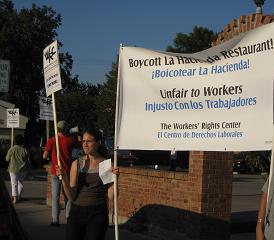
 View originalWhen Alfonso Zepeda-Capistran began documenting wage-abuse complaints from employees at La Hacienda Mexican restaurant on Park Street, the 41-year-old Mexican native didn’t doubt the veracity of what he was hearing. It’s a story he’s heard many times from Latino immigrants who’d worked at other local establishments.
But more than an advocate of workers’ rights, Zepeda-Capistran has been a tireless purveyor of betterment for Madison’s Latino community. As president of Latinos United for Change and Advancement, Zepeda-Capistran promotes social policies that would pave inroads for Latinos with regard to employment and education. As an employee of the state Department of Public Instruction, he works on the Migrant Education Program, which aims to foster the educational success of Latino children statewide.
Zepeda-Capistran recently spoke with me about the challenges facing Madison’s Latino community, its barriers to broad assimilation and why he’s gone up against high profile Latino lawyer Victor Arrelano in a worker-abuse case involving a Latino restaurateur.
Dane101: What is the biggest challenge Madison’s Latino Community faces today?
AZC: One of the biggest challenges is accommodating the numbers of immigrants that have settled into the area, especially in the last 10 to 15 years. There’s a lack of adequate resources and I think there is still a need for the community to somehow understand what immigrants are here for and how they can they be positive contributors to the community. There’s a lack of understanding. They’re often seen as ‘others’ rather than as members of the community as a whole.
 View originalDane101: What are some of the barriers that prevent full assimilation?
AZC: One of the most recent challenges that has been very public is the immigration crackdown and it has been something that has effected the Latino in particular because there are some here who are undocumented and that is a big challenge because not only are people without legal residency status not able to access IDs or Driver’s Licenses, there’s a number of other issues that are difficult for them: Access to health care, decent paying jobs and services.
There is discrimination and also the language difference that often scares people. Many still don’t speak English and that they don’t speak English is sometimes seen as a threatening factor for many.
Dane101: Has all of the immigration talk in Washington had any influence on Madison?
AZC: Whenever there is an initiative or talk in Congress, there is also hope that something positive will come and people would like to see some decent immigration reform come about. Unfortunately, there is a lack of political will to get anything through that is decent. And because of the elections coming up next year, I don’t think any of the leading candidates in any camp are willing to espouse decent immigration reform. They don’t want to talk about any controversial issues.
Dane101: County Supervisor Ashok Kumar recently proposed a county ID card program to help undocumented citizens without ID to open bank accounts, etc. Would such a program be helpful and do you support it?
AZC: I think it would be. Any program that gives people an opportunity to be identified to give them access to something like a bank account…I mean, people are working, people have a need to have things like bank accounts and need to simply have some form of identification that is helpful in case something happens.
That has been one of my criticisms of the state passing Act 126 that prevents them from getting IDs at the state level, because one of the arguments made when that was proposed was that, especially at the national level, they wanted to know that the people are who they say they are when they’re applying for documents, but the trouble with that statement is that if you don’t give them access to an ID, how are you going to know they are who they say they are?
By giving them nothing, you’re basically excluding them from being part of any community and then encouraging them to hide or to go and buy documents that may, in the end, result in worse consequences for them. It’s not helpful to want to identify people but to then not give them an opportunity to identify themselves.
Dane101: Given attorney Victor Arrelano’s high profile, what kind of rift has his defending La Hacienda’s owners caused in the Latino community?
AZC: It is true that Victor is a good attorney. He has a very high profile and he does defend his clients. But unfortunately, because he has taken it public, there are many individuals who don’t agree with him, but they are keeping quiet instead of being outspoken about an outrageous situation, where workers claim to be abused by not being paid what they deserve.
At a minimum, people should be allowed to take their case to some means of dealing with it. Obviously, people with more resources have a higher chance of getting their case heard. Workers that don’t have resources…I’m not saying either side is right or wrong, but if workers have risked their well-being by complaining about the few dollars they’re owed by a restaurant, I’d think there is merit in their case to be listened to.
It’s sad that not more people have come in defense of the workers, because they deserve a chance to be heard.
Dane101: Why did you decide to stick your neck out in defense for the workers at La Hacienda?
AZC: The workers came to me, they talked to me, I interviewed them and it’s something we have seen with places like La Hacienda for a long time. I wasn’t about to doubt that workers who have precarious status would be lying or making up information when there is a lot at risk for them. When I hear a complaint such as this, I am willing to sit down and hear their case.
Unfortunately, in the very beginning, there was an attempt to get together with the owner of La Hacienda and he refused to sit down and that’s why the Worker Rights Center decided to go public and at the same time the attorney representing La Hacienda went public and defended him.
For me, it was a very easy case of…abuse is not to be tolerated, abuse of any kind. You can give it another name, but abuse by any other name is still abuse. If there is any concern from the other side about the accusation then the least that the workers deserve is a chance to sit down and negotiate. I don’t think that happened, there are some attempts to deal with the situation right now.
Dane101: When you say abuses, what kind of abuses are you speaking of?
AZC: One of the concerns from the workers I interviewed, because there had been complaints against La Hacienda before having to do with their accountability, was with worker’s hours. They had asked workers to clock in and clock out. One of their complaints was that, after having worked eight hours, they were asked to clock out, but they continued working for three or four hours. And this was on a daily basis.
So, after awhile you can see if the workers are only being paid for the eight hours that are clocked in and not for the extra hours, then there is legitimate concern. Now, the other side argues that is not the case, but unless you sit down and talk about it, you’re not going to come to any resolutions.
The employer obviously has the right to defend himself and he has hired an attorney. Unfortunately, because of his (Victor Arrelano) high profile, and because he is a good attorney, a lot of people who may see the case for the workers aren’t saying a thing, even when they are in full agreement.
Dane101: How would the situation at La Hacienda be different if the owner was Caucasian and not Latino?
AZC: I don’t think that should be of any consideration. We’re talking about workers not being paid hours they are owed. To me, it doesn’t matter if you are black, white, Hispanic or of any background. If an employer simply is not paying workers for the hours they’ve worked, then it doesn’t matter if he’s Hispanic or not.
You know, that was one of the concerns that was brought up by the attorney, but I don’t think that has anything to do with it. The workers complained and those complaints were documented. Anyone who is Hispanic, Latino or Mexican shouldn’t be exempted from being charged with worker abuse. That shouldn’t matter.
This article also appears in this week’s Madison Times newspaper.