



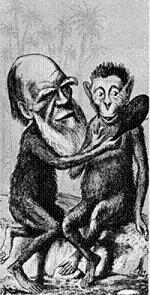
 View originalLast week’s introduction of an Assembly bill restricting how Intelligent Design can be taught in public schools was a poignant tribute to Charles Darwin, the famous evolutionary theorist, whose ideas – which form the bedrock of modern biology – are increasingly under attack by a rabid minority of zealots fighting to bring Creationism back into the public classroom.
The law, sponsored by Rep. Terese Berceau (D-Madison), would prohibit teaching Intelligent Design as science. It is the first such law in the nation aimed at protecting science, specifically biology, from fantastical ideas that can’t be tested, let alone proved. Berceau told Dane101 that in the days following her announcing the bill, legislators from around the country phoned her, pledging to take similar action in their states. The New York Times on Tuesday mentioned Berceau’s bill in a story on the burgeoning groundswell against Intelligent Design.
“We must protect science from the erosion of Intelligent Design proponents,” said Berceau, who is up for re-election this November. “Wisconsin has joined the forefront of taking a stance on this issue.”
The Intelligent Design idea has been around for several years, but only after President George W. Bush took office did the Discovery Institute, a conservative think tank, launch its current assault on evolution. Unlike evolution, Intelligent Design contends that life is too complex to have occurred randomly and must have therefore been guided by a “designer.” The Designer, of course, being God.
Intelligent Design made headlines in 2005 after the Kansas Board of Education required that Intelligent Design be taught in tandem with evolution, outraging many. President Bush weighed in on the debate, saying he believed students should be taught alternative theories about life’s origins, human origins in particular. The press ran with the sound byte, again misleading the public into thinking that Intelligent Design was a legitimate counter to evolution.
Last November, voters in Dover, Ohio ousted its school board because of its unpopular decision to make Intelligent Design part of the public science curriculum. In Wisconsin, the issue has simmered quietly with an occasional skirmish, notably when the Grantsburg School District began teaching Intelligent Design as an “alternative theory.” The School Board has since removed this policy.
Media’s failure to move beyond the he said/she said template and properly contextualize the debate has only assisted the widespread confusion surrounding the issue. Some polls show that as many as 64 percent of Americans believe Intelligent Design is a credible, scientific theory. But the Right’s strategy is two-fold. Not only have they exploited the American population’s scientific illiteracy, they have smeared a false veneer of controversy among the scientific community. Suggesting that Intelligent Design and evolution exist on equal evidentiary planes is irresponsible governance.
Talk to the scientists and one easily realizes there is no debate over Intelligent Design for one simple reason: It cannot be tested, whereas the archeological record reaches back millions of years and is as varied and diverse as one would expect. Not one speck of evidence exists to support Intelligent Design. The Right’s argument that life is too complex to have occurred randomly presupposes that complexity is a preordained outcome when it isn’t. Single-cell organisms continue to thrive on Earth much as they have since life first emerged.
“Republicans bring in these pseudo-scientists to support the false idea that evolution is just a hunch,” said Berceau. “Faith is not science.”
Berceau introduced the bill knowing it would be dead on arrival. That chances of Republicans signing on to the bill are nil. A spokeswoman for Assembly Speaker John Gard (R-Peshtigo) told Dane101 that the Speaker hadn’t yet read Berceau’s bill because “he’s engaged with the important issues facing the people of Wisconsin.”
But the bill has a greater purpose than becoming law. Making the public familiar enough with the issue to discuss the distinctions between science and faith is a critical step in avoiding the huge mistake of undermining values on which the integrity of science depends on. By not aiming to ban the idea as a whole from public schools, Berceau honed in on the very simple reason why Intelligent Design doesn’t belong in the classroom: It simply isn’t science.
However, Berceau does see a place for Intelligent Design in the general curriculum.
“It belongs in comparative religion, philosophy or even social science classes, but not in science class,” said Berceau. “The time spent teaching Intelligent Design could be better devoted to biology.”
Last week marked the 197th anniversary of Charles Darwin’s birth.
Image from the website for the Darwin Society of Finland.