



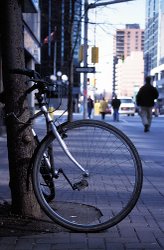
 View originalThough it's only Monday evening, the end of the week is approaching fast, and with it a regular springtime event in Madison (and Milwaukee and a few more Wisconsin locales). This is the annual Bike to Work Week, a recreation and advocacy tandem that is intended to raise the profile of this human-powered form of transportation.
Perhaps not so coincidentally, the Bicycling Federation of Wisconsin recently released a study measuring the overall economic impact of bicycles in the state. An overview of the economic impact study from the bicycling federation includes their full report (2.9 MB pdf) as well as a presentation (800 KB pdf) of the report "from the 2005 League of American Bicyclists Bike Summit in Washington, DC March 17, 2005."
This report did not go unnoticed. Popular State Journal columnist George Hesselberg covered it last Wednesday. As reported by Hesselberg in his front page column, "the total impact in the state is estimated to be between $764,468,956 and $834,468,956, and that is probably conservative."
Moreover, Wisconsin businesses account for almost one-fifth of the entire U.S. bicycling manufacturing industry. Bicycling manufacturing is a drop in the overall economic bucket, but the states' share is impressive nonetheless.
The report was written by Chuck Strawser of the federation, along with Tom Huber, who is the pedestrian and bicycle coordinator for the state DOT.
According to the Federation;
[quote]
This report was requested by the Governor's Bicycle Coordinating Council, which recognized the need to provide a concise and informative presentation of the impact of bicycling on Wisconsin, and particularly on its economy, using the best information currently available. The report is divided into three sections: a discussion of the overall benefits of bicycling to the state of Wisconsin, economic sector data on the bicycling industry in Wisconsin, and anecdotal data on the economic impact of bicycle tourism and recreation in Wisconsin.
[/quote]
The study estimates bicycles' economic impact from varied sources, including manufacturing, wholesale/distribution, retail and service, miscellaneous services (such as couriers), and tourism. It’s this latter source that accounts for most of the variation above. The impact of bicycling tourism is large but not overwhelming. "The tourism maximum of $278 million represents only 3 percent to 4 percent of Wisconsin's $11.7 billion in tourism and recreation revenue in 2003," Hesselberg wrote. However, the estimated financial impact on the state is higher than that of Maine, North Carolina, and Colorado. The report also noted the positive real-estate value effects of bicycle trail frontage.
Hesselberg also noted that the report's authors consider the economic impact of bicycles in the state to be far greater than what they are able to measure, especially considering the vehicles health and environmental externality negating influence, especially when compared to cars.
Of course, the Bicycling Federation of Wisconsin is "a statewide, non-profit organization that advocates increased bicycle use, access, safety and education." Their institutional self-interest must be recognized when considering the report. Because of this, the specific, detailed accounting, as well as the list of citations from a variety of sources in the report enhances the report’s overall credibility.
In yet another top ten listing for Madison (this time from the environmental organization The Green Guide), the profile notes that it "stands out most as a bike-friendly city." It's continuing reports like these that drive people to the region, both for tourism and as well increasingly for relocation.
Perhaps more economic good news for the area (as niche-specific as it might be) will cause a little cognitive dissonance for the Madtown Bears (the crowd the runs around hollering that Madison is bad for businesses). Whether the bears care or not, Madison is a growing market for people interested in operating as much as possible in a local economy, as well as limiting the environmental impact of their consumption. One can lazily dismiss this growing economic dynamic as "surrounded by reality," or alternatively as Floridian (not the state) kool-aid inspired utopian silliness. However, it's becoming clear that it is a major engine of the city's population growth (and emerging backlash from the bears). Anybody who has lived here for more than a month knows that Madison is full of bicycling enthusiasts (or nerds, or yuppies, or whatever).
Naysayers who denigrate cycling (think WTDY's Sly trying to mock bicycling advocate and federation employee Ald. Robbie Webber) may please their car-bound fans, but have little basis in reality. Though bicycles are certainly a limited form of transportation (aren't they all, though), their technological fundamentals aren't much older than the automobile, and they retain a convenience and fuel-free ease that will be with us a very long time.
Though the column by Hesselberg is from last Wednesday, it's retaining its timeliness in the light of the Bicycling Federation of Wisconsin-organized Bike to Work Week beginning on Saturday.
This year, the Bike to Work Week in Madison begins this Saturday, May 14, and ends the following Friday. The schedule for the week includes various activities on the Square, Brittingham Park, Vilas Park, and elsewhere. Tuesday, May 17 is Bike to Work day, and there will be two-wheeled commuting contingents leaving that morning from East Towne, Warner Park, Hilldale, and Dutch Mill park, and converging downtown. The next day is one of advocacy, in which supporters of cycling are encouraged to call elected officials to voice their thoughts on the matter.
Audiovisual info on BTWW are available from the federation's Bike to Work commercial (4 MB mov) promoting the events.