



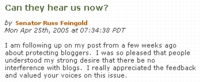
 View originalAs far as Dane101 is aware, there are very few elected officials in Wisconsin utilizing the online blogging medium. Of course, there is a growing number of campaign blogs from incumbents and hopefuls alike, but apart from Rep. Frank Lasee's (R-Bellevue) TABOR-promotional blog, it looks like there is no ongoing blogging from a sitting public servant in the state.
Senator Feingold is diving in headfirst this week, however, by engaging in a fairly substantive discussion on Daily Kos, the extremely high-trafficked interactive blog that is a growing force in the Democratic Party. The Senator has been engaged in a back-and-forth with the site's proprietor, Markos Moulitsas (Kos), regarding FEC regulation of online political campaigning, and the effect this would have upon political blogs.
Like his famed statewide listening sessions in all 72 counties of Wisconsin, Sen. Feingold is paying attention to what people are saying to him on Kos, even though most there are not his direct constituents. This is clearly a part of his ongoing efforts to introduce himself to a broader swath of the nation in advance of the 2008 presidential election. Besides his trips to the South to court 'red state' voters, it looks like Feingold is looking to build a rapport with what is becoming one of the most committed groups of Democratic activists.
Feingold, a favorite amongst the Kossacks and the subject of ongoing speculation over 2008, is arguing in favor of some kind of FEC online regulation. Online campaign regulation has gained traction after Jon Thune, a Republican from South Dakota, employed two bloggers last year to support his victorious Senate campaign against then-incumbent Tom Daschle. This was done mostly through attacks on the largest newspaper in the state, the Sioux Falls Argus-Leader, for its coverage of the race. The affiliations of the bloggers to the Thune campaign were not disclosed until after the election. Because of this case and others (including accusations leveled against Moulitsas), the likelihood for regulation is increasing, particularly following a recent court decision in favor of such. Many online activists consider regulation is primarily a reaction to the growing potency of their medium, for which they have a decent case.
Sen. Feingold originally published at Kos on March 10, stating his case for why he thought, "Blogs don't need Big Government." The post received numerous comments, which received a response from the Senator, saying he thought, "the discussion about the definition of 'blogger' is particularly interesting. It is really helpful to me to read the comments of people who know a lot more than I do about blogging. I value the input."
Yesterday, Feingold made a second entry to the site, apparently looking to respond to a recent offhand comment from Kos that the Senator is an opponent of unfettered blogging, as well as expanding his thoughts on FEC regulations.
Feingold wrote;
[quote]
I read with interest Kos's recent post where he writes that I'm someone who wants to restrict blogging. That just isn't true. I respect Kos's opinion and was sorry to read that he has that impression. For my part, I intend to be a force to make sure that vigorous and free-wheeling blogging will continue without interference. After all, I've just begun to blog!
As the FEC proceeds with its rulemaking process, I'm interested to see what people are thinking now--is the concern just as high that the FEC will act to restrict the rights of bloggers, or has the proposal from the General Counsel reduced the concern? Are there other issues relating to the internet or blogging that are raising concerns? How do people feel about bloggers who are paid by campaigns or parties?
[/quote]
Late on Monday evening, Kos responded to Feingold, stating that he was "glad to hear that's his view." That wasn't the sum of Kos' reaction, however. He continued by challenging the Senator, saying he could "prove his commitment to a vigorous and free-wheeling blogosphere than by co-sponsoring the Reid Act (S.678)."
The Reid Act would basically exempt the Internet from "the definition of public communication" with regards to the FEC.
Sen. Feingold responded to the comments on his post and the request by Moulitsas early this afternoon. He discussed his concerns with the Reid Act, particularly his concerns any consequences to the BCRA (aka McCain-Feingold), concluding, "I cannot support a proposal that would open a loophole in BCRA for soft money to find its way back in the system."
He also gave his overall perspective on blogs and campaigning;
[quote]
Blogs should be able, however, to do whatever they like, say what they want, and link to whoever and whatever they want, with no interference. And bloggers should be allowed to profit. From the looks of the posts I see that many people believe that if bloggers are being paid by a campaign, they should have to disclose that, no matter how big they are - and that should be the responsibility of both the campaign and blogger. I think that is a fair thing to consider. I think that in this area disclosure, not restriction, is the probably best policy, and Kos agrees with that because he had his own disclaimer during the last election. Of course, if the Reid bill were enacted, requiring even disclosure of these payments might very well be prohibited.
[/quote]
The conversation between the high profile Democratic Party activist and sitting Senator from Wisconsin continued, with Kos responding to Feingold shortly thereafter, vigorously disagreeing with the Senator. Kos discussed the ease with which an interested party could establish an utterly opaque and unregulable online political campaign, arguing no law could stop determined Internet astroturf.
Kos also contrasted the ether as a communications medium versus broadcast, discussing issues of interactivity and spectrum scarcity (though not touching on bandwidth scarcity, among those with limited or no access), arguing that there is far more opportunity online for non-professional political activists to make a statement.
Due to this, Kos predicted;
[quote]
What's going to happen, if the FEC attempts to regulate the medium, is that people who are openly and legitimately engaging in online activism can be shut down by frivolous complaints, while the truly nefarious forces will be doing what I describe above -- working in the shadows and using the web's inherent anonymity to ply their dirty wares with impunity.
[/quote]
In response to Feingold's openness to considering disclosure requirements for paid online campaigning, Kos responded noting that similar requirements do not exist for political operatives in the broadcast medium. For example, Frank Luntz, while identified as a Republican pollster in his numerous cable news appearances, is not required to disclose his roster of clients when he is on the air.
Kos also discusses the problems of defining blogs, and the slow fade that exists between them, message boards, and other formats, particularly in the political arena. He wrote;
[quote]
I don't doubt that Feingold wants to protect the blogosphere, but it's an idealized version of the blogosphere, one where everyone knows your (real) name and there are clean money trails. In broadcast, it's easy to find out who paid for an ad. On the Internet, it can be made impossible.
And I don't think Feingold realizes how blurry the lines are in this medium between things like blogs, message boards, bulletin boards, mailing lists, activism centers, and any hybrids thereof. You can't target any of these types of sites without affecting other types of sites.
[/quote]
Kos concludes by arguing that Feingold’s position will lead to overregulation, and drive online political black-ops even further underground.
In a second update, Kos concludes by saying,
[quote]
Oh, and I should really make this clear -- I think it's awesome that Feingold is engaging us in this debate here, in this public forum. If this is a sign of things to come for this medium, where we can debate policy with those in charge of making policy, then our future is extremely bright.
Doesn't mean we'll agree all the time. Obviously, we won't. But if there's a 'best way' to deal with such disagreements, this is it.
[/quote]
Kos is currently getting, on average, about 443,000 site visits per day, and more than 559,000 page views per day. Yesterday when Sen. Feingold posted, the site received about 535,00 site visits and some 647,000 page views. That's far more than the combined daily circulation of the Journal Sentinel, State Journal, and Press Gazette.
As mentioned at the top, this episode is clearly an effort on the part of the Senator to engage with an increasingly significant political constituency, which is becoming the nexus for a growing portion of election fundraising and shoe leather. It is also an example of the Senator, in his celebrated manner, looking to make his case independently, even if it might upset constituents.
This is also a classic case of self-interest on the part of an information source, in this case Daily Kos, which will undoubtedly and zealously guard the growing prerogative of online media to act freely in American discourse, particularly when the increasingly corporatized print and broadcast outlets are failing in their role as independent watchdogs.
Dane101 will be watching with interest. We are also watching to see who will be the next state or local elected official to test the waters online.