



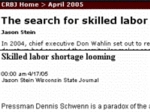
 View originalWhy is the feature business article in the Sunday State Journal titled very similarly to the cover story to the inaugural issue of the Capital Region Business Journal?
The April cover story for the Capital Region Business Journal, The search for skilled labor, was published in late March. Today's Sunday State Journal feature is Skilled labor shortage looming. Though the latter is not a duplicate of the article that appeared in the CRBJ, both are reported by the same journalist.
Both articles focus on the same issue – a regional labor shortage of skilled technical manufacturing workers – while sharing several sources.
The lede to the Sunday feature, used a local pressman at a Waunakee printer as its major source, who was also featured in the CRBJ cover story. Another shared source was Terry Ludeman, the state's chief labor economist. Though Marshall Heyworth of QTI Consulting, sourced in the Sunday feature, is not quoted in the Business Journal piece, a sidebar to that article sources him briefly.
Of course, the Sunday State Journal article reports from a number of sources not found in the original piece, including a Stoughton High School teacher, the research director of the Center on Wisconsin Strategy, and the chief of field operations for the state Bureau of Apprenticeship Standards, among others.
Both articles were written by Jason Stein, a business journalist for the State Journal.
When the Capital Region Business Journal was announced, much public attention was directed towards its advisory board policy, in which a seat at the table (and extended access to the Wisconsin State Journal editorial board) was available to advertisers for $25,000 per annum.
Another element of media start-ups like the Business Journal not discussed as much, however, is content synergy. For expanding chains like Capital Newspapers (and its primary owner, Lee Enterprises), running similar content across media platforms is increasingly used, largely to save production costs. In this case, the production cost is the tool newspapers offer to their consumers – journalism.
The issue raised here isn't with regards to the conduct of the reporter. Jason Stein produces quality journalism, and the questions this raises is not about the quality of his work or his journalistic fairness. Rather, this raises questions about the Lee/Capital business model, in which fewer reporters are doing more work, recycling sibling content across sibling publications.
Also, why is reporting on an issue originally produced for one Lee/Capital publication recycled (to an extent) for a different publication several weeks later? It may simply be that the Sunday paper was short on content, and the CRJB cover story provided fodder for a cheaper rewrite than an entirely new story. If not, though, why is the Sunday State Journal, the most widely circulated newspaper in the region, reporting on a significant economic issue such as this several weeks after it was originally covered in their niche publication?
The importance of this should not be overemphasized, however. There were likely numerous factors affecting the publication schedule of each of these articles, perhaps potentially based upon simple business decisions. If so, though, that is the defining element of this issue – reporting based upon business versus editorial decisions.
What is visible here is a simple demonstration of the practice of synergy at media conglomerates, even at relatively small and regionally-focused companies like Capital Newspapers.