



 View originalThe battle over the fate of Social Security continues apace, with the Bush administration's self-imposed sixty-day period to sell privatization ticking away rapidly with little traction. This latest political effort is part of the administration's hopes to achieve a major legislative victory in this congressional session as soon as possible before the 2006 elections.
However, the push to privatize Social Security is decades old, with the idea moving from the utmost fringes of conservative Christmas lists to its singular position in the Bush agenda today. Groundwork for this metamorphosis has been built for years, and a primary player in recent efforts is the House Republican Paul Ryan, representing Wisconsin's First District.
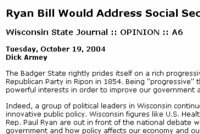
On October 26, 2004, the Wisconsin State Journal published an op-ed by former House Majority Leader Dick Armey in support of Social Security privatization, specifically a bill introduced last session by Rep. Ryan. The op-ed identified Armey as speaking on behalf of FreedomWorks, an organization that he co-chairs. However, the op-ed did not disclose Armey's concurrent work as a lobbyist on behalf of the mutual fund industry
In an article titled Nonprofit group skirts lobbying laws, critics charge for the St. Louis Post-Dispatch, reporter Deirdre Shesgreen reported on the recent assistance given by Dick Armey (a Republican from Texas) to support the Bush administration on Social Security.
Shesgreen reported on Armey's political advocacy for a pharmaceutical mail-order plan named Rx Outreach on behalf of tax-exempt organization named FreedomWorks, for which he is a co-chair. FreedomWorks collaborated with a public relations firm working for Express Scripts Inc., owner of Rx Outreach. Critics charged that these actions called FreedomWorks credibility (and tax-exempt status) into question.
As Shesgreen wrote,
[quote] Either way, their relationship highlights the often ambiguous role that some Washington think tanks and nonprofit groups play in political advocacy and their often-undisclosed connections to those who would benefit.
When corporations hire lobbyists to influence federal policy, those lobbyists must publicly report their fees and the issues or bills they're pressing lawmakers on. But think tanks or other nonprofit groups like FreedomWorks are under no such obligation, which makes them attractive to corporations and other special interests who want to contribute anonymously and under the public radar on controversial issues such as prescription drug prices or Social Security privatization.[/quote]
The article goes on to detail FreedomWorks structure and agenda, its collaboration with Express Scripts, and the lobbying entanglements found among its power brokers, including Armey. One of FreedomWorks recent priorities has been Social Security privatization, which coincides with Armey's paid lobbying work for the Investment Company Institute, a mutual fund trade group representing an industry that might see financial benefits were Social Security privatization enacted.
As detailed by Shesgreen,
[quote] In an op-ed column in October in the Wisconsin State Journal, Armey touted a bill by Rep. Paul Ryan, R-Wis., to allow workers to divert half their payroll taxes to private accounts. Armey said the move would "let all workers begin to accumulate real assets for retirement" and help "avert the program's coming financial shortfall."
Armey was identified in these statements as head of FreedomWorks, not as a lobbyist whose clients include the Investment Company Institute.
Chuck Martin, an editorial writer at the Wisconsin State Journal, said Friday that he doesn't believe the paper knew that Armey was a lobbyist for the mutual fund industry when it ran his column. (The editor who handled Armey's piece has since left the paper.)
Martin said he would have identified Armey differently. "It's important for the reader to know that he is paid for producing views on behalf of a client," Martin said.[/quote]
The article concluded with dueling quotes from supporters and critics of Armey's dual-role political advocacy.
It also raised a couple of interesting questions with regards to the publishing of the op-ed.
The first is a simple matter of misinterpretation. In the article, Shesgreen wrote "[t]he editor who handled Armey's piece has since left the paper." What actually happened was that Tim Kelley, the State Journaleditorial page editor last fall, was promoted at the beginning of this year to managing editor. When asked about the error, Chuck Martin said he told Shesgreen that "he [Kelley] had left, meaning the editorial page," which was apparently interpreted by Shesgreen to mean that Kelley left the paper.
The second question is about the publishing of the op-ed. Martin confirmed his positions as quoted in the article. When asked how Armey's lobbying was unknown to them, Martin said, "in the case of the Armey piece, we were unable to recover the original copy that was emailed to us. So we weren’t able to verify what they told us or what they didn't tell us, but we didn't believe that he was identified as a lobbyist for the mutual fund industry."
Dane101 contacted Kelley for confirmation, and asked him about his role in publishing the op-ed last October. Kelley agreed with Martin's statements, and said that they didn't know of Armey's lobbying work. If they had, Kelley said, "we would have made a decision to disclose that, or maybe we wouldn't have run the column." Kelley said that the op-ed came to the State Journal via "some third party involved who offered the column," and other aspects of Armey's political advocacy were on his mind at the time.
Though he no longer works on the editorial page, Kelley said, "some higher profile incidents at bigger papers have made everybody more cautious," noting "if something comes from a PR firm in DC we would look askance at it, particularly with the recent Bush administration scandals."
As stated by Kelley, "the disclosure part is important, for the reader to weigh what is in the paper."
A search in the State Journal online archives for a printed clarification or explanation of the omission in the op-ed yielded no results.
When Dane101 asked Martin how the State Journal is trying to prevent a future omission of this type, he said they verify identity on a case-by-case basis. "In terms of a systematic policy, we don't have anything like that at this time, but with a new editorial page editor, it's something that we may look at in the future," he said.
Kelley and Martin explained the circumstances of the omission, but they did not address a proactive solution to this problem. It is well known that retired Washington lawmakers oftentimes begin new careers as industry lobbyists. This kind of job placement is so clichéd that it is labeled the "revolving door," a Beltway reality certainly known by newspaper editorialists. In the future, it would be prudent for newspaper editorial pages to routinely inquire retired legislators submitting op-eds about any lobbying entanglements. If the State Journal does look at more formal op-ed submission policies in the future, this is one worth considering.
Note: In the spirit of disclosure discussed in this article, I am employed by the non-profit organization Center for Media & Democracy, which conducts investigative reporting on political advocacy groups such as FreedomWorks. This is an unaffiliated web site. It is not a production of Center for Media & Democracy(CMD). Statements on this site do not represent the views or policies of CMD.