



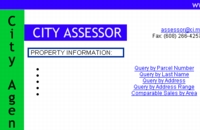
 View originalIf you are a real-estate owner in Madison, the 2005 property assessment and tax information was released on Friday by city Assessor Ray Fischer. Information about the property you live in, work in, or own, can be found at the Madison City Assessor database. Properties are searchable by parcel number, last name, address, address range, or comparable sales by area.
As reported in both the State Journal and Cap Times, the average home in Madison was assessed at more than $220,000, marking an increase of 8.6% since last year. This percentage increase is the highest in a decade.
In response, Mayor Cieslewicz was quoted in the WSJ article saying that this is "excellent news," telling Madison homeowners that "the value of your biggest investment has just increased substantially." In terms of details, residential property values have increased at nearly double the rate commercial properties have in Madison, while condos have increased at twice the overall residential rate. Also, new construction accounts for almost two-fifths of these increases.
The Cap Times article also reports that the overall land/development value of the city of Madison is $18.1 billion, though the assessment does not account for non-taxable properties (such as on the UW or Overture), where construction has been booming.
The articles go on to detail in which neighborhoods the rates have increased the most and the least – Ice Age Falls (southwest) and Waunona (south) respectively – and where the city's most and least affordable homes are. The most affordable homes are on the far east side, in the Fair Oaks-Worthington Park neighborhood, while the least affordable are in the Spring Harbor neighborhood, which fronts the southwest shores of Lake Mendota.
The State Journal article reported "Mayor Cieslewicz’s home on the near west side rose 8 percent to $317,700."
That's pretty interesting information to learn about the mayor, but what about the publisher of the article?
The publisher of the State Journal, James Hopson, lives in an adjacent near west side neighborhood to the mayor. His property assessment rose some 1000% to $893,000, but this is simply due to the fact that a home worth $798,000 was built last year on his lot. Wow.
As for the other daily, Cap Times publisher Clayton Frink lives in Fitchburg, and is thus not searchable via the City of Madison assessor system. It doesn't appear as if the same service is available at the Fitchburg e-government site – hopefully it will be as the city matures.
Also, to be fair, the downtown apartment building I rent at is divided into two portions for assessment purposes. The larger share's assessment did not increase since last year, with the land and development together staying put at $2.46 million. The smaller share of the property increased by 5% ($13,600) to $285,700.
Though both articles touch on the increasing city expenditures (and decreasing state support) that result in higher property taxes, neither article really discusses the expanding American real estate bubble (excepting a quote from Ald. Benford in TCT article). a subject of growing concern among economists and other financial watchers, not to mention prospective homeowners, those with variable rate mortgages, or property tax payers in general. Hopefully more local reporting of these issues in a broader context will be forthcoming.
The WSJ article concludes by letting readers know about an avenue of recourse if they disagree with the assessment.
[quote]Those who disagree with their assessment should call the assessor's office at 266-4531 and personally discuss it with their assessor, Fisher said.
Homeowners who want to file a formal objection must complete a form available at the assessor's office at the City-County Building, 210 Martin Luther King Jr. Blvd. The forms must be completed and returned to the assessor's office by 4:30 p.m. April 29 or be postmarked by midnight on that date.[/quote]
There is also extensive discussion about this year's assessment at TDPF. These discussions include a thread where posters compare and contrast their assessments (while making allusions to the nationwide real estate bubble being felt here), and another asking if posters' income is keeping up with their property ownership commitments.