



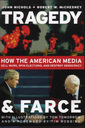
 View original“Don’t blame Bush and Cheney,” John Nichols said. “They’re supposed to lie, it’s their job. They did it well.” Nichols continued, “Blame the media who portrayed (so faithfully) the fantasy that Bush and Cheney put forth.” Nichols, along with Robert McChesney, spoke to a mostly full room on the UW campus last night. Nichols and McChesney have been traveling in support of their new book Tragedy & Farce: How the American Media sell wars, spin elections and destroys democracy. This forum was sponsored by Rainbow Bookstore Cooperative, WORT 89.9 FM and the UW Havens Center for the study of social structure and social change.
Nichols and McChesney are at the center of a national modern Media Reform Movement, and Madison is it’s birthplace. The first national conference for media reform was held in Madison in November of 2003. The second of which was held in May of 2005 in St. Louis. Bill Moyers has been a keynote speaker at each conference.
According to Nichols we are at a Madisonian Moment in American history. The American media failed the public in the buildup to war in Iraq by not intervening when the time was critical. In a democracy built upon free speech and the freedom of the press, as heralded by President James Madison, war is to be most dreaded and the antidote to unending war is freedom of the press. “War demands a media that serves democracy” Nichols said. “The media’s job is to wedge itself between the politician and the citizen. Before Iraq we simply had stenography.”
Nichols went on to relate how the British media in particular asks harder questions and gets more straight answers because they do not simply take what is given to them by politicians as fact. Perhaps this is why the Europeans opposed the war more than Americans; they had more of the facts behind the propaganda. McChesney pointed out that Investigative Reporting in the USA is dying and has been suffering for the last thirty years as larger and larger corporate entities (now down to six) gobble up smaller media outlets to form billion dollar conglomerates with their interests ranging from television, radio, industry, and the military. It’s no wonder we had, in the words of Nichols, an “empty and vapid election in 2004.”
Robert McChesney, now a research professor in the Institute of Communications Research and the Graduate School of Information and Library Science at the University of Illinois at Urbana-Champaign, gave a short history of the corporate attack on the media in the last 100 years, where professional journalism had it’s peak between the 1930s and the 1960s, which is also explained in further detail in the Tragedy & Farce book.
What can citizens do to demand a media free of corporate self-interest? Our Media Not Theirs: The Democratic Struggle Against Corporate Media (Seven Stories Press2002), also authored by Nichols & McChesney, is an excellent primer on how to help support the U.S. media reform movement. Also, challenge the status quo, support policy advocates in Washington by logging on to Free Press and the Center for Media & Democracy websites, among others. Most importantly, support independent media outlets such as Rainbow Bookstore Cooperative and radio stations such as WORT 89.9 FM. You will be informed, meet like minded reform activists, and be welcome into an open and honest debate about the precarious position of our media industry and what we as citizens can continue to do about it.