



Hallie Lieberman is a PhD student in the UW-Madison School of Journalism and Mass Communication, where she's studying the history of sex toys in America. She blogs at Dildographer, where she reviews sex toys, proposes ways to make female sexuality more accepted, and takes a critical look at pop culture products such as the recent film Hysteria.
Dane101: When I first contacted you about an interview, you mentioned being able to talk about the histories of vibrators OR dildos -- why is there a distinction between those two categories?
Hallie Lieberman: What's different about the history of dildos in America is that they really started to be mass-produced when rubber was first vulcanized (cured from its brittle raw state into a more durable material). Around the mid-1800s. Charles Goodyear developed that process, and that's when we were able to mass produce them.
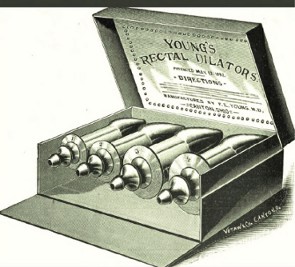
Before we had these things called dilators. They were made of glass, usually. Some of those would shatter in people's vaginas. So when rubber was vulcanized we were able to make dilators that were safer, a little bit cheaper, that could be mass produced. And they produced rectal dilators too, basically butt plugs.
Were they used as butt plugs, or in a medical way?
That distinction is what I struggle with in my work. I don't know how they were used. They were marketed as medical devices. One of the biggest companies was Young's Rubber Dilator. In fact I was at the Smithsonian this summer on a fellowship and they have them and I was able to see some there. They don't put them on display. They're embarrassed.
That's so weird.
Yeah. But they were really cool in giving me the fellowship.
Anyway, these were marketed for constipation, they were marketed for prostate troubles, they were also marketed for asthma. Young was kind of a quack and he had this theory that the rectum was the center of all health. There was a lot of orificial theory at the time. It's highly likely people also received pleasure from them, especially the man, but no one writes about how they used them.
So this is part of your big challenge as a researcher.
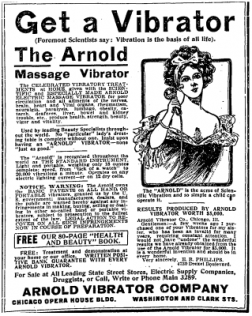
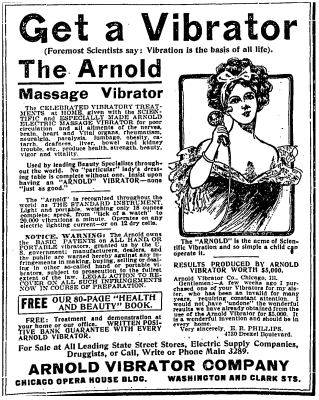
Right. Meanwhile, the vibrator -- was when electricity became widespread in the early 1900s. It was marketed as a public appliance. In fact, even the rural electrification administration in the 1940s, one of the things they promoted was vibrators. It was the many things, small household appliances and vibrators were one of them, that they said would "help your health and beauty."
So what is aim of your research? Why is this history important?
One of my aims is to see if this history has been told accurately or at all in some cases. Two, I think we should talk openly about this. There's this silence around sex and the history of it and this story hasn't really been told. I feel academics need to be more comfortably about it, the general public. These objects have a history and masturbation isn't something people should be ashamed of and there's a lot of technical ingenuity that went into these objects people use to masturbate with.
Sex research has gone on a long time...there's a survey that's more than a hundred years old. Why, do you think, is there still a hesitancy?
What's happened is sex research, the trend was if you wanted to get funding for it it had to be about health. About preventing AIDS, pregnancy, how things worked. The pleasure aspect, you couldn't get funding for it, it wasn't legitimate. Part of what I'm saying is the history of how we have pleasured ourselves is legitimate. And we shouldn't think of it strictly in terms of preventing disease and such.
For example, dildos as a non-mass-produced object have been around forever. Any time I run into an archaeologist, they tell me they have a friend who found all these sex toys at this site but they don't want to write about it. So there's this history that's been hidden. We kind of don't want to own that part of our history. We'd like to think that these people were not masturbating, they were too busy gathering berries, coming up with agriculture. But you know they can't do that all the time. Or in ancient Greek history, there are plays about dildos, they used olive oil as lubricant. As soon as we could figure out to shove things in our crotches, we started doing it.
So why focus on this narrow chunk of sex toy history?
I'm really interested in America and commerce and how sex is everywhere, but we don't really use sex to sell sex toys. We have shied away and made it a medical thing. Even today. 2 years ago, Trojan came out with the Triphoria, this vibrating toy. MTV said, no, you can't advertise it as a vibrator. And this is MTV. They said, “You have to call it the vibrating Triphoria, instead of ‘our Trojan vibrator.’" Because that term vibrator had such a bad meaning. So I'm interested in consumption, mass produced culture, the sexualization of everything but sex, which is medicalized. OR it's this holier-than-thou oh, our vaginas are beautiful, we need to worship them...as opposed to, it's just fun. Why do we have to come up with all of these justifications? That's what I'm interested in.
That’s a good point -- that us sexualizing everything but not talking about sex itself openly is actually kind of weird.
It is weird. We sexualize things but talking openly about pleasure just weirds people out. And laughing at it...I was on this panel about Hysteria with the A Woman's Touch people. And we kind of got in an argument about things and they took masturbation very very seriously. I believe we should be taken seriously, but we can also have fun with it. I'm saying we can giggle about it, we can say women like to fuck, it doesn't have to mean something political.
At the same time, do you think there's any validity to some of the politicization?
I believe there are many ways of being political. I believe feminism has done great things. But there needs to be more acceptance of different ways of celebrating sexuality, not just this hallowed, very sincere thing, but we can also be dirty and rough and admit sex is gross and admit that out of context vaginas look kind of weird but in context they're amazing. Have a more nuanced view.
So bodies are ridiculous, but that's okay.
Yes.
When you're conducting your research, where are you looking for information about how people used devices?
Figuring out how people used stuff is really really hard. I can't find first-hand accounts, so I'm looking at pornography of the time. For example, they mention this rubber vaginal syringe, they kind of looked phallic. This was in the mid-late 1800s. A lot of women used them, unfortunately, for contraception, and they didn't work. It was bad to do that, they would use all sorts of horrible chemicals, Lysol, that whole thing. Looking at porn at the time, I can see they were used as masturbatory objects by some people.
This was also around the time of the Comstock anti-obscenity laws. And Anthony Comstock believed that those syringes were used as dildos as well. So, the whole question of how they were used, it's hard to have firsthand accounts, but it's clear that people believed they were used in multiple ways. And that's what I have to go on. It's more circumstantial than direct evidence.
One of the things I'm curious about is whether you've uncovered anything particularly local in your research.
Racine was the center of small motor production in the early 1900s. And that's what was used in vibrators. Hamilton Beach claimed to be the first to have a mass-marketed massager with a universal motor, running on alternating and direct current. They produced this small motor that was used for hair dryers, it was used for blenders.
There was kind of a vibrator war. There were so many companies in Racine and the Midwest in general producing vibrators and so companies would have all these different claims, saying oh no, we're the real one. They'd have 300-page booklets explaining how to use it. But they'd rarely market them to stimulate the genitals. The one in Racine, Hamilton Beach, would have a number 9 attachment shaped like a penis, this phallic thing that you had to send away for, it was $1.75.
There was also a story in the Racine paper. A boy died using a vibrator. He was in the bathtub, he was 17, and they didn't really understand electricity at the time. He had the door locked. And his family, his brother heard him cry out and they had to get in through the window and he was dead. So people didn't understand electricity that well.
But there were a ton of companies producing vibrators then. And Racine was this big industrial center.
I feel like that's a thing that for any other industry, they'd have a museum and an annual "Vibrator Days" holiday to celebrate that history.
Exactly. Because it was amazing--it wasn't just the motors with the different attachments. They also had these companies making a motor you wore on your hand that made your fingers vibrate. They used them in barbershops too. Any other history they'd celebrate. And Racine neeeds money. But with this kind of history, people like to pretend it never happened. A lot of it gets destroyed, and it's hard to find records.
Why can't we acknowledge pleasure in this way? Do you have any theories?
I have a couple theories. Masturbation doesn't seem to serve any logical function. We like to distance ourselves from animals. And talking about our history in that sense, we like to think of ourselves as intellectuals. And talking about masturbation and how a significant amount of our intellectual power has gone to developing new ways of masturbating--it kind of looks like our culture isn't enlightened when we do that. And we can talk about the history of contraception, and health, but when it comes to pleasure, Americans in particular are very utilitarian. And pleasure takes away from work, the Protestant ethos in particular doesn't fit well with telling a story about pleasure in America. People don’t want to be proud of it.
It's so interesting that the Protestant ethos is what you bring up. I feel like that’s a reputation Catholicism has.
You could argue that, too. It's not just one thing. It almost transcends religion in our culture; we work more than Europeans. And Europeans are cooler about sex and their sex history. We work and it's all about how can this serve our needs? And even when it comes to masturbation, it's a thing to work on. We have to strengthen our vaginas with these exercises. It's like another part of our body we need to work out. And so we have this very performance-oriented ethos in this culture, practical, and that sometimes pushes out this sensual and pleasure-oriented thing. It's the same thing as food. We have to work out what's the nutrition, what are the calories, and we don't have fun with them.
Why do you think it's important for people to talk about this history?
One is the shame associated with masturbation and female sexuality. I wrote a blog post about clitoral shame recently. I remember when I said I masturbated in high school, people would say, 'You must be lonely. That's sad.' And I'd be like, 'What?' And I started to think, should I be? Should I be sad or lonely? Men can talk about it, women can't. I want them to not feel shame, be more comfortable and have more pleasure in their lives. And one of the ways I can do this is by showing it's a continuous thing in human history, that women have found things to masturbate with and that it's nothing to be ashamed of and it's something we should investigate and celebrate.
Are there any artifacts of male masturbation you’re finding?
Oh yes. Our government was very upset about penis pumps in the early 1900s. They were called vacuum appliances, for penis enlargement, but men would also jack off with them. There were fake vaginas called 'Bachelor's Friend' and 'Silent Wife' -- that was my favorite.
Oh, that's awful.
There was also a Silent Husband for women. So at least it's equitable. But anyway, uncircumcised men have a built in masturbation sleeve. And hands work pretty well. So it's easier for them to masturbate. But there needs to be more innovation in male sex toys, too.
Any very strange or surprising things you've learned? Both in historical and contemporary sex toys.
There's this disease called vaginismus where penetration is painful for women, and sometimes can't be done at all. And there was a doctor who coined the term who is considered the father of modern gynecology. And he also had a line of dilators, basically medical dildos. But if women couldn't have sex with their husbands because of vaginismus, he would put them under ether and while they were out cold their husbands could have sex with them. That was a really interesting and disturbing part of our medical history. The concern about a woman being out cold, you can't consent, they just didn't think about it.
More recently, I've really seen sex toys evolve over the past ten years. People have more concern about materials and body safety. Silicone, toys that are nonporous versus these phthalate jelly toys that are more unsafe, that would kind of melt together. Also, there's a new trend toward natural materials. Wood dildos. There's a trend toward recycled materials, and hand-cranked vibrators, which brings it full circle to the first vibrators. And then there's a trend toward luxury toys, made of gold and all this stuff. So you're seeing the industry evolve like other industries. In that sense, sex toys are becoming normalized. Another thing I'm seeing is vibrators shaped like fruit. Luxury cupcake vibrators, popsicle shaped, vegetables, bananas. It's weird how they've repackaged the early do-it-yourself ethos and turned it back like that.
 View originalYou also review sex toys. Do you use them and then review them?
Yes. Initially I reviewed a few I bought myself. Then, one company recently sent me one to review, and I had to use it with my boyfriend, it was a couple's toy. I felt really bad giving it a bad review, but it was terrible. It's really popular and has won awards, but it didn't work well, and made me wonder if the people who give those awards actually use the toys.
You put those reviews and other essays on a public blog with your name on it. Have you encountered any issues with writing about a topic like sex, and sometimes including your personal experiences in that?
I'm sure there will be difficulties when I go on the job market. The main difficulties I've had are the initial weirdness with my family. My parents have been incredibly cool, but, like, they'll skip over posts about sex with my boyfriend. But I'm very open and not embarrassed and I've always put it all out there. Sometimes I get creepy comments, like 'I want to watch you use this,' but that's to be expected. I think at another time I'd probably burn at the stake, so in that sense we've progressed.
What are you trying to do with your blog? Why have it at all?
The aims of the blog are to get beyond the academic world. Academics have a responsibility, especially at public universities, to make their research and their thoughts available to a wider public readership. So that's one of the aims. And also I can meet and exchange ideas with more people. I've met so many people and sex researchers through that. The basis for it is, is it easy enough for my mom to read if she wanted to? And is it interesting to people who aren't specialists?
What is the state of sex research right now? Are there any challenges it faces?
I was going to say funding, but I think people have been really cool in giving me funding. In my field in particular, journalism and mass communication, most people aren't studying sex. The challenge is finding other people who are doing your stuff. It's interdisciplinary, spread across different departments. So the blog helps with that. But there's still that shame within non-sex departments, where other people's stuff will be celebrated, while for me, it's great what Hallie's doing, but let's not put it on the website. Which I understand, it's a public university. But sex researchers all band together because they've all had these experiences.
You wrote an essay critical of the film Hysteria, which is probably the most recent exposure to vibrator history many people will have had. In the Next Room, covering the same topic, also played in Madison relatively recently. Both are based on the work of Rachel Maines--can you talk a bit about some of the problems you see in her work?
Rachel Maines was very important in that she opened up the field. Without her I wouldn't have a starting point. The main problem I have with the work is that it makes it seem as if physicians had no clue what was going on, women had no clue about sexuality, that they were so in the dark--literally with a sheet draped over the vagina, so everyone's fumbling around and we're so clueless to it that we didn't understand pleasure at all. It portrays doctors as idiots, it portrays women as idiots. Her argument was that people truly did not understand the role of the clitoris, so they did not think it was sexualized when doctors massaged the clitoris. And that they didn't understand until it was shown in stag movies in the 1920s. But one problem with that is that stag movies weren't popular, women didn't see them, you had to be rich to have that equipment. The other is that we as women come out as victors, we're triumphant, we opened it up, we know now and they didn't. It takes this trajectory from repression to liberation, and it doesn't work that way. In some ways we were more liberated then, in terms of availability. We had more sex toy ads than we do now. It's more nuanced.
And there are still sex toys that are advertised medically, purely medically. The Trojan one you mentioned earlier, "body massagers" like the Hitachi Magic Wand.
That's what's cool about Amazon. The reviews are like, one old lady saying, 'I used this for my sciatica!" and another review says, "I came so fast!" This is what I wish I had for my research as a resource from the early 1900s, so you could actually see how people use those things.
As someone who reviews and studies sex toys, any advice for people looking for contemporary vibrators?
What people should look for is the material it's made out of. Making sure it's a non-porous material, not phthalates. I would recommend silicone, I would recommend glass. Hard plastic, also. You learn your body through using sex toys, so in the beginning you find out what pleasure you get from certain things. Sometimes the Europeans make better sex toys than we do--I guess that's not too surprising. Oh, and lubricants. Spend money on a good silicone lubricant--but don't use it on a silicone toy. Another cool trend is you can buy a good lubricant in an ordinary store, not just KY.
As a final question, just because it's popular right now, do you have any opinions about 50 Shades of Gray?
I'm always really happy when people are reading erotica. I think that's great. I think it's cool that bondage is being normalized, and anal stuff. But I don't think people should use it as a sex manual, but if it's encouraging people to be more adventurous, that's great. Just that people are striving toward being more adventurous. But in some ways it's an old story...As far as dirtiness goes, this doesn't compare at all to the dirtiest book I've ever read. 50 Shades of Gray was like, oh, I did this yesterday. And they consider these sexy e-mails?
But, as I think you said yourself, it does demonstrate that people are interested in pleasure on a wider level than we as a society might have thought?
Yes. Because it's legitimized it--people can talk about sexual pleasure through these characters. And sex toy companies have all latched onto it. All the women-focused ones are all having 50 Shades of Gray workshops. They say that S&M stuff has increased their sales. I know there are going to be a lot of unused handcuffs and stuff, though--like I wrote in my blog, you have to have a good relationship to be able to handle S&M. If it's not strong, it's going to be a problem. So I can see these women trying it and bringing up all these issues and then giving the handcuffs to Goodwill. There'll probably be whips and chains all over Goodwill.