



Strollers Theatre is concluding its strong 2012-2013 season by getting “back to the canon” with Shakespeare’s A Midsummer Night’s Dream. It’s also a return to Shakespeare for director Greg Harris, who directed Pericles at Broom Street Theatre in 2012. Despite recent productions by University Theatre (2009) and American Players Theatre (2008), the Strollers production was my first experience of this play onstage. In his notes for the production Harris observes that “theaters are places of the imagination,” and the staging is one that consciously avoids spectacle.
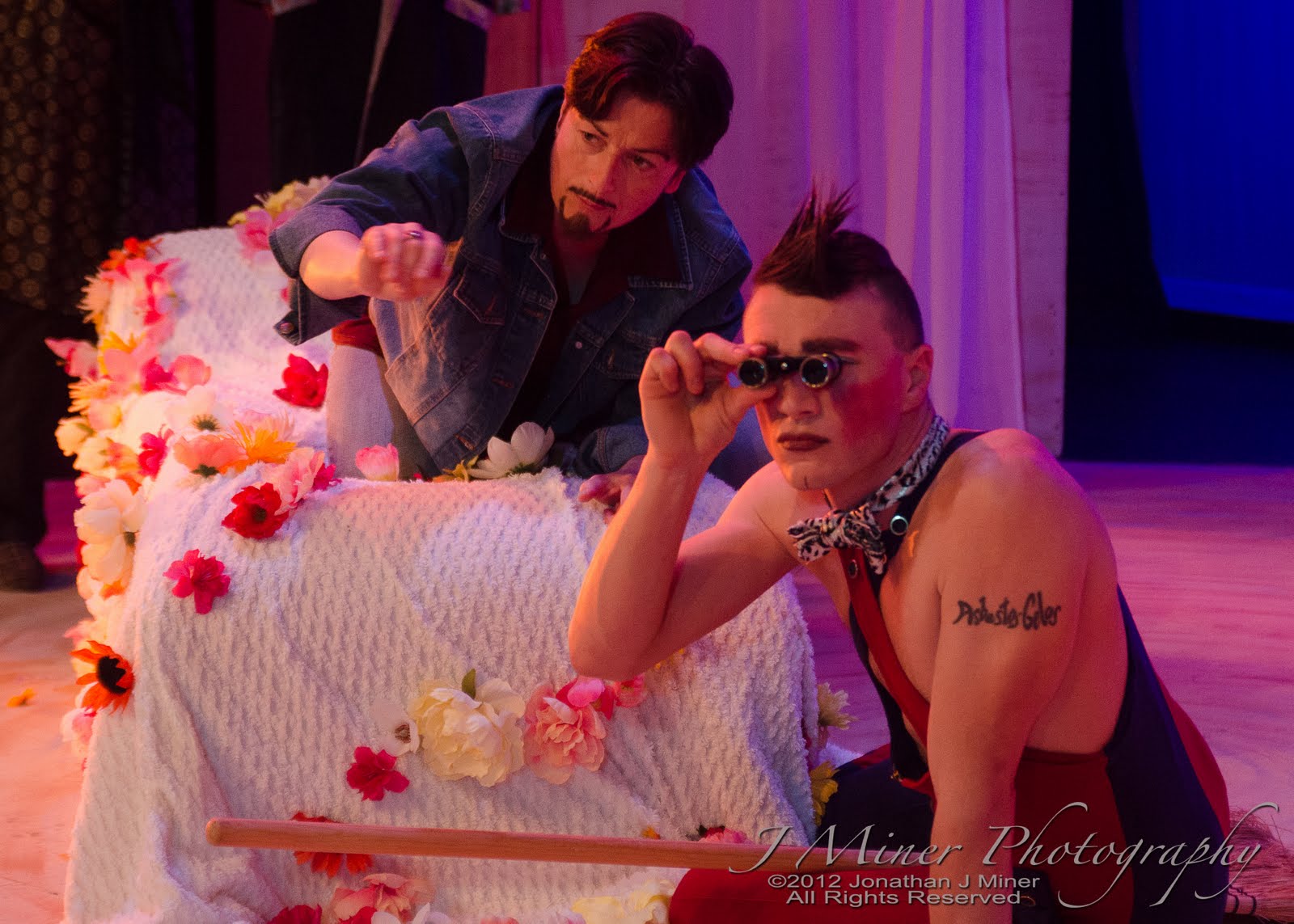
The set, which Harris designed, employs white sheets as as a palette to which the audience must apply the imagined trees of the forest. The costume design by Matthew Schroeder takes a “conventional,” modern-day approach. It’s one that works fine for the Athenians and the comical “rude mechanicals” who stage the-play-within-the-play at the end, but at first I was a little thrown when I saw the denizens of fairyland dressed (for the most part) in similar clothes as the mortals. The costume Erin Baal wears as Titania evokes a lithe elegance befitting a fairy queen, but people expecting more in the whimsy department may have seething brains when they see Oberon as a dude in a denim jacket — even if he does have the Orlando Bloom kind of dashing mien that Kathy Lynn Sliter exhibits in the role. On the other hand, in appearance and manner Sean Langenecker’s Puck is an agent of comic chaos, literalizing his line at the end “I am sent with broom before/To sweep the dust behind the door” by brandishing different sweeping implements over the course of the play.
Harris' approach to creating woodland magic in Midsummer is one of garnishment rather than immersive illusion. An aspect of the production that’s especially notable is the live accompaniment provided by local musicians db pedersen and Brothers Grimm. They employ instruments that include a guitar and cello but also more unusual elements like a musical saw and “found objects” like pot lids, and provide a slight otherworldly touch to the onstage action. The props, designed by Mary Betts, include dolls that represent the fairies who attend Titania (manipulated and voiced by the same actors who play the rude mechanicals). The lighting, designed by Steven M. Peterson, begins the play in blues, which for me evoked the memory of the first scenes of The Wizard of Oz and the promise of an exuberant end to the dark beginnings.
Amanda Carroll and Andrea Kleiner as playfellows Hermia and Helena each had a forceful stage presence that was delightful to see singly and in combination, whether they were evoking sympathy or going for laughs. The scene in which Lysander (Trent Mendez) and Demetrius (Taran O’Reilly) both attempt to woo Helena had a wonderful comic energy and was one of my favorites. The rehearsal scenes with the craftsmen were quite entertaining, with Joseph Lutz portraying a Nick Bottom whose unreflective self-confidence invited fondness rather than derision.
The conclusion of the play assembles the whole cast onstage for a farewell song, which has a simple yet expressive melody. It’s delivered to the audience and is an unexpected and stirring moment; the play has several references to the act of creating theater, and a scene like that finale creates the kind of connection that one can only have on the stage.
A Midsummer Night’s Dream is at the Bartell Theatre until May 25. Thursdays at 7:30, Fridays and Saturdays at 8, with 4 p.m matinees on the 11th and 18th. Tickets are $20 full price, $15 for students and senior citizens. Production photos by Jonathan J. Miner are here and Rob Matsushita’s trailer is here.
If you're craving more Midsummer after the Strollers production closes its run, check out the Royal Shakespeare Company's "digital theatre project" project Midsummer Night's Dreaming June 21 - 23.