



Key of Life could not have more mainstream sensibilities: It’s about an amnesiac (!), an impostor hitman (!!) and a woman who has pledged to find love by a certain date (!!!). Its festival qualifications are that it's Japanese, but there isn't a single beat that would've been out of step in a major American studio comedy. Of course, when the studios gift us with a glossy, “sophisticated” live-action comedy with witty stars and no obvious CGI, we get Date Night and Identity Thief. Some contrarians might sniff, and not wrongly, that there’s a lot confirmation bias that goes into privileging a festival film or foreign film over a multiplex draw, but the reverse is also true. Regardless, skill is skill, and Key of Life is a straight-up funny, happy movie about sad people.
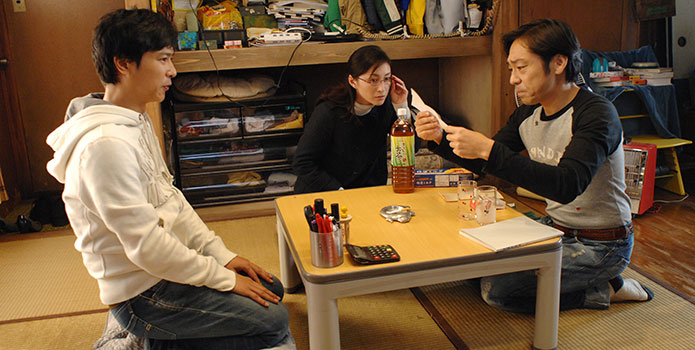
That sadness is important; when it's genuine, there’s more room for lift. The movie opens on Kanae (Ryôko Hirosue), a successful but withdrawn type-A editor who enlists her staff to help arrange a marriage for her; any other type A ought to do. Then melancholy Kondo (Masato Sakai) knifes a businessman and throws him in his trunk. And then Sakurai (Teruyuki Kagawa, of WFF2009’s Tokyo Sonata) fails to commit suicide. The actors sell each character’s distinct case of is-this-all-there-is-ism, abetted by writer/director Kenji Uchida’s unhurried shots, which always capture his actor’s faces as framed and amplified by Koichi Kanekatsu’s colorful, precise sets. Some of this is obvious shorthand (Kondo’s condo is fastidious, Sakurai’s flat is a mess, Kanae is boxed in by orderly bookshelves), but it’s shorthand with flair — classicism.
So Kondo loses his memory; Sakurai steals Kondo’s stuff, a move he’s unable to undo before they have effectively switched identities; and out of (mostly) magnanimity, Kanae befriends the befuddled Kondo, who is applying his ruthlessness to Sakurai’s shambles of a life as a failed actor. The more you describe the plot, the more rote it sounds and your praise again risks being stamped as special pleading, but: Scene by scene, the movie delivers genuine pleasure, either as pure antics or with just the right tug on the heartstrings. Credit the cast, and credit Uchida’s sense of rhythm and willingness to engage in earnest emotion between the laughs.
That rhythm fails Uchida a bit in the third act — there’s a bagginess to scenes that you want to feel a little more like mousetraps — but the last few scenes are perfect, and en route you get a marvelous single-take comedy extravaganza. It’s between Sakurai and the memory-restored Kondo as Sakurai tries to dance around questions of responsibility, professionalism, and women. We see the depths of Kondo's pragmatism, and also kindness, as well as Sakurai's broken-clock understanding of the world, which at least is right twice a day. Uchida contrives to have them execute something, multiple times, in an extended medium shot that offers no respite; it's glorious.
I could single out a dozen such terrific marriages of performance and staging, or of high comedy and low. There's a gag involving a sound effect that very few modern comedy directors would indulge — the Farrelly brothers, maybe, or Peyton Reed — but that tore up the Sundance audience. (The better referents are Wilder or Tashlin, maybe Sturges.) Uchida only has a few films to his name, but anyone who directs mass entertainment with such bravado, wit, eye and casting sense earns my allegiance.