Read-only archive. Accounts and comments are unavailable. Browse the archive.

WiFilmFest 2013 Review: Computer Chess

Computer Chess shoots the moon:
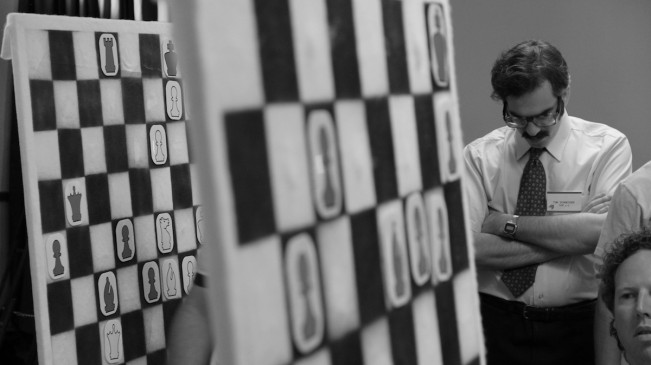
  • It’s shot on lo-fi video, which is typically a curse, but it’s so lo-fi that is goes back around the bend into weird analog beauty.
  • It’s half a mockumentary, which is as overdone on the festival circuit as it is in horror movies, but rather than go for (a) broad comedy, (b) improbable-behavior-in-front-of-a-camera drama or (c) foreground tedium while waiting for something exciting and “unexpected” in the background, its documentary sections are legit — and as a result, the story’s surprisingly deep intrigue is perfectly fueled by appropriate buttoned-down reactions or public performance.
  • The cast is primarily nonprofessional actors, but they are remarkable.
  • It is, according to writer/director Andrew Bujalski, much less scripted than the movies that earned him a rep as a founder of mumblecore, and so while you might think mumblecore + more improv = yikes, each scene is coherent both in itself and in serving the story. (… OK, I’m excluding the cat scenes from that judgment.)
But the thing about shooting the moon is that it's pretty risky, and I don't know a #wifilmfest movie that got a chillier reaction: @ThisIsDrivel I made it through just 30 mins before bailing on it. @NextShotInGlass Did not compute for me. Repeat Line 30. End. @BryanPost Is that supposed to be a good movie? Help me out here, Internet, because I wanted to leave the ENTIRE. TIME. @gregorthecat Ok. Who liked Computer Chess? Tell me why. OK: Computer Chess is set at a circa 1980 convention where computer companies and hobbyists pit their best chess-playing software (and hardware) against one another for a tidy cash prize and larger ego boost. Critical here are the reigning champs (Gordon Kindlmann, Wiley Wiggins, Patrick Riester), the well-funded upstart (James Curry), the competitor that has brought the first female in the history of the tournament (Robin Schwartz), the cracked genius (Myles Paige), the grandmaster the winning computer will play (Gerald Peary) and the crackpot spectator worried about World War III (Jim Lewis). (Of those actors, only Wiggins has more than two acting credits on IMDb, and most have only this one.) Out of this, Bujalski crafts the best Altman movie since Altman died. The only mockumentary portions are those that take place in the tournament; the rest is shot on the same vintage black-and-white tube cameras, but is shot as a fiction feature. But in both arenas, the performances hit that blessed zone of naturalism that works perfectly on camera. (Of the above actors, only Paige fails to convince; he gets the character’s bluster but it comes off as too mannered; you could connect this to the characer's ultimate fate, but that feels like overreaching.) The central story is about the Kindlmann/Wiggins/Riester knot, with Schwartz thrown in (as well as Anne Dodge, Kindlmann's wife, playing his character's wife), and this plotline by itself would have sustained me: Last year’s winner starts losing, and no one can figure out why. In its plotting, this storyline is practically commercial, a retro-techno-thriller portrayed through a slow build-up of inferences and interior performances. Kindlmann is the genius of the group, Wiggins the worthy tinkerer and Riester the curious apprentice, and those relationships feel deeply real, particularly when nonactors Kindlmann and Riester sit together for a debugging session — that scene is the perfect example of how well Bujalski succeeds with this approach. If this subplot didn’t do anything for viewers, then the movie as a whole is likely to lose them because it needs a solid anchor for the half-dozen bonkers things that happen (again, it’s a post-Altman Altman), including a New Age circle-cum-swingers’ party, a computer that … has graphics capabilities ahead of its time, a character that performs a self-craniotomy, and those cats. I wish I could say that I had a theory for all of this, and I likewise wish that I could confidently affirm that, in its climactic excess, the movie was in fact hitting homers and not foul balls, but: At least it isn’t bunting. I found Computer Chess meaty and will be delighted to revisit it, plus now I have to shake off the mumblecore bias and see Bujalski’s other works. Bujalski and Peary, a UW alum and film critic whose documentary For the Love of Movies played a previous fest, were on hand for Q&A after the screening. Politely, those in the crowd thinking “WTF?” didn’t ask it, and we got good insight into Bujalski’s process from both him and Peary, orchestrated by festival Director of Programming Jim Healy. Bujalski noted that while his other films have been fully scripted, this never had more than an eight-page treatment, with actors given scene parameters on the spot and left to improvise (or, in Peary’s case, write and memorize his own monologues). The most telling moment of the Q&A was that Bujalski was in the process of becoming a father for the first time as he hatched this movie, which goes some way toward tying down some of the bonkersness. Describing how the film came about — specifically, how pressure to shoot video instead of 16mm film led him to this archaic format, and how the period cameras reminded him of a book of the same vintage about chess-playing computers, et voila — Bujalski could only sheepishly confess that he had killer commercial instincts.