



People may have seen a viral video clip that made the rounds last year of a herd of dairy cows being lead out of their barn after being cooped up all winter. Their massive bovine forms nearly prance into the green fields of grass, kicking up their heels in the free open space of a meadow.
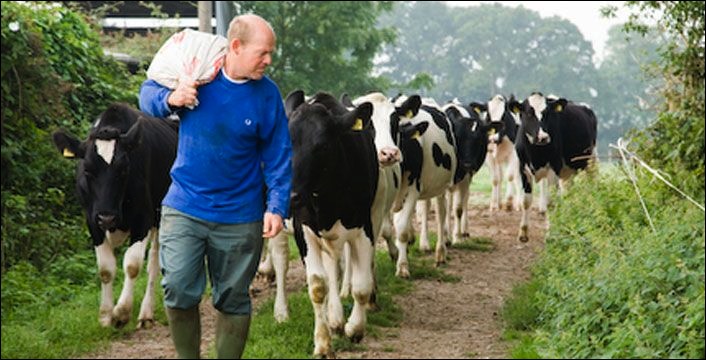
Moo Man includes such a clip, but notes that this display of apparent animal joy, and dairy cattle even getting a taste of fresh springtime grass, is the exception to the norm. Steve Hook is an English dairy farmer or “herdsman” as he refers to himself. He tends a herd of 72 dairy cows, which is well below the number normally found at farms now a day. He and his family run Hook and Sons, which provides fresh raw milk door to door and at farmer’s markets as a specialty small business offering in a world of inexpensive mass-produced dairy products.
The film has very little narration, with Hook only rarely speaking to the camera. It's not an incredibly tight film technique-wise, but for what it sets out to do-- give a window into the life of a small farmer-- it doesn't need to be high tech. The times the filmmakers chose to add music are few and far between. Many times the audience is left listening to the droning sounds of the milking equipment.
Still, the film itself is not monotonous. It skillfully shows the repetitive nature of being a farmer, but also the life or death situations that happen frequently, from calves being born early to cows getting sick or having trouble giving birth at all. Watching Hook chasing, pushing , feeding, lugging, watering and milking these giant creatures shows the physical demands of the job as well.
Hook has found a way to make his farm profitable, but he laments unnaturally low milk prices that force so many others out of business. "All we want is the dignity to make our own living," he says. If the system is set up to pay less for milk than it take to produce it, "what's the point ? You work hard for nothing."
Early on there is a scene of a mother cow being separated from her calf. Watching this film in Wisconsin, in a crowd that no doubt contained a high percentage of people who grew up on or, like myself, near dairy farms, made me consider how different a person with urban roots versus one of rural background would view it. Scenes with cows doing their business wherever they stand, flies covering the faces of animals, the farmer discussing a steer’s personality while unloading bags of meat containing the remnants of the animal in question may have a greater impact on people who have not “been there, done that.” Still, hearing that mother cow crying for her baby could still move even the most rugged individual close to tears.
Cows are pretty funny creatures—giant, boxy, lumbering, with perpetually confounded expressions and so often, massive utters that swing back and forth as they walk. We see a lot of cows in this film, and when not in peril, just the sight of them doing cow things on the big screen compelled titters of laughter from the crowd. The real lasting images of the film are the happy ones, like the cows cavorting in the grass. Even when we see Hook struggle with the fact that he treats some cows more as pets than as livestock, which leads to some tough decisions, we also see there is no other way to be compassionate. Love can be bittersweet, but it’s all we have.