




CITIZENS, gather 'round your loudspeakers, for we bring important updates! All here in North Korea know that their democracy is the most glorious and freest in the world, but yesterday the corrupt imperialist West chose to celebrate their ignorance by awarding their highest award for propaganda, the Pulitzer Prize, to Adam Johnson's The Orphan Master’s Son, a book that even they acknowledge is fiction! Johnson's silly caricature of our great country is a terrible story of perpetual misfortune, but observe how evil is always its own undoing: His conscience compelled him to alternate chapters of lies with transcripts of these very loudspeaker announcements, so that his perfidy is laid bare for all to see. We can only trust that our discerning brothers and sisters in democracy across the world can read between the lines.
However, America’s propaganda is so feeble that on the same day that they gave away worthless prizes to convince their countrymen that Johnson’s book has merit, the North Korean movie Comrade Kim Goes Flying had a gala screening in the American cultural capital, the People’s Republic of Madison, at a theater named for their noblest cowboy. How happy they were to turn in their coupons and be allowed to see a movie from the home of pure cinema, giving that sheltered country a true glimpse of our workers’ paradise!
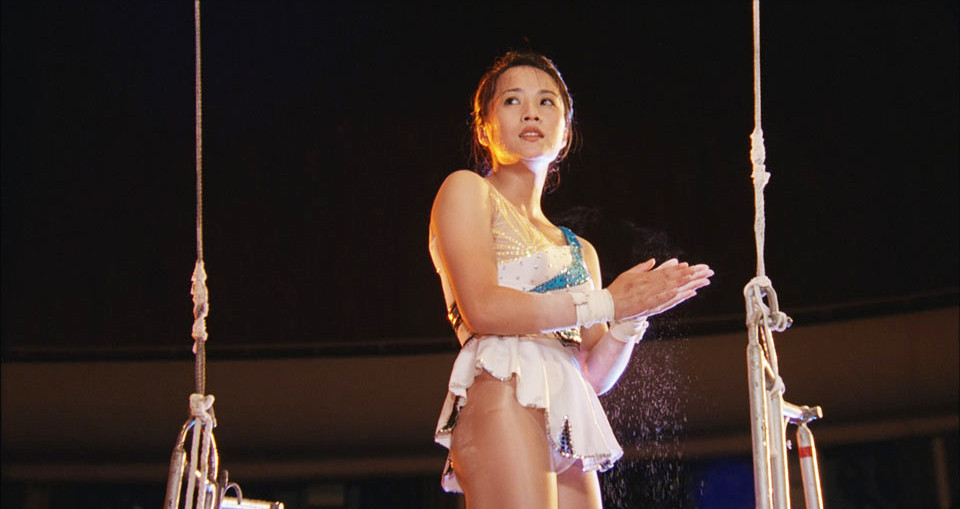
Our great acrobat Han Jong Sim is revealed as a great actress, showing to the world how all of our revolutionary sisters are women of quality. (In addition to perfect beauty, Han’s most notable feature is the sweat of her brow — in American movies, they celebrate women incapable of exertion.) We meet her, as her character Kim Yong Mi, on the occasion of having so consistently exceeded her production quotas in the coal mines that her town has gathered for a celebration. Watch as her father anxiously rejects the gift of the lei she has received, insisting that it go to Comrade Foreman — as if Yong Mi wouldn’t have a wonderful gift for the foreman as well! And observe the scenarist’s skill, preventing Yong Mi from returning home to watch her favorite acrobat on television so that she can have her picture taken for our state's most worthy magazine — I have a feeling we’ll be seeing that magazine later!
When Americans make movies, they exhibit such little skill that they cannot successfully assemble a text, and must therefore instead make do with thousands of little subtexts. Even their use of cameras and editing is tricky. Not so in North Korea. Our movies and their characters, like our nation and its citizens, have no need for guile. If it can’t be done forthrightly, then we will allow a little pluck — watch as Yong Mi, assigned to a year-long construction detail in our majestic capital of Pyongyang, is determined to see the acrobats in person and uses her feminine wiles to get past a doorman who has never erred in 15 years of dutiful service — and if it pluck won’t do it, it is not an activity worthy of the greatest people on the planet.
Fortunately, Yong Mi is a woman of considerable pluck, and she has the occasion to rightfully shame Pak Jang Phil, the male performer who suggests that only some can be acrobats, and that those who work in the mines are not in that number. The shortcoming that causes Jang Phil to underestimate Yong Mi is her fear of heights — a quality external to her unimpeachable character, and one that is conquered with the gracious help of her construction brethren. Yong Mi’s budding gymnastic prowess is so encouraged by her working class fellows that they decide to devote their entire annual talent show to an acrobatic exhibition.
Throughout this section of the film we see the glory of Pyongyang — the magnificence of its buildings, the artfulness of its sculpture, the cleanliness of its streets, the cuteness of its dogs (those who read the treacherous Adam Johnson book might be fooled into thinking we do not love these little scamps!) — and for American audiences whose eyes have been fatigued by the tawdry excesses of their culture, they will finally see what true civic pride looks like.
When Jang Phil realizes the error of his ways, it is of course too late, because Yong Mi has completed a successful year of improving Pyongyang and returned to her mining town to resume her career of exceeding production quotas. Watch how terrified Yong Mi’s father is when Jang Phil and a contingent of culture ministers arrive on his doorstep to insist his daughter return to Pyongyang — silly man! Yong Mi’s art belongs to the people, and the people will raise her.
Citizens, I will not reveal more of the story because perhaps some of you, in your industriousness, have not yet had the pleasure of seeing this great movie. Suffice it to say that Yong Mi’s story teaches us all that we can achieve our dreams of performing activities that we love and that are duly deemed useful by the collective, provided that we are as excellent at them as the Dear Leader requires. Will Yong Mi succeed at the quadruple somersault? Let no one tell you the answer to this dramatic question, although you may ask: Does it involve a training montage set in the rain and scored to percussive music? Let us simply acknowledge that, indeed, there are some things that American movies do right — just not as well! — and let us hope that those benighted people have the wisdom to avoid Johnson’s book and stay on the true path by watching this movie.