



Reviews by Kat Kosiec and Christie Taylor
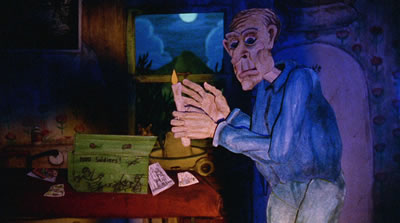
Kat Kosiec: The result of 15 years of shooting Consuming Spirits one 16mm frame at a time and screening unfinished drafts at festivals (including the 2005 Wisconsin Film Festival) is this 129 minute film. Composed of multiple animation techniques, including cutout animation, pencil drawing, stop-motion, and collage, it is not a surprise that director Chris Sullivan is also a professor at the School of the Art Institute of Chicago.
The animation is incredible; jaw-dropping, beautiful, haunting, and disturbing. Most of the film feels like it takes place in an alternate reality that is part dream, part nightmare, and part small-town America. The slightly crude and grotesque protagonists of the film aren’t very likeable, but absolutely fascinating on screen as they say pretty much whatever comes to their minds.
Told in 5 parts, the three main characters literally crash into each other’s lives after a late-night accident involving a school bus and a nun. While at times hard to distinguish between past and present, the film ties up all of the loose ends nicely, making sure to have horticulturist Earl Gray spell everything out to us in detail.
Despite the mammoth amount of time spent on the film, and the absolutely amazing animation, I wish the film was edited more liberally. The plot just isn't on the same level as the animation, and it's disappointing because the film has so much potential. At times, the plot felt drawn out, and I found myself squirming in my seat, wondering if I could sneak a peek at my phone without illuminating my face in blue cell phone light. The slightly awkward dialogue and plot twists are also uncomfortable at times. Anything goes, and pretty much anything that could happen, logical or not, happens in this film. After about an hour in, the quirkiness of the film gets tiresome and makes a disappointing turn to boring, and even the fabulous animation can’t save it.
Christie Taylor: Like Kat, I found the animation jaw-dropping, which was, if not always gorgeous in this dark, grotesque film, then at least perfect for the mood, right down to one character's articulated paper cat. Sullivan deserves his accolades. Moreover, the mix of styles suited the story, and once I figured out that his barest-bones black-and-white pencil animations indicated memory and the past, I loved even the unfinished quality of those.
But this story was still, at first, confusing. I even had trouble telling some of the characters apart at first, before I realized they're always wearing the same clothes, driving the same vehicles. It settles in more as a jumble of sensory impressions, then, and the plot slowly emerges from there.
And what a plot. The car crash with the nun is only the kickoff to the final act of a story that actually, we come to learn, began years ago. Victor Blue, whose dysfunctional adulthood traces back to his dysfunctional childhood and alcoholic father, must now solve his father's disappearance for legal reasons. It's his past that we spend our time in, for the most part, and it's heavy and sad. The present is at first more mundane, studded with late night drives, either exhausted or drunk, and often narrated by radio host Earl Grey (voiced, gorgeously, by Robert Levy), whose garden wisdom often expands into terrifying reflections on life as a whole. We also lurk in the life of Gentian Violet, who struggles to care for an aging and mentally declining mother.
It's awkward to tell someone that the film they spent 15 years on is too long. Unlike Kat, though, I enjoyed the small touches that made the film quirky, funny, (for a good laugh, read the written words that appears on the screen) and further set the mood. It's difficult to tell, at times, where the meat of the story is in these flurries of birds, flashbacks, and perpetual presence of deer at fenceposts and in gardens, but I enjoyed the world Sullivan built for us, and I'm all right with touring it.
But the end, I think, ran on, and gives away too much in Earl Grey's final monologue and the last few surprise twists of the film. I disagree with impulses to tie up every single loose end, and it's frustrating, as an audience member, to be at the receiving end of explain-it-all bursts of exposition after I've spent two hours trying to solve the mystery elements of the story. If you're going to ask your audience to work to understand, don't spoil their sense of accomplishment by giving away the answers.
One answer we didn't get: what is meant by the title? At first I thought the "consuming spirits" might be alcohol, for all that it rules Victor and his father's lives. But the last revelations lead me more to suspect it's obsession in a more general sense, the kind that leaves no room for common sense or kindness at the outskirts.