



Leviathan
Thu, Apr 18 | 6:30 PM
Sundance Cinema 5
Leviathan is a movie that leaves you slightly dazed in your seat during the credits, grasping for words. Then, graciously, it provides them: The last card reads "Produced for Sensory Ethnography Lab."
SEL turns out to be an outfit run out of Harvard, home base of directors Lucien Castaing-Taylor and Verena Paravel, but that descriptor — sensory ethnography — is just right for describing this portrait of a deep-sea fishing vessel. There's no narration; there are no characters; there is no story apart from the most basic causality (as in, you don't see any fish get cleaned until you see some caught).
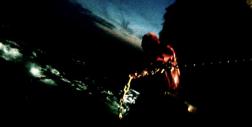
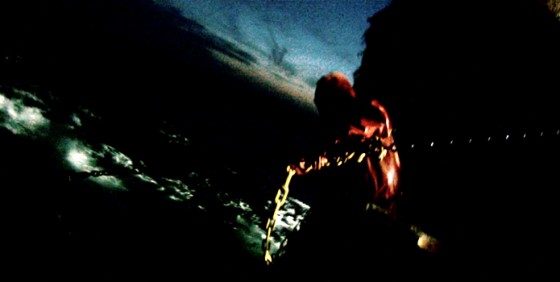
What you get instead: A camera mounted on a fisherman who's supervising the trawl nets in the back of the boat on a choppy night, watching cables and chains retract out of the infinite black. A camera sliding on the ground as gutted fish are piled around and atop it. A camera seemingly used as a bobber, oscillating in and out of the water as other marine life circle for discarded meat.
Each sequence is at most three or four shots, and is most typically only one. There’s an expectation that direct cinema about men at work is going to be simply shot — set up a camera 100 ft away and see what happens. This is not that. There’s no “objective,” “indifferent” reason to include an upside-down shot of seagulls flying. You only do that when you feel like having the image of upside-down seagulls; it’s a painter’s concern, pure aesthetics.
And Leviathan is in its own way beautiful. The title creature is not any fish but the boat itself, the apex predator of the seas. The movie concerns itself, ethnographically but also biographically, with the functioning of the ship, with each sequence essentially detailing another bodily system. We see it eat; we see it digest; we see it excrete.
We often see humans, but other times just machinery, or just fish — the movie is concerned with the components, with no particular prejudice. (The cast list in the credits is in alphabetical order, and freely mixes the boat’s crew with the featured fish species.) We do watch a man on his lunch break watching Deadliest Catch, but that feels less like one character’s development and more like an involuntary function, a peek at the ship's subconscious.
I found that its 90 minutes flew by. It’s a bloody sit — any pescatarians could be driven straight into pure vegephilia — but it is both an invaluable window into global foodways and an amazing feat of immersion.
The remaining screening is at Sundance; I would be curious to peek in at it there to see if the picture issues are a function of having been shot on cameras optimized for the robustness necessary to let them be dropped into the ocean, or if the equipment at the Elvehjem is still behind the curve. I swore off this venue after a bad bout of digital projection at the 2009 fest, and while this wasn’t as bad — the blacks were nice and black, at least — there was still more pixelation and video noise than I’d hoped to see.