



Blancanieves
Friday, April 12, 7:45 p.m., Sundance Cinema 6
Rush tickets only
There's a concept in Spanish called duende that we used to talk about a lot in my college poetry workshops. It is, to summarize in far too few words, a heightened emotional state that is connected to death, irrationality, struggle, darkness. Duende might be why a certain note of the blues, or the ragged edge in a singer's voice, or a violin bow scraping against the string makes you shiver. Spanish poet Federico Garcia Lorca, who wrote extensively about duende, connected it in particular to flamenco music and dance, and, more recently, musician Nick Cave points to Bob Dylan, Van Morrison, and Tom Waits as masters of that dark shiver.
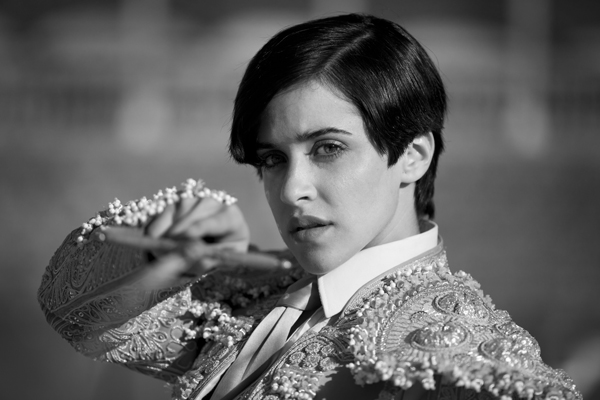
I say all this because Blancanieves, the third retelling of Snow White in the last two years, is thick with the darkness that breeds duende. It's 1920s Spain, and, fitting to the decade, we're in a classic silent, black and white film. Star bullfighter Antonio Villalta (Daniel Giménez Cacho) becomes crippled, and his wife dies giving birth to daughter Carmen (played by Sofia Oria as a child, then by Macarena García as an adult). Villalta remarries a greedy woman, Encarna (Maribel Verdú), and Carmen lives first with her grandmother, then in the chicken coop of her stepmother's sprawling country estate, where her father, trapped in a second-floor room, secretly teaches her some of his trade. Only as an adult does she become free, falling in with a group of six bullfighting dwarfs and making use of her heritage as the great bullfighter Blancanieves (Snow White).
I was worried a lack of color or dialogue would limit this film. I was wrong to worry. The cinematography takes full advantage of the clarity of a black and white world; the enormity of the sky in landscape shots overwhelms, while something as simple as an eyelash can starkly dominate the entire screen for an eternity.
The actors convey most of what they need, fluently, in gesture and eye contact. The dialogue we do get is often fewer than five words, and by the end I was in love with every actor because I'd been paying such close attention to their faces. And yes, the music is gorgeously matched, with plenty of fast-paced flamenco at pivotal moments of struggle. If Blancanieves were only the bullfighting scenes, flamenco, or a rickety wooden wagon traversing a treeless grassland, it would still be a beautiful show.
It would be easy to criticize plausibility in places. While nothing explicitly magical occurs, convenience and uncanny timing are both definitely common. Some events are predictable, because we know what basic story we are seeing played out. Carmen, who starts out life as a lonely little girl who longs to know her father, is always and forever the heroine, and we of course cheer when she first finds him, and later when she does him proud. But did she have to be so uncomplicated and sweet? And did Encarna have to be so cartoonishly evil? We see her scheming, jealous, and at times enacting scenes of leather-clad domination with her chauffeur--unfairly consigning that particular lifestyle to the realm of evil, by the way. I get that fairytales are built in part on shortcuts, and much of the emotion of this film rests on simply wanting Carmen, after all her trials, to be happy, but wouldn't it be a nice challenge, not knowing who to root for?
This film will try to trick you into thinking it is one thing or another. Don't get comfortable. Laugh when it's funny (it is), be charmed by moments of triumph, but also be ready to quietly leak out the corner of one eye when duende strikes (it will). Remember the elements of the fairytale, but don't get hung up on what you think you know about them. There will be an apple, but the magic mirror is a magazine, and there are only six dwarves. And the prince? And the ending? This film will try to trick you. As Antonin Villalta himself warns both Carmen and us: Never take your eyes off the bull.