



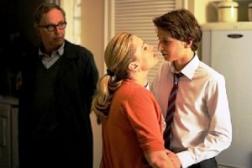

In the House begins in the classrooms of a French high school, where English teacher Germain (Fabrice Luchini) is starting a new year with students whose writing skills bore and depress him. "Barbarians in our classrooms," he tells his wife Jeanne (Kristin Scott Thomas) while grading papers one night. Then he stumbles upon Claude Garcia (Ernst Umhauer), a poor student whose writing, the beginning of a story about his middle class classmate Rapha (Bastien Ughetto), shines in contrast.
Claude, whose own family is scattered and struggles with money, writes that he's been fascinated with the life of the middle class, and has tricked "normal, affable" Rapha into asking him for math help, and thus letting him "in the house," a phrase repeated often throughout the film. He shares, with an anthropological fascination, the intimate details of Rapha and his parents' lives: how his mother and father pick him up from school hand-in-hand, their father-son rituals, and "the distinctive scent of a middle-class woman" that piques an even deeper, more dangerous fascination with Rapha's bored stay-at-home mother (Emmanuelle Seigner).
Germain is quickly enthralled by the unfolding narrative, and encourages Claude to continue the story as weekly homework, even as Germain loans him books and teaches him, in one-on-one tutoring sessions after school, the more advanced tools of fiction. The film is heavy with dialogue and, as Claude narrates his scenes with Rapha, monologue. Tellingly, most scenes take place either "in the house," at school, or in Germain's own home, where he shares Claude's work with his wife. It is an odd kind of story within a story, where the audience sees the two, Rapha's home life and Claude's observation of him, as existing in parallel. But meanwhile, Germain and Claude talk about these real people as characters--and slowly confuse us as well.
What really happens, and what is imagination? Claude says at one point that he can't imagine, that he has to be in the house in order to write, but he also changes key plot points in revisions, and even some that go unchanged fall into morally questionable territory--did he imagine Rapha's parents making love, or did he in fact peek through the doorway?
Director François Ozon builds tension with both that uncertainty, and another--What genre is this story, this film? "This will end badly," Jeanne observes at one point. But are we to laugh, cry, or bite our nails in suspense?
Germain gives us clues even as he critiques Claude's writing. "What are you trying to write? A middle-class satire, a coming-of-age story?" he asks early on. "We're in a bad farce," he declares later. And indeed, if he was our entrance into this world, he soon has the air of a dupe, while Claude, always half-smiling, rises in our estimation as the true master of not just Rapha's story, but Germain's as well.