



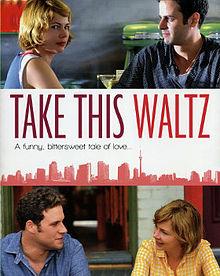
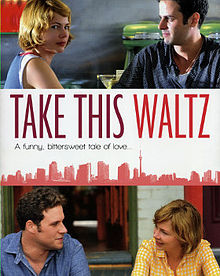
For much of its running time Take This Waltz is a surprisingly touching and rigorous infidelity drama.
Once you bear with some over-cranked meet-cute dialogue in its first 15 minutes, the movie settles into the sweet and sad process by which Margo (Michelle Williams) puts her happy five-year marriage to cookbook writer Lou (Seth Rogen) on the scales opposite her thrumming ardor for her neighbor, starving artist-cum-rickshaw cabbie Daniel (Luke Kirby).
The question of "will she?" is not a fait accompli: Daniel trips all of Margo's lust triggers and is a master of sensitive-guy questions, but Lou is a font of goofy companionability, a playful and supportive partner despite the fact that he and Margo easily lapse into the bickering of committed couplehood.
The best part of the movie proceeds in this vein as Margo goes on allegedly chaste quasi-dates with Daniel around a crayon-hued Toronto (which has never looked better onscreen), then goes home to Lou aching to feel something. This lets Williams take full advantage of her bruised-peach demeanor, the way her face can go in two seconds from neutral to smiling by way of almost sobbing. Margo is a portrait of self-consciousness that unselfconsciously alternates between halting and strutting, and Williams gets more out of closed lids and a half-retracted gesture than many actors can achieve with their best puppy dog eyes.
Speaking of puppy dogs, Rogen and Kirby are merely fine, able counterparts in their scenes with Williams but blanched by being grab bags of convenient male traits more than characters (by contrast, in only four scenes Sarah Silverman turns in a fully sketched performance as Lou's alcoholic sister).
Writer/director Sarah Polley foreshadows her true ambition, however, when Margo tells Daniel her fantasy of going with him (wink wink nudge nudge) to the lighthouse. The last act expands on that staked claim: Polley wants to contribute something to the feminist canon, a common-cause attagirl for women who've come to feel they're in the wrong marriages.
The problem is that the movie seems to only be able to advance this concept by eventually undercutting the idea that Margo and Lou were ever happy. Rogen makes Lou chummy and warm, but in the clutch Polley sells him short, depriving him of qualities anyone would regard as critical, such as an interest in carrying on dinner conversation. Likewise, Margo’s prospective relationship with Daniel is as explicitly carnal as it can be while still being technically chaste, and so reducing Margo and Lou's conjugal bliss to a one-second shot of preparatory under-the-covers pajama-shucking stacks the deck. Near the end, Margo's baby-voiced "I wuv you" is contrasted with a huskily whispered "I love you," a signal that Lou and Margo's cutesy manner -- the surest thing those two have, and which Polley had earlier privileged -- is, in fact, infantilizing her, keeping her from fully entering womanhood.
This all shifts the movie's thrust from "Should Margo leave a happy marriage?" to "Should Margo stay in a stifling marriage?" That's a much less gripping question, and as Polley turns her attention toward it, she revises away the tension that made Margo's plight so screenworthy. Even viewed through the lens of "Margo’s awakening" rather than "Team Lou vs. Team Daniel," the movie suffers every time Lou’s behavior lowers the cost of that awakening.
The bookend sequences downplay the idea of happy endings in favor of dramatizing Silverman's proclamation that "life has a gap in it" -- delivered with the gravitas of one who knows -- and in so doing Take This Waltz respects its subject. But for all this lovely movie does right, it takes an easy way out when a more challenging spirit -- one that made the husband more empathetic, or that cast Rogen as a silly paramour and the conventionally hunky Kirby as a stolid spouse -- might have made it exceptional.
Take This Waltz plays at 7 p.m. on Thursday, October 4, as part of the Madison Museum of Contemporary Art's Spotlight Cinema series.