



As the Union South Marquee opened up Friday night for animator Don Hertzfeldt's screening and Q&A, the screen showed sketches and storyboards full of chicken-scratch instructions and cryptic calculations. Some showed blurry scribbles of nothing in particular, others showed people with mutant distended crotch-bellies bumping into grocery-store fruit displays, and still others showed the story of Hertzfeldt's "Bill" trilogy coming into focus.
The screening included the newest of that series, "It's Such A Beautiful Day," and the previous entries, "Everything Will Be OK" and "I Am So Proud Of You." The three films, about a man suffering from an unidentified mental illness, alternated with the kind of gleefully violent shorts for which many of us first came to love Hertzfeldt. Sure, they all featured his simple line-drawn characters, but it made for a temperamental lurching back and forth that highlighted how far he's pushed himself emotionally with the new work.
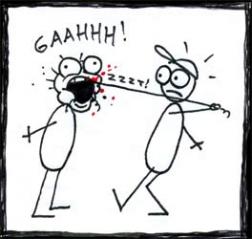
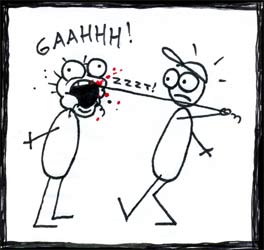
The screening kicked off with "Wisdom Teeth," in which a friend pulls out stitches from his friend's gums after a wisdom-teeth operation. The characters speak in a quasi-European gibberish language, subtitled with lines like "This is a pain of unreasonable proportion." The brilliance of the short is that it somehow finds comic timing within one interminably drawn-out bit, the victim picking just the right moment to toss his arms up in exasperation as more and more thread piles up at his friend's feet. It's not quite as long and hallucinatory as the amazing "Rejected," which wasn't included Friday night, but had the same power to wrench laughs out of a crowd.
The little corn-puff dudes from "Rejected" (i.e. "My anus is bleeding!") did appear in an "Intermission" short, and they shared at least one thing in common with Bill: the goofy triangles that their mouths form when they're smiling their purest, most wonder-glazed smiles. Between the first and second Bill films, the audience also got some release from another demented favorite, "Billy's Balloon," in which colorful balloons beat up on little children and lift them up into the sky to drop them. The room got to feeling a little uneasy as "Billy's Balloon" kept on escalating, as if it doesn't tap into its own comic sickness quite as effectively as "Wisdom Teeth."
In much of the Bill shorts, released between 2006 and last year, the characters appear in irises torn out of a black background, making for an assault of imagery — the first short piles dead horses and an unpleasant boxing injury, unafraid to overlap runaway details over the main story. Even the narration occasionally begins to pile up in multiple simultaneous loops and tracks.
Hertzfeldt later told an audience member who asked about his sense of humor that "there's some escapism in black comedy," but the trilogy really seems focused on how frightening the world can become, even on the most dull day. Here, the violence of a "Rejected" or a "Wisdom Teeth" mutated into subtler and more flexible forms, especially the bursts of flames and color that invaded the frames, in a mix of film and digital animation.
There were still plenty of grotesque laughs, though, especially as "I Am So Proud Of You" revealed the history of mental illness in Bill's family. His grandmother is shown rubbing detached cat heads on her scalp, their ears flopping and their mouths fixed, again, in those happy triangles. In "It's Such A Beautiful Day," the more color-blasted, experimental animation begins to meld even more deftly with Hertzfeldt's wobbly scratch-paper style, as Bill's illness becomes more unaccountable, more unpredictable, and, to him, unbearably vivid. Bill dreams of the headlights of cars submerged in the ocean, and "his bath mats are gorgeous." At first in the Bill trilogy, you might understandably wait for the weird slapstick, especially Bill's neuroses about supermarket fruit and where it's been, but pretty quickly it's clear Hertzfeldt's animation has a command of much more than shocking laughs.
Hertzfeldt came out afterwards to take questions from the audience and from WFF and Cinematheque programmer Jim Healy. In a short Q&A session, both Healy and fest-goers managed to get in some good questions, and Hertzfeldt came off as soft-spoken and deferential. He explained why it's important for him to tour with his films, which is also a big part of how he funds them, as a mostly one-man operation. If he didn't go out on the road, he'd have never known about "Wisdom Teeth" driving an elderly couple out of a New York City theater within its first two minutes. Also, he said, "I spent two years in very dark rooms making the new movie, and it's good for me to get out."
The most surprising parts of the Q&A were about Hertzfeldt's use of music and sound. The most interesting question came from an audience member: Why do so many of his films include an airplane-engine sound? Healy asked Hertzfeldt about his habitual use of classical music, and Hertzfeldt revealed that the soundtrack of the Bill trilogy includes some bursts of "infra-sound," which are outside the range of human hearing, but can be felt physically. Though the trilogy is more technically ambitious, and integrates more digital imagery into his frame-by-frame shooting on old 35mm cameras, Hertzfeldt also said that he used broken glass and "cheap magnifying glasses" for some of the effects. Lastly, he also gave up just a little detail about a feature-film project he's planning: "It's a period piece, it's set about 100 years ago, it's 2-D, so you can tell the major studios are falling all over themselves."