



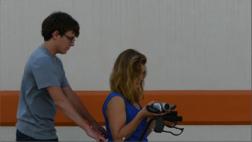
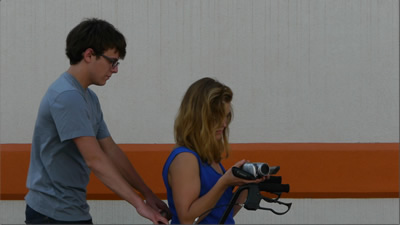
Frames is a schematic movie, a thriller-in-quotes, built in a very particular way to run contrary to received expectations about how moviegoing is supposed to go. As ever, viewers are welcome to their reaction (it feels like a high school pageant version of Blue Velvet, which I truly don't mean as a diss, and I thought it was at least one entanglement shy of being knotty enough to be haunting), but the fact that it's stiff and mannered on purpose means there's no profit in harping on those qualities.
Rather, let's engage the movie on its own terms. An example of its manneredness is that every time someone finishes a line of dialogue, you can always say "one Mississippi" in your head before anyone reacts to it, such as with their own dialogue, or perhaps a facial reaction. OK -- we're going for Bresson's highly unaffected "model" (as opposed to actor) approach. But to what end? In the post-film Q&A, cinematographer Aaron Granat called these "pregnant pauses" a suspense-building technique, but I have to differ -- whatever soupçon of suspense you experience from this the first 20 times ultimately contributes to a narcotizing effect. As a result, none of the pauses are really suspenseful, even the longer ones -- you've negated their force. This same torpor kneecaps the humor as well -- as near as I can tell, cutting from Peter's love interest saying "Do you want to go to my room? My dad won't be home for more than an hour" to the two of them sitting on her bed with their hands folded in their own laps is a punchline, but the audience is on parsing-formal-awkwardness tenterhooks and therefore indisposed to laughter. I counted at least four sequences where I believe the filmmakers expected to get a chuckle out of their audience that didn't come.*
Director Brandon Colvin also notes the opportunities created by this deviation from naturalistic speech -- he's interested in the "slippage" that occurs in viewers' minds between actor and character, an underbelly that the pauses expose. This is true, and effective even, although when dealing with a somewhat green and definitely unfamiliar cast, you risk having viewers assign the wrong motives to why they're especially aware of the actors more than the characters -- namely, because this is a hallmark of amateur acting, although for my money no actor seems ill-qualified for their role.
The movie's aesthetic is highly planimetric long takes, which it executes well, but there's a problem in having the movie be about first-time director Peter (Holland Noël), and then opening the movie with the same shot of scaffolding that Peter also wants to use as the opening of his documentary about his small town -- a decision that Peter comes to fret later in the opening scenes. Even experienced filmmakers operating at the height of their powers can't keep a meta-soufflé like that from collapsing.
So even recognizing that the film has peculiar objectives, it's fair to say that it achieves those objectives, but hit or miss as to whether meeting those objectives served the movie. Frames is, legitimately, a student film, and it's heartening to see students committed to using that forum to continue to refine their ideas of what movies should or could be. After the film, Colvin, Granat and editor Tony Oswald ran Q&A, which included some justifiably befuddled viewers who hadn't realized to what they were signing up for, as well as attuned audience members who compared the film favorably to Jeanne Dielman, 23 quai du Commerce, 1080 Bruxelles, one of the signpost movies of the extended-take, counter-naturalism approach. (This name-check elicited high fives and fist pumps among the filmmakers.) Colvin noted that, in retrospect, his movie had "too much plot" for them to take their ideas as far as they wanted -- he and Oswald rued the loss of a three-minute scene in which you watch the microwave count down the cooking time on a Hot Pocket -- and Colvin warned their next movie wouldn't be quite so plotty. (And in Frames' case, we're talking about as much plot as you could fit into two thimbles.)
But what the filmmakers wanted is a perfectly ambiguous movie -- does Peter, through his filmmaking, see what he thinks he sees, with a conspiracy actually afoot, or is he just manufacturing dragons when none exist -- and Frames executes it. They expect the film to be available for free online viewing eventually, and if you want to test your mettle against a moviegoing style that's likely unfamiliar to you, it's a good exemplar because it's just engaging enough in its own right.
* One perverse joke that may not have been intended for mass appreciation: Peter says the only Hitchcock movie he's seen is Psycho, but when Frames reprises Psycho's peephole scene -- namely, a man illicitly peeking at a lingerie-clad woman facing her dresser stage-left -- they steal not from Hitchcock but from Gus Van Sant's Psycho remake by foregrounding the sound of Peter's breathing, one of Van Sant's more notable changes in his "shot-for-shot remake." Even as I say that, calling it a "joke" turns to ashes in my mouth, but, hey, it was funny.