



Dan Walkner's review
If you have an uncle who lives in the U.P., you're probably no stranger to metal detectors. Personally, I once used a metal detector to locate the decapitated head of a Big Bertha driver that was in some swampy deep-rough near a water hazard: it turns out that without both broken parts you can't cash in the warranty. Familiar Grounds, another gem from Quebec, written and directed by Stephane LaFleur, begins with a lonesome figure detecting metals in what looks like a snow covered landfill. That figure is Benoit, played solemnly by Francis La Haye. We follow Benoit and his sister Maryse, played brilliantly by Fanny Mallette, as they deal with depression, boredom, and a super-natural visitor who holds the key to an altered future for both of the siblings.
When described on paper, this movie sounds fantastically absurd. Maryse begins a mental spiral after an incident at the factory where she works when a co-worker loses an arm in a powerful machine. Her husband Alain is a driver’s ed. instructor who is trying to sell a back-hoe parked on a pile of snow in his front yard with no takers. Benoit is a Peter Pan-esque character who gets from point A to point anywhere else via his father’s vintage and unreliable Ski Doo snowmobile. Let’s not forget the brutal assault of a defenseless snowman. Then there’s the used car salesman who returns to the past, from 7 months in the future, as a messenger to Benoit with a portent of doom for Maryse. What can’t be captured on paper, though, is the film’s ability to convey the complex emotions of solitude and loneliness while truly capturing the day-to-day drudgery that often surrounds industrious, blue collar lives.
Industrial Canada mirrors the industrial Midwest in that it follows a few simple, unspoken rules: First, you work, and you work hard. Second, don’t talk much. Even in cases where someone is giving all of the signs that they have something to say, don’t engage them unless you absolutely have to. Third, don’t ever ask for help. And finally, if someone in your family needs help, you better do anything it takes to make things right.
The movie is paced much like a three act play; except instead of acts, it is partitioned by accidents. Accident number one is foreshadowed by numerous close-up shots of safety stickers on dangerous equipment in the factory where Maryse works. You know the type: black and white stickmen getting mauled in a variety of settings. Electrocuted. Impaled. Crushed. All with a red lining going through them as if to say, “Ok, I get it. You’re working on a rhythmic smashing machine for 10 hours a day, but don’t lulled into a false sense of security and allow yourself to be maimed or worse.” A subsequent workplace maiming leads Maryse down a contemplative road leading through depression, thoughts of divorce, and her probable violent demise.
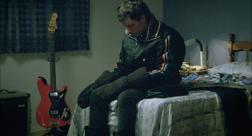
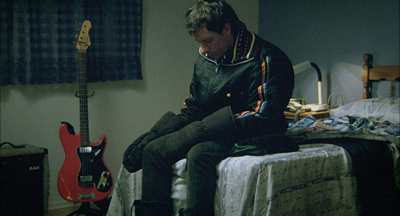
The scenes of the movie jump from day to day drudgery and boredom (shoveling, chipping ice, hanging out in sweat pants) to shots of self –imposed solitude (Benoit playing bass in his bedroom in his underwear, Alain racing to VHS tapes of the Tour de France on a stationary bicycle in his living room, a sleepless Maryse staring out of a living room window in the dark). At no point did the film ever seem monotonous or stagnant. Even though Benoit is visited by a used car salesman from the future, specifically next September, the actions and dialogue never seem contrived. Speaking to the salesman’s harbinger of doom, the car ride in a blizzard to the family cabin was as cliff-hanging a scene as I’ve ever experienced. My heart was beating out of my chest. Benoit sold the tension as he sweat it out in the passenger seat knowing the next on-coming semi-truck may be the one that ends both of their lives.
Familiar Grounds is a perfectly delightful depiction of small town living. From my own experiences from a small town upbringing, these are things I deem to be true: Your entire life reeks of familiarity. Your parents’ house is unchanged from your youth. You punch the same clock for the same interval at the same time everyday. Like clockwork, you eat the same lunch in the same dining room with the same people. You retire and wait patiently in sweatpants and acrylic sweaters for the end to rear its often anti-climactic head. Familiarity is one of the few things you can count on. This film shows that small doesn’t need to mean insignificant. Lesser, seemingly unrelated events can lead to an epiphany. Greater yet, they may avert misery or save a life.
Sean Weitner's review
In Stéphane Lafleur's ostensible comedy Familiar Grounds, siblings Benoit and Maryse live, and hate to live, in Quebec in the winter; by the end of the movie, they've self-diagnosed themselves with seasonal affective disorder and sit in the glow from their dead mother's lightbox -- really the only respite the characters find all movie. The actors that play them, Francis La Haye and Fanny Mallette, share that most important quality of film actors -- they have extremely watchable faces -- and, like the characters themselves, the audience's only real pleasure is taking in the reflected light of their countenances, no matter how glum.
Both stuck in romantic relationships by which they are not nurtured and do not nurture (in Maryse's case, through neglect; in Benoit's case, through tone-deafness and general Benoit-itude), their lives are basically misery. The film fest programmer who introduced the screening noted how much the milieu reminded him of small Wisconsin towns, and I have to agree that many of the details do indeed mesh, though the characters' inability to scrape together an existence seems specific to them rather then general to either locale. The movie's hook is that Benoit is visited by a self-proclaimed prophet, warning that Maryse will soon die in a car accident, and Benoit will be totally devastated. Benoit doesn't take this news like you or I might; instead, he sees it as an invitation for a benign suicide pact -- believing he has identified the car trip in question, he invites himself along, closing his eyes as trucks thunder toward them in the no-visibility snow. It's quirky and clever enough to elicit a smile, but you get parched for laughs. Having not died, Benoit overexerts himself to harsh on Maryse as she actually becomes happy while partying with old friends. And when he decides to get behind the wheel himself ... well. The fest is showing many Quebecois films, and is co-sponsored by their consulate; hey guys, I'll assume this isn't actually what life is like in Quebec if you give us a pass on American Reunion.